The best cycling routes in Occitania
4.4
(17444)
177,142
riders
26,559
rides
Touring cycling in Occitania offers diverse landscapes, from the flat, historic paths of the Canal du Midi to the challenging mountain passes of the Pyrenees. The region features a varied terrain including coastal routes along the Mediterranean, winding roads through the Cévennes, and river-carved canyons like the Gorges du Tarn. This geographical diversity provides a wide range of experiences for touring cyclists.
Best touring cycling routes in Occitania
- The most popular touring cycling route is Tour de l'étang de Thau…
Last updated: September 23, 2026
4.6
(679)
3,391
riders
56.2km
03:45
170m
170m
Hard bike ride. Good fitness required. You may need to push your bike for some segments of this route.
4.8
(43)
2,435
riders
33.4km
03:03
1,350m
1,350m
Hard bike ride. Very good fitness required. Mostly paved surfaces. Suitable for all skill levels.

4.5
(208)
1,247
riders
53.6km
03:07
100m
110m
Hard bike ride. Good fitness required. You may need to push your bike for some segments of this route.
4.5
(199)
1,205
riders
51.5km
03:00
80m
100m
Hard bike ride. Good fitness required. You may need to push your bike for some segments of this route.
4.2
(127)
791
riders
58.5km
03:22
100m
100m
Moderate bike ride. Good fitness required. Mostly paved surfaces. Suitable for all skill levels.
4.6
(158)
831
riders
37.6km
02:21
260m
260m
Moderate bike ride. Good fitness required. Mostly paved surfaces. Suitable for all skill levels.
4.5
(61)
886
riders
14.2km
00:54
50m
10m
Easy bike ride. Great for any fitness level. Mostly paved surfaces. Suitable for all skill levels.
4.3
(3)
6,378
riders
23.4km
01:35
390m
390m
Moderate bike ride. Good fitness required. Mostly paved surfaces. Suitable for all skill levels.
4.5
(98)
808
riders
24.7km
01:24
60m
60m
Easy bike ride. Great for any fitness level. Mostly paved surfaces. Suitable for all skill levels.
4.5
(115)
574
riders
76.6km
04:35
190m
160m
Moderate bike ride. Good fitness required. Mostly paved surfaces. Suitable for all skill levels.
Get access to more routes and recommendations from other explorers.
Already have an account?
Our route recommendations are based on thousands of hikes, rides, and runs completed by other people on komoot.
Start today with a free account
Your next adventure awaits.
Other adventures in Occitania


Tips from the Community

The Phare de la Méditerranée is one of the emblematic monuments of Palavas-les-Flots, but its history is surprising to say the least: it has never been a lighthouse. At this location, the Redoute de Ballestras once stood, a military structure built in the 18th century to defend the port. After its defensive function was abandoned, the redoubt was integrated into several facilities intended to supply Palavas with drinking water. In 1943, a large concrete water tower was built around the existing structures and operated until 1997. Rather than being demolished, the old water tower was rehabilitated between 1998 and 2000 to become the Phare de la Méditerranée: an observation tower, a convention center, and a revolving panoramic restaurant. The redoubt, hidden within the water tower, was dismantled stone by stone and then rebuilt on an islet in the Étang du Levant.
2
0
Here, the stony path follows the Rhône canal in Sète to Les Aresquiers. This canal directly crosses the Étang d’Ingril and forms a long, straight cut within the lagoon. The pond is thus separated into two parts, while remaining in communication with the canal through several passages. This waterway resulted from the digging of the Canal des Étangs, which began in the early 18th century to connect Sète to the Rhône; the Frontignan section then became a major element of communication and goods transport. The canal has progressively transformed the organisation of this lagoon landscape, which was once much more continuous.
2
0
From the greenway, the panorama opens onto the Étang de Vic. This vast coastal lagoon of over 1,000 hectares stretches between the Gardiole massif and the Aresquiers lido. Protected within the Natura 2000 site of the Palavasian ponds and recognized as a wetland of international importance under the Ramsar convention, the pond forms a vast landscape of lagoon, salt marshes, and wetlands here. This opening allows its full extent to be appreciated from the surroundings of Vic-la-Gardiole.
2
0
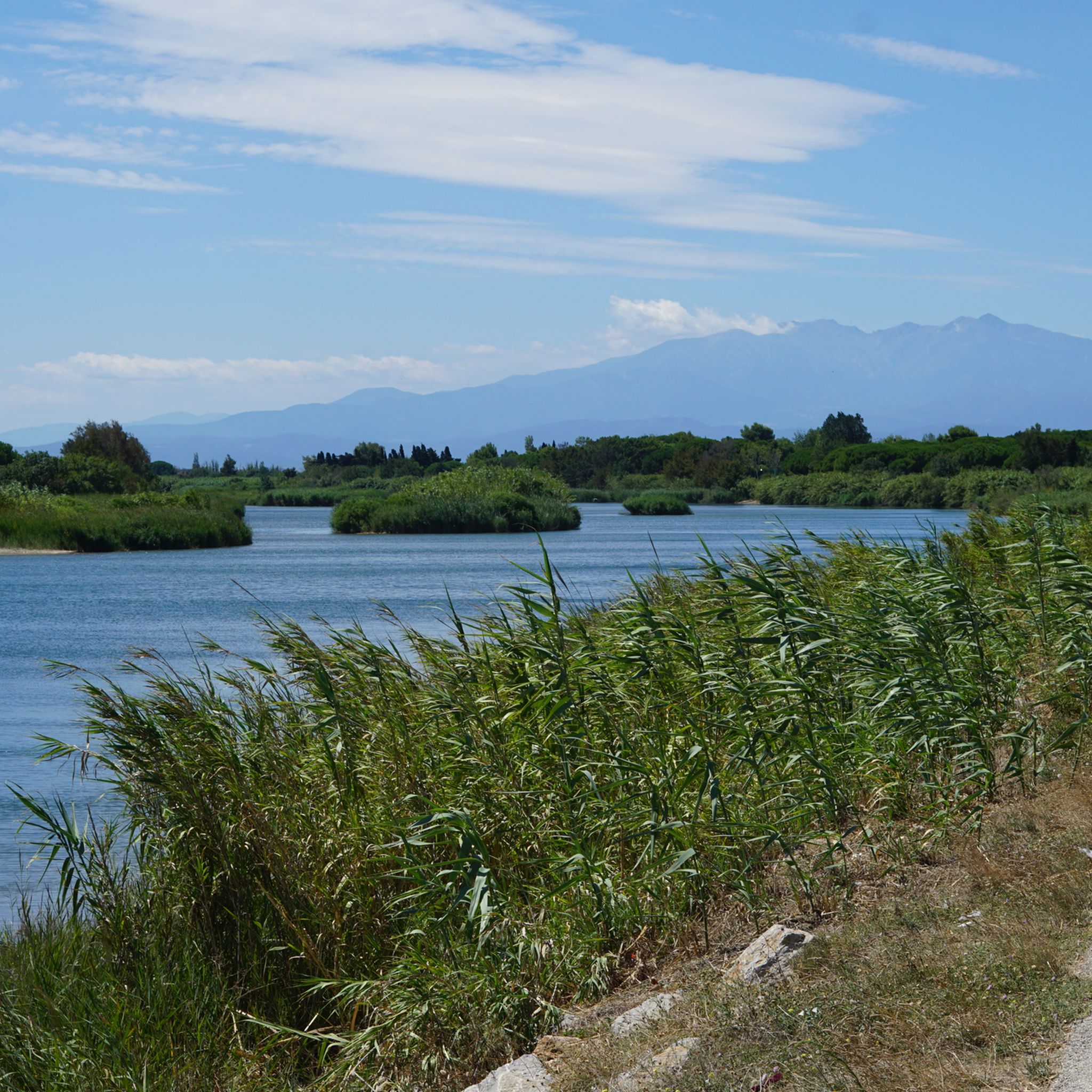
At the exit of Palavas-les-Flots, the voie verte follows the mouth of the Lez river in contact with the ponds. The coastal river joins here the coastal plain and its lagoons, including the Étang du Grec, a vast protected wetland. Reed beds, sansouïres and halophytic vegetation make up a magnificent landscape.
2
0


The canals of Sète, nicknamed the "Venice of Languedoc", connect the Thau lagoon to the Mediterranean Sea and structure the entire heart of the city.
0
0
The étang du Méjean (also called étang de Pérols) is a protected natural site of over 600 hectares located in Lattes, just 8 kilometers south of Montpellier. Managed by the Conservatoire du littoral, this exceptional lagoon space offers a mosaic of preserved landscapes (marshes, reed beds, sansouïres) where you can easily observe pink flamingos, white storks, bulls, and Camargue horses.
0
0
L'étang de l'Arnel is a vast coastal lagoon located in the municipality of Villeneuve-lès-Maguelone, in the Hérault department, less than 20 km south of Montpellier.
0
0
Frequently Asked Questions
How many touring cycling routes are available in Occitania?
Occitania offers a vast network for touring cyclists, with over 26,000 routes recorded on komoot. This includes a wide range of options, from leisurely rides to challenging mountain ascents, ensuring there's something for every skill level.
What are some of the most challenging touring cycling routes in Occitania?
For experienced cyclists seeking a challenge, the Pyrenees region offers demanding routes with significant elevation gains. A prime example is the iconic Col du Tourmalet from Luz-Saint-Sauveur, known for its steep climbs and breathtaking mountain scenery. Overall, over 10,700 difficult routes are available in the region.
Are there easy or family-friendly touring cycling routes in Occitania?
Yes, Occitania is home to many easy and family-friendly routes, particularly along the historic Canal du Midi. These paths are generally flat and shaded, offering a relaxed cycling experience. An excellent option is The Canal du Midi by Bike: Toulouse to Montgiscard. There are over 5,600 easy routes to explore.
What kind of landscapes can I expect to see while touring cycling in Occitania?
Occitania's diverse geography means you can experience everything from the flat, tree-lined paths of the Canal du Midi to the dramatic peaks of the Pyrenees. You'll also find coastal routes along the Mediterranean, winding roads through the Cévennes National Park, and stunning river-carved canyons like the Gorges du Tarn. The region also features vineyards, historic villages, and karstic landscapes.
What historical landmarks or natural features can I explore along touring cycling routes in Occitania?
Many routes pass by significant cultural and natural attractions. You could cycle near the medieval fortress city of Carcassonne, a UNESCO World Heritage site. Along some routes, you might encounter unique natural monuments like the Avy Spring or historical sites such as Saint-Marcellin. The region also features impressive caves, including La Baume Saint-Vérédème Cave and Chapel.
Are there touring cycling routes along the coast or with water views?
Absolutely. Occitania's Mediterranean coastline offers beautiful routes, some of which are part of the EuroVelo 8 network. You can enjoy rides along sandy beaches, through fishing villages, and around lagoons. The Tour de l'étang de Thau is a popular option, circling the Étang de Thau lagoon with views of coastal towns. Another great option is Sète to Grau-du-Roi via Palavas-les-Flots.
What is the best time of year for touring cycling in Occitania?
The climate in Occitania is generally mild, making it suitable for cycling from April to October. Spring and early autumn offer pleasant temperatures, ideal for longer rides. Summers can be hot, especially in the lowlands, but the Pyrenees provide cooler conditions. Always check local weather forecasts before heading out.
Are there any circular touring cycling routes in Occitania?
Yes, many routes are designed as loops, allowing you to start and finish in the same location. For example, the Uzège-Pont du Gard Loop offers a scenic ride around the famous Roman aqueduct. Another option is the Lavardens Village – Lavardens Castle loop from Peyrusse-Massas, which explores charming villages and historic sites.
Can I combine touring cycling with public transport in Occitania?
Yes, Occitania is developing its infrastructure to support sustainable tourism. The 'Occitanie Rail Tour' is an initiative that allows for easy access to various cycling routes by combining train travel with cycling, making it convenient to explore different parts of the region without a car. For more detailed information on bike-friendly train services, you might consult the official Occitanie tourism website: visit-occitanie.com.
What do other touring cyclists enjoy most about touring cycling in Occitania?
The area is highly rated by the komoot community, with an average score of 4.4 stars from over 14,000 reviews. Cyclists often praise the region's incredible diversity, from the tranquil canal paths to the challenging mountain passes, as well as the rich cultural heritage and stunning natural beauty found along the routes.
Are there multi-day touring cycling routes available?
Occitania is well-suited for multi-day touring, especially along the Canal du Midi and the Canal de Garonne, which together form the 'Canal des Deux Mers' linking the Atlantic to the Mediterranean. These routes offer numerous charming towns and villages for overnight stays. A segment like Stage 11: Béziers to Sète – Canal des Deux Mers by bike can be part of a longer journey.
Where can I find routes that connect major cities or towns?
Several routes connect significant urban centers, offering a blend of natural scenery and city exploration. For instance, the route from Béziers to Sète provides a coastal journey between these two vibrant towns. Another option is Palavas-les-Flots to Montpellier, offering a shorter connection to the regional capital.
Most popular routes in Occitania
Most popular attractions in Occitania

Get inspired with the komoot mobile app


Didn’t find what you were looking for?
Check out more Cycling routes throughout Occitania below and find the perfect route in your destination.
Explore more
Browse the best Cycling routes in other regions.
