The best MTB trails around Tábua
4.8
(13)
262
riders
21
rides
Mountain biking around Tábua, located in Portugal's Coimbra District, offers diverse terrain for riders. The region features rolling hills, verdant valleys, and dense forests, providing a varied backdrop for mountain bike trails. Riders can expect paths through pine and eucalyptus groves, agricultural land, and areas along riverbanks. The landscape includes significant elevation changes and technical sections, catering to different skill levels.
Best mountain bike trails around Tábua
- The most popular mountain bike trail is Roman Bridge of Sumes – Vale…
Last updated: June 24, 2026
5.0
(8)
65
riders
34.5km
03:42
640m
640m
Moderate mountain bike ride. Good fitness required. Advanced riding skills necessary.
27
riders
51.2km
05:31
1,630m
1,640m
Hard mountain bike ride. Very good fitness required. Advanced riding skills necessary.

Sign up for free
16
riders
65.1km
05:45
980m
980m
Hard mountain bike ride. Very good fitness required. Suitable for all skill levels.
9
riders
44.8km
04:03
860m
860m
Moderate mountain bike ride. Good fitness required. Advanced riding skills necessary.
8
riders
33.9km
03:00
610m
610m
Moderate mountain bike ride. Good fitness required. Suitable for all skill levels.
Get access to more routes and recommendations from other explorers.
Sign up for free
Already have an account?
Our route recommendations are based on thousands of hikes, rides, and runs completed by other people on komoot.
Start today with a free account
Your next adventure awaits.
Login or Signup
Tips from the Community

Bridge built over the Cavalos River, with a deck approximately 50 m long and 3 m wide. It probably forms part of the same road link as the Roman road of Pedra da Sé, serving as a connection between the Roman civitas of Bobadela and that of Viseu. It has only one arch with a perfect semicircular span, and the pavement that forms part of the deck is the result of intervention after the time of construction. It has been classified as a Property of Public Interest (IIP) since 1990, by Decree No. 163 of July 17, 1990.
1
0

Penedo C'Abana is a large rocky outcrop located near Póvoa de Midões, on the slope overlooking the Mondego River. It provides a prominent viewpoint overlooking the river and the municipality of Tábua. It has the unique characteristic of swaying slightly when pressed upon, shaking it. Penedo C'Abana is classified as a Property of Public Interest.
0
0
Small but very pleasant river beach (without sand) on the course of the Rio de Cavalos.
2
0
The Trilho dos Gaios runs along the banks of the Rio de Cavalos. It starts at the river beach of Vale de Gaios and goes all the way to the ancient Roman Bridge of Sumes. Along this route you can see several waterfalls hidden among the lush vegetation and moss-covered rocks.
1
0
The Penedo C'abana is a large rocky outcrop located near Póvoa de Midões, on the slope overlooking the River Mondego. It is a reference point for viewing the river and the municipality of Tábua. It has the peculiarity of swaying slightly when pressure is applied to it, shaking it. The Penedo C'Abana is classified as a Property of Public Interest.
1
0
The Roman Bridge of Sumes, with its round arch, is a stone masonry structure measuring approximately 6.4 metres. It stands over the Cavalos River, in a natural setting, punctuated by enormous granite rocks and crisscrossed by dirt paths. This is where the fantastic Trilho dos Gaios begins (or ends), winding along the Cavalos River between several waterfalls and lush vegetation.
2
0

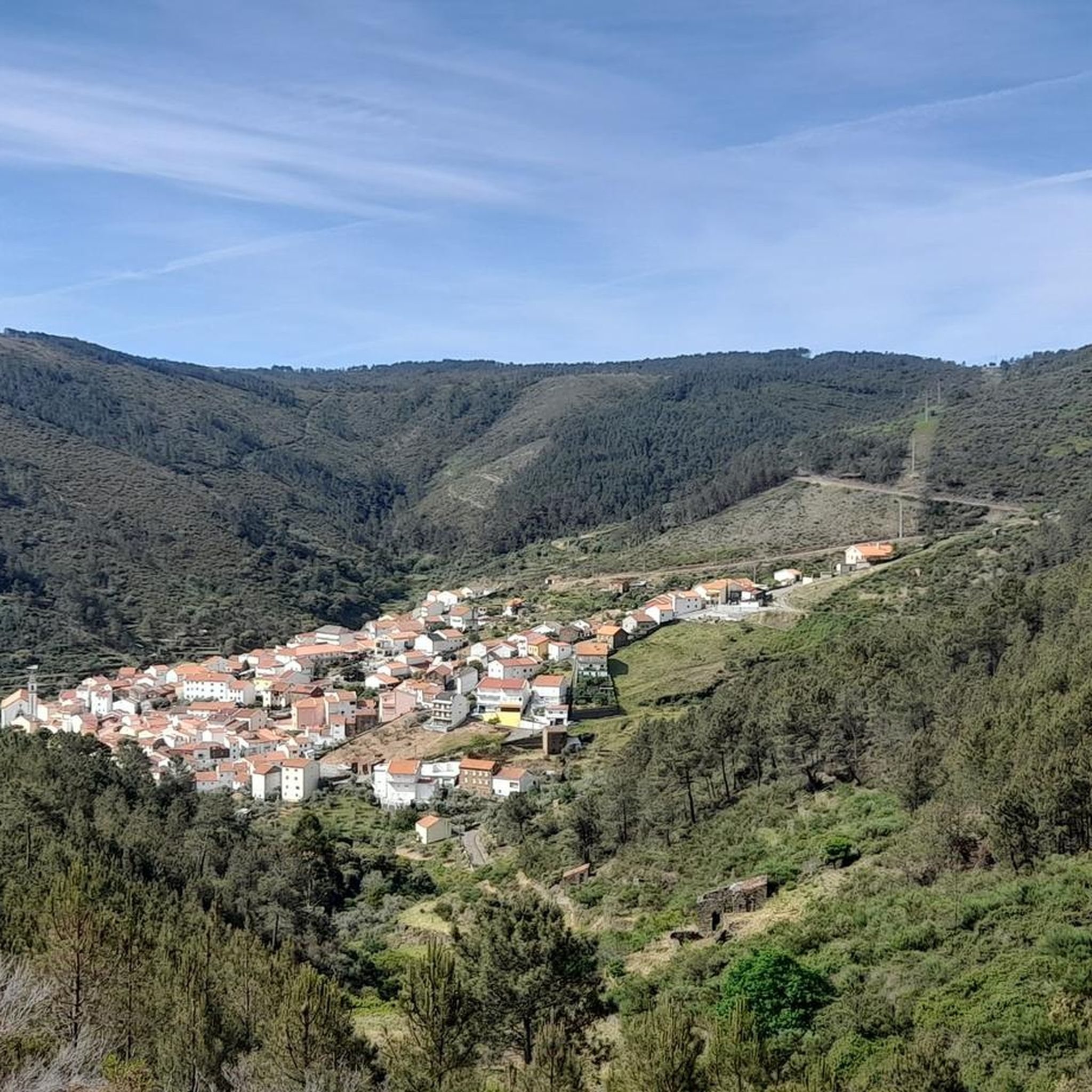
Due to the steep slope of this region, the route moves away from the river and follows old rural paths, where stone steps mark the ascent. The route requires caution, especially when crossing areas where the water has carved its own path in the rock. At the top of the ridge, the reward is a breathtaking view over the valley. In the distance, Benfeita stands out, one of the "white villages" of the network of schist villages, nestled on the edge of the protected landscape of the Serra do Açor.
2
0
The Roman Bridge of Sumes stands over the River des Chevaliers, shrouded in mystery. Although its foundations appear to be Roman, the exact date of its construction remains uncertain. An inscription reading "80 AD" found on a nearby wall suggests its origin, but some historians believe it refers to an ancient spring. In the surrounding area, traces of medieval paving can still be seen. Regardless of the bridge's uncertain age, it is classified as a Property of Public Interest, having witnessed centuries of history.
3
0
Frequently Asked Questions
How many mountain bike trails are available in Tábua?
Tábua offers a network of over 20 mountain bike trails, catering to various skill levels. You'll find a mix of moderate and difficult routes, with 14 moderate and 8 difficult options to explore.
What kind of terrain can I expect on Tábua's mountain bike trails?
The terrain in Tábua is diverse, featuring rolling hills, dense forests, and meandering rivers. Riders can expect paths through pine and eucalyptus groves, agricultural land, and areas along riverbanks. Some trails include significant elevation changes and technical sections, offering a good challenge.
What is the best time of year for mountain biking in Tábua?
The best seasons for mountain biking in Tábua are spring and fall, when the weather is mild and pleasant. Summer can be very hot, which might make longer rides uncomfortable, while winter may bring rain, potentially making some trails slippery.
Are there any circular mountain bike routes in Tábua?
Yes, Tábua offers several circular routes. For example, the Roman Bridge of Sumes – Vale de Gaios River Beach loop from Tábua is a popular moderate circular trail that takes you past historical sites and scenic river paths.
What interesting landmarks or natural features can I see along the mountain bike trails in Tábua?
Many trails in Tábua pass by notable landmarks and natural features. You can encounter the historic Roman Bridge of Sumes, the impressive Fraga da Pena Waterfall, or enjoy panoramic views from spots like Miradouro do Penedo Cabana. The Dão River Railway Bridge, part of the Ecopista do Dão, also offers excellent views.
Are there any trails that feature waterfalls in Tábua?
Yes, the region is known for its natural beauty, including waterfalls. The Sevilha Waterfall – Vale de Gaios River Beach loop from Tábua is a challenging route that leads through lush vegetation and along riverbanks, often featuring the Cascatas de Sevilha.
What do other mountain bikers say about the trails in Tábua?
The mountain bike trails in Tábua are highly rated by the komoot community, with an average score of 4.9 stars from over 10 reviews. Riders often praise the varied terrain, the scenic beauty of the forests and rivers, and the challenging nature of some of the routes.
Are there any trails suitable for advanced mountain bikers looking for a challenge?
Absolutely. Tábua offers several difficult trails with significant elevation changes and technical sections. An example is the View of Benfeita – Olive Oil Mill and Watermill loop from Arganil, which is a demanding 51.1 km route with substantial climbing.
Can I find trails that pass through traditional villages or rural areas?
Yes, many routes in Tábua wind through picturesque rural landscapes, including agricultural land, vineyards, and traditional villages. The region's Schist Villages (Aldeias do Xisto) are often integrated into the trail network, offering unique cultural experiences alongside your ride.
Are there any long-distance mountain bike routes that connect Tábua with other areas?
Yes, Tábua is part of a broader network. The Grande Rota do Mondego (GR48) is a linear route that connects several municipalities, with the Mondego River as its central axis, offering opportunities for longer rides that extend beyond Tábua's immediate vicinity.
What are the typical elevation gains on mountain bike trails in Tábua?
Elevation gains vary significantly depending on the trail's difficulty. Moderate routes like the Roman Bridge of Sumes – Roman Bridge of Sumes loop from Midões can have around 850 meters of ascent, while more difficult trails can feature over 1600 meters of climbing, such as the View of Benfeita – Olive Oil Mill and Watermill loop from Arganil.
Most popular attractions around Tábua

Get inspired with the komoot mobile app


Explore more
Browse the best MTB trails in other regions.
