Top 12 Lakes in Potosí
Lakes in Potosí are primarily high-altitude lakes concentrated within the Eduardo Avaroa Andean Fauna National Reserve. These lakes are known for their unique geological features, distinct colors, and diverse wildlife. The region's natural landscape offers exceptional destinations for nature enthusiasts and photographers.
Best lakes in Potosí
- The most popular lakes is Laguna Colorada, a lake that is famous for its striking red color caused by sediments, algae, and microorganisms. It is a crucial breeding ground for large flocks of three different species of pink flamingos.
- Another must-see spot is Laguna Verde, a lake characterized by its vivid emerald-green waters. The lake's green color is set against the backdrop of the majestic Licancabur volcano.
- Visitors also love Laguna Blanca, a lake notable for its white appearance, often due to borax deposits along its shores. Its ethereal white landscape provides a striking contrast to the other colored lagoons in the region.
- Potosí is known for its red, green, and white colored lagoons. These high-altitude lakes offer diverse geological features and unique ecosystems.
- The lakes in Potosí are appreciated by the komoot community, with 13 upvotes and 77 photos shared.
Last updated: July 6, 2026
Laguna Colorada
Highlight • Lake
Its reddish color is caused by the high mineral content and algae.
The lagoon is a wonderful place for bird watching. Numerous flamingos also live here; All three species (Andean flamingo, Chilean flamingo and James flamingo) are represented.
Translated by Google •
Tip by

Laguna Verde
Highlight • Lake
The Laguna Verde can be reached by off-road vehicle from San Pedro de Atacama (in Chile, about 70 km away) after crossing the Bolivian border. The Bolivian entry and exit procedures must be observed.
Source: de.m.wikipedia.org/wiki/Laguna_Verde_(Bolivien)
Translated by Google •
Tip by

Sign up now to discover places like this
Get recommendations on the best single tracks, peaks, & plenty of other exciting outdoor places.
Sign up for free
Laguna Blanca
Highlight • Lake
Translated by Google •
Tip by

Salar de Chalviri
Highlight • Natural
Source: de.wikipedia.org/wiki/Salar_de_Chalviri
Translated by Google •
Tip by
Laguna Colorada
Highlight • Lake
Translated by Google •
Tip by

Laguna Hedionda
Highlight (Segment) • Lake
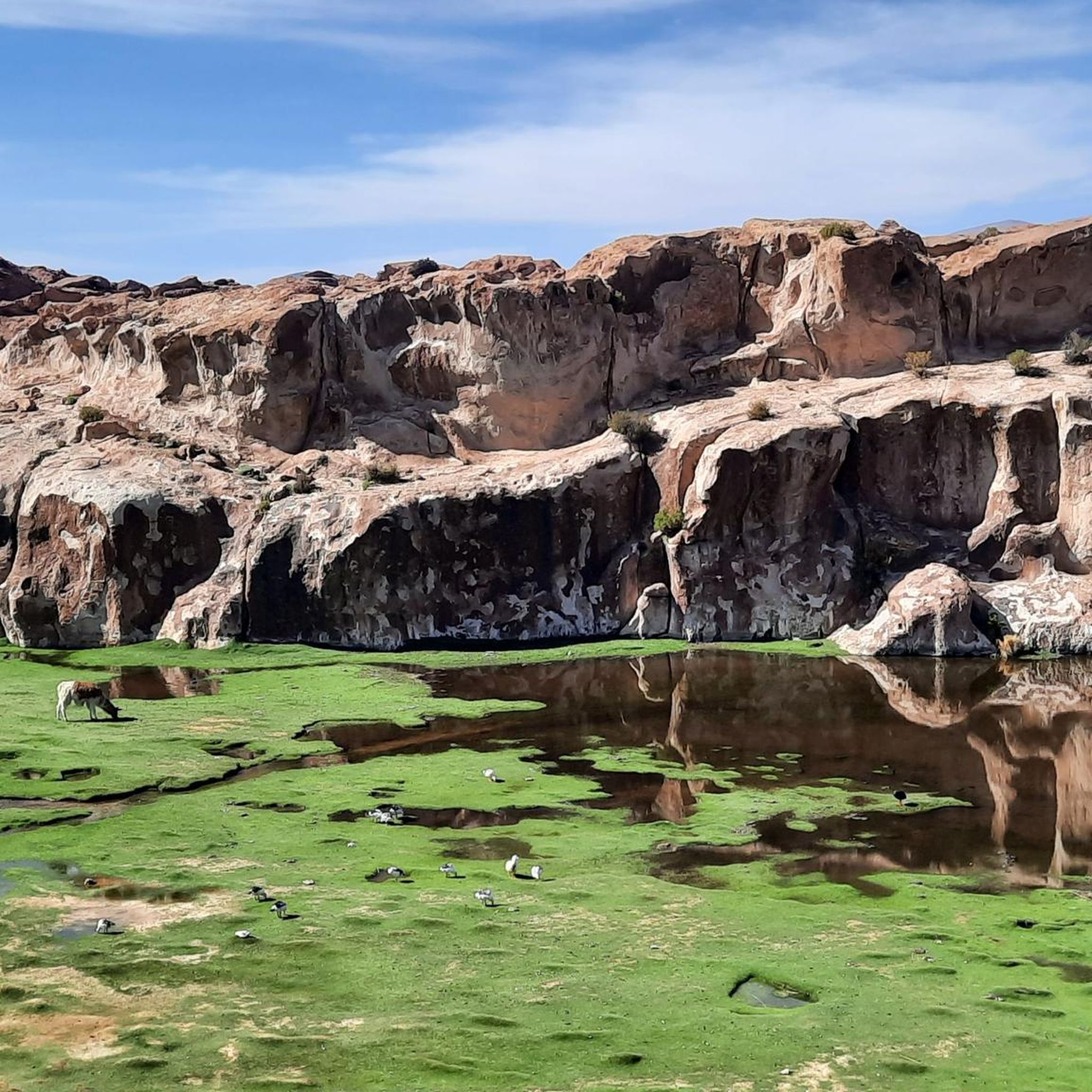
Laguna Hedionda is one of the nine small salt lakes in the Andean Altiplano. It lies at an elevation of 4,121 metres (13,520 ft) and has an area of 3 square kilometres (1.2 sq mi). Salt flats and bofedales (wetlands) are spread around the periphery of the lake. It is located in a very remote area where there are hardly any people. However, llamas and alpacas can also be seen grazing in the area.
Source: en.wikipedia.org/wiki/Laguna_Hedionda_(Nor_L%C3%ADpez)
Translated by Google •
Tip by
Laguna Vinto
Highlight • Lake
Translated by Google •
Tip by
Laguna Charcota
Highlight • Lake
Source: es.wikipedia.org/wiki/Laguna_Charcota
Translated by Google •
Tip by
Trail and Valley to Laguna Catal
Highlight • Trail
Translated by Google •
Tip by
Lakes Near the Village in Bolivia
Highlight (Segment) • Lake
The young people of the village seemed very surprised to see tourists passing by on bicycles. Everyone was very welcoming and warm.
Translated by Google •
Tip by

Sign up for free to discover even more lakes in Potosí.
Sign up for free
Already have an account?
Start today with a free account
Your next adventure awaits.
Login or Signup
Popular around Potosí
Tips from the Community

Here you pass through a small village with a shop (a small one, but enough to keep you from starving). On either side of the village are small lagoons. The water isn't always the same color, and it's worth a visit. The young people of the village seemed very surprised to see tourists passing by on bicycles. Everyone was very welcoming and warm.
0
0

Laguna Hedionda (Spanish for "stinking lake") is a salt lake in the Nor Lípez Province of the Potosí Department of Bolivia. It is known for various migratory species of pink and white flamingos. Laguna Hedionda is one of the nine small salt lakes in the Andean Altiplano. It lies at an elevation of 4,121 metres (13,520 ft) and has an area of 3 square kilometres (1.2 sq mi). Salt flats and bofedales (wetlands) are spread around the periphery of the lake. It is located in a very remote area where there are hardly any people. However, llamas and alpacas can also be seen grazing in the area. Source: https://en.wikipedia.org/wiki/Laguna_Hedionda_(Nor_L%C3%ADpez)
0
0
The Charcota Lagoon is a Bolivian saltwater lagoon located in the Nor Lípez Province in the Potosí Department, near the border with Chile. It is close to the Cañapa Lagoons and many others. Many flamingos come to this lagoon to feed in shallow waters. Source: https://es.wikipedia.org/wiki/Laguna_Charcota
0
0
A lonely spot on the windswept Altiplano at an altitude of more than 4,000 meters: The Laguna Colorada not only has a unique location, but also combines all the colors of nature. The deep blue of the sky, the barren brown mountains and, last but not least, the unusual, bright red of the lagoon, which has given the lake the name Laguna Colorada (colored lagoon). Together with the pink flamingos that live here, the Laguna Colorada is a wonderful spectacle of nature that will delight nature lovers. During your visit to the Altiplano, explore the huge, colored salt lake, which stretches for kilometers and creates a dreamlike backdrop that no picture can really capture. Along with the Island of the Sun and the Salar de Uyuni, the Laguna Colorada is one of the most beautiful places on earth that Bolivia has to offer. Source: https://www.skr.de/bolivien-reisen/sehenswuerdigkeiten/laguna-colorada/
3
0
The Salar de Chalviri is a salt flat in the extreme southwest of Bolivia. It is located in the municipality of San Pablo de Lípez, which belongs to the province of Sur Lípez in the department of Potosí. The Salar de Chalviri is located on the Altiplano at an altitude of about 4400 m in the Reserva Nacional de Fauna Andina Eduardo Avaroa. From the south, the Cerro Boratera protrudes into the Salar de Chalviri, and to the south it borders the Salvador Dalí Desert. On the western edge of the Salar, in the settlement of Chalviri, there are hot springs whose water is used for a small thermal bath and which forms a lake on part of the surface of the salt pan, the Laguna Chalviri. The closest towns are Peña Barrosa and Quetena Grande, 30 and 40 kilometers away respectively in a north-northeast direction. Source: https://de.wikipedia.org/wiki/Salar_de_Chalviri
2
0
The Laguna Verde ("Green Lagoon") is a lake in the Andina Eduardo Abaroa National Park in southwest Bolivia. It lies at the foot of the Licancabur volcano at 4,329 m. The Laguna Verde can be reached by off-road vehicle from San Pedro de Atacama (in Chile, about 70 km away) after crossing the Bolivian border. The Bolivian entry and exit procedures must be observed. Source: de.m.wikipedia.org/wiki/Laguna_Verde_(Bolivien)
1
0
The Laguna Verde ("Green Lagoon") is a lake in the Andina Eduardo Abaroa National Park in southwest Bolivia. It lies at the foot of the Licancabur volcano at 4,329 m. The Laguna Verde can be reached by off-road vehicle from San Pedro de Atacama (in Chile, about 70 km away) after crossing the Bolivian border. The Bolivian entry and exit procedures must be observed. Source: https://de.m.wikipedia.org/wiki/Laguna_Verde_(Bolivien)
2
0
Laguna Blanca is a high Andean lagoon located in the Eduardo Abaroa Andean Fauna Natural Reserve in southwestern Bolivia, in the department of Potosí. The water has a whitish color due to the high mineral content and is therefore called Laguna Blanca. It is located in the Puna area, has a dry climate, has dimensions of 5.6 kilometers long and 3.5 kilometers wide and an area of 10.9 km² at an altitude of more than 4,000 m above sea level and is connected to Laguna Verde by a small strait. The lagoon has a circumference of 22 kilometers. Source: https://es.m.wikipedia.org/wiki/Laguna_Blanca_(Bolivia)
0
0
Frequently Asked Questions
What unique natural features can I expect to see at the lakes in Potosí?
The lakes in Potosí are renowned for their striking colors and unique geological formations. For instance, Laguna Colorada is famous for its vibrant red hue caused by sediments and microorganisms, while Laguna Verde boasts emerald-green waters due to high mineral content, set against the backdrop of the Licancabur volcano. You can also find Laguna Blanca, which often appears white due to borax deposits.
What kind of wildlife can be observed around the Potosí lakes?
The high-altitude lakes in Potosí are crucial habitats for diverse wildlife, especially birds. Laguna Colorada is a significant breeding ground for large flocks of three different species of pink flamingos (Andean, Chilean, and James flamingos). You can also spot various migratory species of pink and white flamingos at Laguna Hedionda, alongside llamas and alpacas grazing in the remote areas.
Are there hiking opportunities near the lakes in Potosí?
Yes, there are several hiking opportunities around the Potosí lakes. For example, you can find an easy 1.6 km loop trail around Laguna Colorada. For more hiking options in the region, including trails of varying difficulties, you can explore the Hiking in Potosí guide or the Easy hikes in Potosí guide.
What is the best time of year to visit the lakes in Potosí?
The high-altitude lakes in Potosí can experience cold temperatures, especially at night. While the region is generally accessible year-round, visitors often recommend packing warm clothes, as temperatures can drop below 0°C, particularly during the mid-year months (e.g., June). The dry season (May to October) typically offers clearer skies, which are ideal for photography.
Are the lakes in Potosí suitable for family visits?
The lakes offer unique natural beauty and wildlife viewing that can be captivating for families. While the high altitude and remote nature require preparation, the visual spectacle of the colored lagoons and flamingos can be a memorable experience. Easy trails, like the 1.6 km loop at Laguna Colorada, are suitable for families looking for gentle walks.
How can I access the lakes in Potosí, and are permits required?
Many of the lakes, such as Laguna Colorada and Laguna Verde, are located within the Eduardo Avaroa Andean Fauna National Reserve. Access is typically by off-road vehicle, often as part of organized tours. Entry into the reserve usually requires a permit, which is often included in tour packages. It's advisable to confirm permit requirements with your tour operator.
What makes Laguna Verde unique compared to other lakes in the region?
Laguna Verde is distinct for its vivid emerald-green waters, a color attributed to its high mineral content. Its surreal beauty is further enhanced by its location at the foot of the majestic Licancabur volcano, creating a breathtaking and iconic Andean landscape perfect for photography.
Can I find any less-known or 'hidden gem' lakes in the Potosí region?
While the main colored lagoons are popular, other lakes like Laguna Vinto offer stunning natural beauty and rich birdlife. Laguna Charcota also provides picturesque views and a serene atmosphere away from the more frequented spots.
What are the typical terrain and elevation conditions around the Potosí lakes?
The lakes in Potosí are high-altitude, with many situated above 4,000 meters (e.g., Laguna Colorada at 4,278m, Laguna Verde at 4,350m). The terrain is generally rugged, characterized by volcanic landscapes, salt flats, and sparse vegetation, typical of the Andean altiplano. Visitors should be prepared for potential altitude sickness and varying weather conditions.
Are there any specific viewpoints or scenic spots recommended for photography?
Absolutely. The entire region offers incredible photographic opportunities. The contrast of the red waters of Laguna Colorada with pink flamingos and the surrounding landscape is spectacular. Laguna Verde, with the Licancabur volcano as its backdrop, is another iconic spot. Laguna Blanca offers ethereal white landscapes, and Laguna Cañapa is known for its mirror-like reflections on clear days.
What amenities or accommodations are available near the Potosí lakes?
The lakes are located in a remote, high-altitude region, primarily within the Eduardo Avaroa Andean Fauna National Reserve. Amenities are basic and limited, often consisting of simple refuges or guesthouses that are part of organized tours. It's best to confirm accommodation and meal arrangements with your tour provider, as independent options are scarce.
What do visitors enjoy most about the lakes in Potosí?
Visitors consistently highlight the surreal and breathtaking natural beauty of the lakes. The vibrant colors of the lagoons, the abundance of flamingos, and the dramatic high-altitude landscapes create an unforgettable spectacle. Many describe it as a 'wonderful spectacle of nature' and a 'dreamlike backdrop' that offers unique photographic opportunities and a sense of being in a truly untamed environment.
Most popular routes in Potosí
Most popular attractions in Potosí

Get inspired with the komoot mobile app


Didn’t find what you were looking for?
Find the best lakes in Potosí per region:
Explore more
Still not found your perfect lake in Potosí? Check out the guides of these regions to see even more beautiful places.
