Top 9 Castles around Cusago
Best castles around Cusago offer a glimpse into Lombardy's rich history, situated in the lowlands west of Milan. The area features an agricultural landscape and historical waterways like the Naviglio Grande. This region served as a strategic location for noble families, leading to the construction of various historical residences and fortified structures. The flat terrain and proximity to Milan made it an ideal location for country estates and hunting lodges.
Best castles around Cusago
- The most popular castles is Palazzo…
Last updated: August 10, 2026
Sforza Castle
Highlight • Castle
Translated by Google •
Tip by

Cascina Femegro
Highlight • Structure
Translated by Google •
Tip by

Sign up now to discover places like this
Get recommendations on the best single tracks, peaks, & plenty of other exciting outdoor places.
Sign up for free
Villa Gaia
Highlight • Historical Site
Translated by Google •
Tip by

Binfa Caffè at Palazzo Archinto
Highlight • Cafe
Translated by Google •
Tip by

Low underpass near Buccinasco Castle
Highlight • Bridge
Translated by Google •
Tip by

Sign up for free to discover even more castles around Cusago.
Sign up for free
Already have an account?
Start today with a free account
Your next adventure awaits.
Login or Signup

Tips from the Community

Two rural settlements from the last century. Their importance is evidenced by the presence of the mill and the church, which largely guaranteed their physical and spiritual independence.
0
0

route for children and tourists
1
0

On the way to Genoa
0
0

It also functions as a restaurant. Very crowded on summer Sundays during aperitifs. As a bar stop (with built-in Gazetta reading) with a view, I can't imagine a better place on the Navigli.
1
0

With its seven centuries of history, the Sforza Castle is an extraordinary testimony to Milan's glorious times and dramatic moments. A fortress built by Galeazzo II Visconti between 1360 and 1370, the Castle became a ducal residence during the Visconti era, undergoing partial demolition during the Ambrosian Republic (1447-1450). Rebuilt by the new lord of the city, Francesco Sforza, it became the elegant setting for one of the most sumptuous European courts during the time of Galeazzo Maria Sforza and Ludovico il Moro, in an era that saw artists such as Leonardo da Vinci and Bramante in Milan. Having lost its appearance as a noble residence, the Castle was used as a barracks during the foreign dominations of the State of Milan: Spanish (1535-1706), Austrian (1706-1796), French (1796-1814), and Austrian again (1814-1859). Only at the end of the 19th century, during a unified Italy, was the historic building rebuilt, restored, and transformed into a museum by Luca Beltrami. Today, the Castle, with its museums and cultural institutions, is one of Milan's most significant monuments and attracts visitors from around the world.
0
0


A Sota🚴a Look at the Archito Palace 🏰
1
1
Frequently Asked Questions
What are the most notable castles to visit around Cusago?
The region around Cusago features several historical castles. Among them, Palazzo Archinto stands out, an imposing structure visible from the Naviglio Grande. Another significant site is the Visconti Castle in Cusago, which served as a hunting retreat for the Visconti Family. Additionally, Robecco sul Naviglio Castle offers scenic views along the canal.
What is the historical significance of the Visconti Castle in Cusago?
The Visconti Castle in Cusago, built in the 14th century by Bernabò Visconti, was primarily a hunting lodge and country residence for the powerful Visconti and Sforza families. It played a role in the leisure activities of Milanese nobility, including hosting figures like Ludovico il Moro and Emperor Maximilian I. Its unique 'naviglietto' canal, excavated in 1438, connected it to the Naviglio Grande for easier access.
Are there family-friendly castles or historical sites in the Cusago area?
Yes, several castles and historical sites around Cusago are considered family-friendly. Palazzo Archinto, Robecco sul Naviglio Castle, and the Visconti Castle in Cusago are all categorized as family-friendly. These sites often provide a glimpse into history that can be engaging for all ages.
What kind of outdoor activities can I do near the castles around Cusago?
The flat terrain and proximity to the Naviglio Grande make the area ideal for outdoor activities. You can enjoy cycling along the canal paths, with routes like the 'View of the Canal – Visconti Castle in Cusago loop' starting from Cusago. Hiking is also popular, with options such as the 'Naviglio Grande in Gaggiano – Gaggiano Bridge loop'. For more details on routes, explore the Hiking around Cusago or Cycling around Cusago guides.
Are there hiking trails directly around the Visconti Castle in Cusago?
While the Visconti Castle in Cusago itself is a historical site, the surrounding area offers easy cycling and walking paths. The 'View of the Canal – Visconti Castle in Cusago loop' is an easy cycling route that passes by the castle. For more hiking options in the broader Cusago area, you can refer to the Hiking around Cusago guide.
What natural features can be observed near the castles in Cusago?
The castles around Cusago are situated within the agricultural landscape of the Lombardy lowlands, often near historical waterways like the Naviglio Grande. This area is part of the Parco Agricolo Sud Milano, offering scenic views of canals, fields, and rural settings. The Robecco sul Naviglio Castle, for instance, provides views along the Naviglio Grande with its relaxing nature.
What is the current status of the Visconti Castle in Cusago?
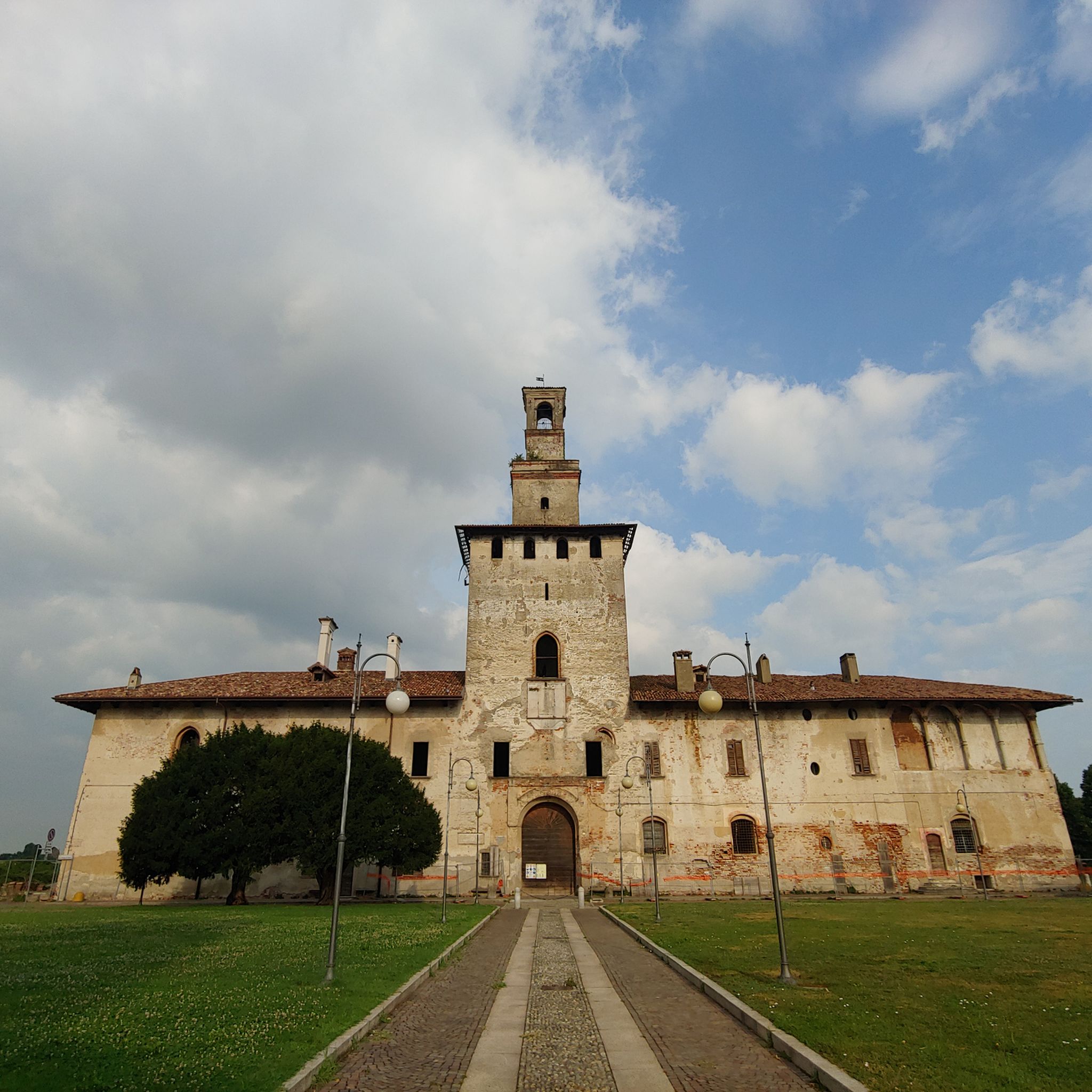
The Visconti Castle in Cusago is currently undergoing restoration efforts. This work aims to preserve its historical significance and architectural elements, allowing future visitors to appreciate its original grandeur and rich past.
Can I find cafes or restaurants near the castles around Cusago?
Yes, the area around the castles, particularly along the Naviglio Grande, offers options for refreshments. For example, near Palazzo Archinto, there is a bar on the opposite side of the canal. The towns themselves, like Cusago and Robecco sul Naviglio, also provide local cafes and restaurants.
What makes <a href="https://www.komoot.com/highlight/3287824" target="_blank" rel="noopener">Palazzo Archinto</a> a popular highlight?
Palazzo Archinto is popular for its imposing structure overlooking the Naviglio Grande. It is often used for events, including weddings, and is clearly visible from the canal path, making it a picturesque stop for those exploring the area.
Are there other historical structures besides castles in the Cusago area?
Yes, beyond the prominent castles, the Cusago area is known for various historical country residences and fortified farmhouses. An example is Cascina Femegro, a historic farmhouse that dates back to the 12th century and was once mentioned as a castle. These structures showcase the architectural evolution and strategic importance of the region over centuries.
What is the best time of year to visit the castles around Cusago?
The Lombardy lowlands, where Cusago is located, are generally pleasant for visiting castles and engaging in outdoor activities during spring and autumn. These seasons offer mild temperatures, which are ideal for exploring the historical sites and enjoying walks or bike rides along the Naviglio Grande.
What architectural features are characteristic of the Visconti Castle in Cusago?
The Visconti Castle in Cusago features a quadrilateral layout with a single central tower over the entrance, a design that influenced other Visconti castles. It was built for residential purposes rather than defense, lacking a moat but including a portcullis. The building has two stories with distinct arc-shaped and pointed arch windows, and remnants of an angular loggia and internal portico.
Most popular attractions around Cusago

Get inspired with the komoot mobile app


Explore more
Looking for the best castles somewhere else? Discover other guides around Cusago:
