The best gravel rides around Pérignac
4.7
(9)
105
riders
27
rides
Gravel biking around Pérignac offers diverse terrain across rolling countryside, quiet roads, and vineyard tracks. The region features a network of greenways and riverside paths, providing varied surfaces from smooth asphalt to unpaved sections. Cyclists can explore routes through extensive vineyards, along the Charente River, and into local forests like the Forêt de Pons. The landscape includes rolling hills, particularly in areas such as the Coteaux du Montmorélien, offering varied topography.
Best gravel bike trails around Pérignac
- The most popular…
Last updated: October 6, 2026
4.4
(5)
42
riders
34.4km
02:08
120m
120m
Moderate gravel ride. Good fitness required. Mostly paved surfaces. Suitable for all skill levels.
20
riders
81.4km
05:16
250m
250m
Hard gravel ride. Very good fitness required. Mostly paved surfaces. Suitable for all skill levels.

5.0
(4)
19
riders
48.2km
03:04
250m
250m
Moderate gravel ride. Good fitness required. Mostly paved surfaces. Suitable for all skill levels.
8
riders
76.7km
05:13
490m
490m
Hard gravel ride. Very good fitness required. Mostly paved surfaces. Suitable for all skill levels.
10
riders
93.3km
06:18
430m
430m
Hard gravel ride. Very good fitness required. Mostly paved surfaces. Suitable for all skill levels.
Get access to more routes and recommendations from other explorers.
Already have an account?
Our route recommendations are based on thousands of hikes, rides, and runs completed by other people on komoot.
Start today with a free account
Your next adventure awaits.



Tips from the Community

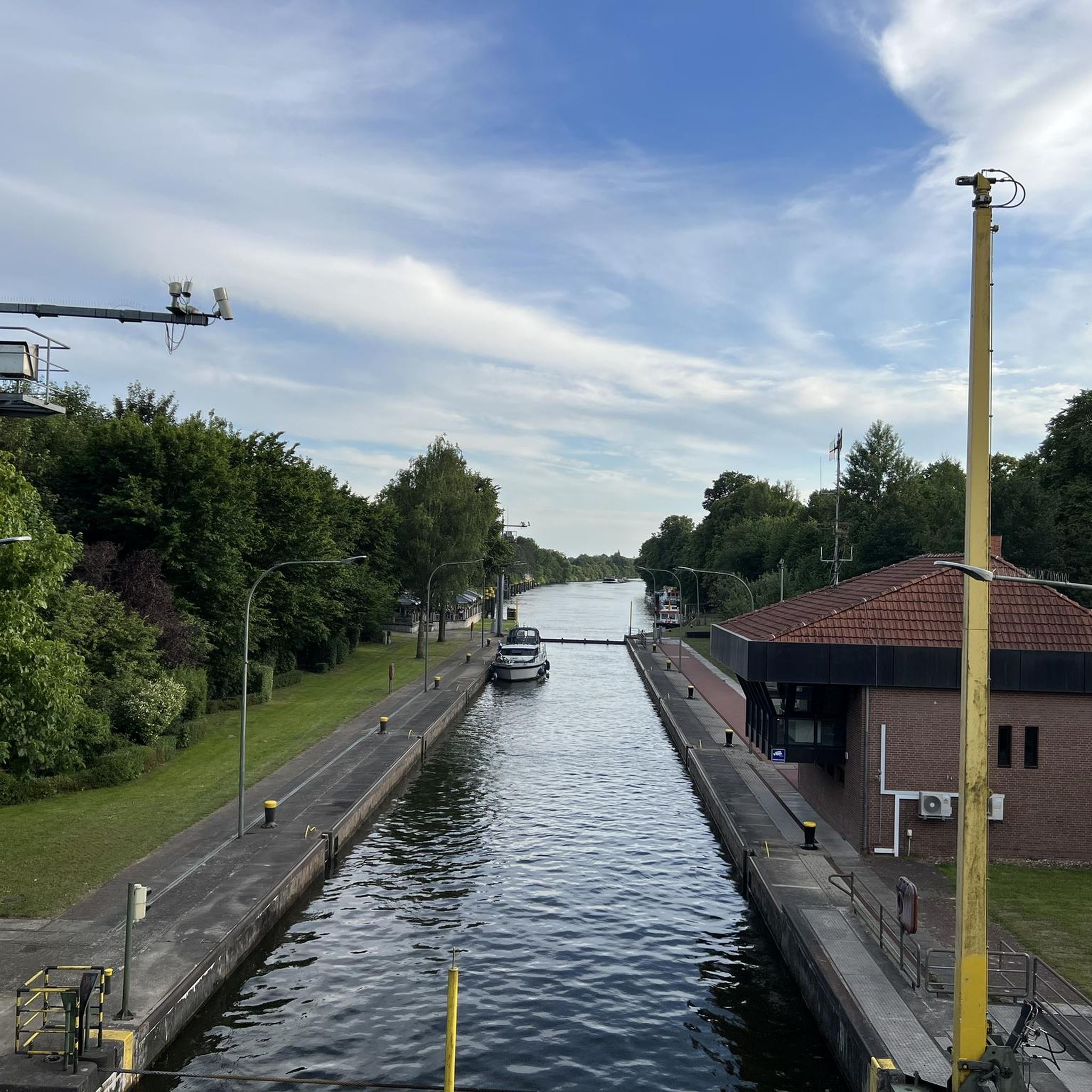
The site of La Baine, in Chaniers, predates the current mill. 14th century: the first attested mills A document dated 1310 mentions cloth mills at La Baine. They were built on piles driven into the riverbed and were used, among other things, for fulling fabrics. These mills then belonged to the dean and chapter of the cathedral of Saintes. They had been destroyed a few years earlier by the Count of la Marche. In 1313, the chapter obtained authorization to rebuild two mills, a weir, and a fishery. 17th century: Colbert's royal mill It was in the 17th century that La Baine gained considerable importance. A complex of five wheat mills was rebuilt on a secondary branch of the Charente, which was not used for navigation. Around 1630, the mills belonged to the brothers Charles and Jacques Duval, who held the beneficial ownership, while the lordship of Chaniers was under the chapter of the Saint-Pierre de Saintes cathedral. Then came Jean-Baptiste Colbert, minister to Louis XIV and Secretary of State for the Navy. Around 1670, Colbert had the mill redeveloped and enlarged to considerably increase its production capacity. The new complex had seven water passages and thus became one of the most powerful mills in the region. Why was Colbert interested in La Baine? The reason was directly linked to the creation and development of the Rochefort arsenal. The mill primarily produced wheat and barley flour intended for the sustenance of the Royal Navy sailors. The grains arrived via the Charente aboard gabares (flat-bottomed barges). After delivering their cargo to the mill, the gabares departed with the flour destined, among other places, for Rochefort. The mill of La Baine was therefore part of a true royal industrial and logistical system organized around the Charente and Rochefort. 19th century: gradual transformation In the 19th century, milling activity continued. The old mills gradually became a true industrial establishment. In 1845, the site was operated by five different millers. From 1897, the complex was gradually brought together by Mr. Lardy, who modernized the facilities and introduced machinery. His son Rémy Lardy succeeded him. 20th century: the flour mill In the 1930s, the mill had become a true industrial flour mill. Its capacity reached about 50 quintals of wheat per day. In 1936, the hydraulic power was supplied by several wheels about 5 meters in diameter. The total water intake was about 4 meters, with a head of 1.50 meters. The facilities included, among other things: two double grinders; a double converter; a pair of millstones; a plansichter; five purifiers. Milling activity finally ceased in the mid-20th century, with sources placing the end of industrial activity around the years 1940-1960, depending on whether one refers to the flour mill or the complete disappearance of milling activity. Today The building has been preserved and transformed into a restaurant, while retaining remarkable elements of its industrial past, notably the wheel and part of the old machinery. The Moulin de la Baine is now located at 14 rue Colbert, 17610 Chaniers, directly above the Charente. A particularly interesting point The mill, the dam, and the locks form an inseparable historical ensemble. The current dam has, however, undergone modern transformations: a prefectural decree from 2012 classifies the hydraulic structure of the Moulin de La Baine as a Class D dam, among other things.
0
0
The Chaniers ferry (Charente-Maritime) is one of the last traditional river ferries still in operation in France. It allows crossing the Charente River between Chaniers and Courcoury, a few kilometers downstream from Saintes. A crossing used for centuries History of the Chaniers ferry The ferry crossing at Chaniers is very old: it dates back to the Middle Ages. In the mid-17th century, it was already an important crossing point on the Charente. It was not only used to cross the river: it also allowed residents to access the meadows on the other side, particularly for agricultural activities. In the early 20th century, the Chaniers ferry was part of a much larger network of crossings on the Charente. In 1909, thirteen ferries were still recorded in Charente-Inférieure, including the one in Chaniers. Ferries were essential at the time before the proliferation of bridges. Why "chain ferry"? The principle consists of holding the ferry on a chain connecting the two banks. The ferryman uses this chain to move the boat forward and keep it on its course despite the current. In Chaniers, the current ferry is motorized, unlike the ferry in Dompierre-sur-Charente, which is operated manually. The Tourist Office, however, still describes it as a "chain ferry," and the municipality as the traditional crossing method connecting Chaniers to Courcoury. The ferry today The crossing takes place between Le Communal in Chaniers and the Courcoury bank. It is free and can transport pedestrians, cyclists, and motorized vehicles. Its operation depends in particular on the flow of the Charente River. The municipality of Chaniers officially presents "the port of Chaniers and its chain ferry" as an element of its local heritage. Important point: I am correcting my previous message: the Chaniers ferry is not simply a "19th-century ferry." The crossing has been attested since the Middle Ages; it is its mode of operation and its equipment that have evolved over the centuries.
0
0


I really enjoyed this ride. I’m 46, I did it on a 40 year old road bike, it’s more suited to a cyclocross bike!
1
0


Chesnel Castle, which has the appearance of a fortified castle, is intriguing. However, the niches here have a purely decorative function. The architecture of this building, erected in 1610, is therefore rather original. You can visit the castle by making an appointment via this link: https://patrivia.net/visit/chateau-chesnel
0
0
This imposing holm oak is approximately 500 years old. We do not know if it was planted on the occasion of the birth of the future king of France François I in 1494, on the occasion of his coronation in 1515 or on the occasion of his death in 1547. What we do know, however, is that it measures 17 meters high with a trunk circumference of 5.5 meters. Classified as a “remarkable tree”, it was even elected “tree of the year” in 2014 by the National Forestry Office.
0
0

Cognac is a beautiful, wealthy town where the future François 1st was born (hence the house of the same name). This wealth comes mainly from the pineau and cognac trade… It was in the 15th century that this distillation process appeared to better preserve these wines which were sent throughout Europe and in particular to the countries of the Hanseatic League where this "burnt wine", brandevin or brandy is very appreciated, most often cut off from water. In Cognac, the Henessy, Rémy Martin, Courvoisier and Martell houses have numerous buildings. I also passed in a town next to an old building used as a cellar, a very pleasant smell emanated from it.
2
0
Frequently Asked Questions
How many gravel bike trails are available around Pérignac?
There are over 30 gravel bike trails around Pérignac, offering a diverse range of experiences. These routes cater to various skill levels, from easier greenways to more challenging paths through rolling countryside and vineyards.
Are there gravel bike trails suitable for beginners in Pérignac?
Yes, while many routes offer a moderate to difficult challenge, the region's network includes greenways and riverside paths that provide smoother sections, ideal for those new to gravel biking. These paths often feature varied surfaces from smooth asphalt to unpaved sections, offering a taste of the gravel experience without extreme difficulty.
What kind of terrain can I expect on gravel bike routes in Pérignac?
You can expect a rich mix of terrain, including quiet country roads, vineyard tracks, and paths along riversides. The region is characterized by rolling countryside, with surfaces ranging from smooth asphalt to unpaved sections. You'll also encounter greenways and towpaths, providing a quintessential gravel experience through diverse landscapes.
What are some of the longer, more challenging gravel routes in the area?
For experienced riders seeking a challenge, routes like the Vibrac Bridge – Pont d'Angeac loop from Cognac, spanning nearly 79 km, or the Bourg-Charente – Bourg-Charente Castle loop from Cognac, which is over 86 km, offer extensive exploration of the region's varied topography and rural landscapes.
What natural features or landscapes will I see on these gravel rides?
Gravel routes in Pérignac often weave through extensive vineyards in the 'Petite Champagne de Cognac' area, offering scenic rides through rows of grapevines. You'll also find paths along the Charente River and its tributaries, passing through alluvial forests and marshes. The landscape includes rolling hills, particularly in areas like the Coteaux du Montmorélien, providing varied topography and scenic viewpoints.
Are there any historical sites or attractions I can visit along the gravel bike trails?
Yes, the region is rich in history. You might encounter Romanesque churches, such as the Saint-Martin Church, or the impressive Pons Donjon. The Chêne de François 1er, a 500-year-old holm oak, is another unique natural monument you could discover. Many routes also pass through charming villages and areas associated with Cognac production.
What do other gravel bikers enjoy most about riding in Pérignac?
The area is highly rated by the komoot community, with an average score of 4.4 stars. Riders often praise the diverse terrain, from quiet country roads to vineyard tracks and riverside paths, which offer a varied and engaging experience. The opportunity to explore charming villages and historical sites while cycling is also a highlight for many.
Are there dedicated cycling paths or infrastructure in the Pérignac area?
Yes, Pérignac benefits from its location within departments that actively promote cycling. Key routes like the Flow Vélo and sections of the Scandibérique (EuroVelo 3) traverse the Charente and Charente-Maritime, providing well-marked paths suitable for bicycles. These often combine dedicated cycle paths with low-traffic country roads, ensuring a safe and enjoyable experience.
Can I find loop trails for gravel biking around Pérignac?
Absolutely. Many of the gravel routes around Pérignac are designed as loops, allowing you to start and finish at the same point. For example, the popular Saint-Brice Castle – The Jarnac Quays loop from Cognac is a great option for a circular ride through vineyards and along the Charente River.
What is the best time of year for gravel biking in Pérignac?
The region is generally pleasant for cycling from spring through autumn. Spring offers lush green landscapes and blooming vineyards, while autumn provides beautiful colors and comfortable temperatures. Summer can be warm, but riverside paths and forest sections offer welcome shade. Winter riding is possible, though some paths might be muddier.
Are there options for family-friendly gravel biking near Pérignac?
Yes, the region offers routes suitable for families. The greenways and flatter riverside paths provide a gentler experience away from heavy traffic. These routes allow for a relaxed pace, making it enjoyable for all ages to explore the scenic countryside and charming villages.
Where can I find more information about cycling in the wider Charente region?
For additional information on cycling routes and infrastructure in the broader Charente and Charente-Maritime departments, you can explore resources like France Vélo Tourisme, which details routes like the Flow Vélo, or Sud Charente Tourisme for local cycling loops.
Most popular attractions around Pérignac

Get inspired with the komoot mobile app


Explore more
Browse the best Gravel rides in other regions.
