The best running trails around Sherbourne
4.0
(147)
15,459
runners
563
runs
Jogging around Sherbourne offers a variety of running routes through diverse landscapes, particularly in the areas linked to Warwickshire. The region features a mix of historic landscapes, parkland, and countryside paths, providing varied terrain for runners. These routes often include mild inclines and opportunities to explore natural surroundings, with some trails extending up to 10 miles. The area is characterized by its blend of historic charm and accessible natural features, suitable for different fitness levels.
Best jogging routes around Sherbourne
…Last updated: June 22, 2026
295
runners
3.96km
00:25
10m
10m
Easy run. Great for any fitness level. Mostly paved surfaces. Suitable for all skill levels.
3.0
(1)
35
runners
11.2km
01:10
70m
70m
Moderate run. Good fitness required. Mostly paved surfaces. Suitable for all skill levels.

Sign up for free
37
runners
8.73km
00:54
40m
40m
Moderate run. Good fitness required. Mostly paved surfaces. Suitable for all skill levels.
29
runners
7.35km
00:45
20m
20m
Moderate run. Good fitness required. Mostly paved surfaces. Suitable for all skill levels.
14
runners
6.19km
00:39
50m
50m
Moderate run. Good fitness required. Mostly paved surfaces. Suitable for all skill levels.
Get access to more routes and recommendations from other explorers.
Sign up for free
Already have an account?
Our route recommendations are based on thousands of hikes, rides, and runs completed by other people on komoot.
Start today with a free account
Your next adventure awaits.
Login or Signup
Tips from the Community

The Tudor House has been closed for a few years, now. There are a couple of pubs/bars nearby, The Castle Pub next to the Tudor is vibrant, the Old Post Office is quirky and traditional and the Four Penny nearby has rooms and great food.
0
0

West Gate is a grade I listed stone archway that dates back to the 12th Century. Located at the junction of the High Street and Bowling Green Street in Warwick town centre, the structure was one of three gates through Warwick’s medieval town wall and supports St James Chapel which forms part of the Lord Leycester Hospital. The A429 High Street passes to the south of the structure but the pedestrian footway passes through the archway. The archway is constructed from a type of sandstone that is susceptible to a form of erosion called contour scaling. This results in a hardened crust breaking away from the face of the stone revealing a softer granular layer beneath. Much of West Gate’s masonry is heavily eroded, particularly on the outside elevation that faces the High Street and the vaulted section of the archway, beneath the chapel’s bell tower.
0
0
The Guild of Warwick included among its charitable work the support of eight poor women, who were said to have been housed in part of the guild buildings. It is not clear how these almswomen were maintained after the guild's dissolution, but by 1582 they were receiving parish relief. In the next century the Priory estate provided a quarterly payment of 34s. 8d. and a clothing allowance, administered by the bailiff of Warwick and the Vicar of St. Mary's. By 1826 eight widows lived in four houses and received 13d. quarterly. After the death of Mr. Henry Wise, owner of the Woodcote estate, in 1883 no new inmates were appointed, but three years later seven women were still in residence, two receiving 2s. 6d. a quarter and five 13d. In 1888 the Misses Louisa and Julia Harris financed the demolition of the almshouses and erected the four which now stand by the West Gate. One of these ladies, then Mrs. Trollope, by will proved in 1904, devised £1,000 to the almshouse trustees to be invested to provide 2s. each week to each of the four inmates. In 1956 the whole income, comprising a rent charge of £1 14s. 8d. on the Woodcote estate and the Trollope legacy, became part of the St. Mary's Almshouse Charity.
0
0
Park Cottage located at the entrance to Warwick Castle and formerly known as Park Lodge is a Grade II listed, timber framed property, which was built in the early 15th Century. Park Cottage belonged to the Earl of Warwick and indeed was sited within the boundaries of Warwick Castle from 1440-1978. The current Breakfast Room with its original sand-stone floor acted as the Dairy for the castle for a number of years. Park Cottage was sold in 1978 by the Earl of Warwick to a private individual who ran the Ground Floor as an Antique Shop until 1987. In 1987, Park Cottage became a Bed & Breakfast.
0
0
In 1845, Hill Close pasture land began to be divided into garden plots which Warwick tradesmen rented. They planted apple trees and soft fruit, grew vegetables and flowers and kept pigs and poultry. They built summerhouses of brick or wood in order to shelter from rain or to sit and enjoy the view across the Common. At a later date, the freeholds of these plots were purchased individually, though some were then sub-let. In the early twentieth century, part of Hill Close Gardens was sold off for housing in Linen Street and St Paul’s Close. Fortunately the remainder has been saved and restored.
0
0
Nestled next to Warwick Castle, the racecourse is one of the oldest in the country with racing being traced back to as early as 1694. The sport was introduced to the market town in the hope of attracting wealthy professionals to help rebuild the areas wealth after the devastating Great Fire of Warwick. The inaugural race at the course was held in 1707, but another 102 years passed before the first stand was opened, parts of which remain today among the later developments. The most famous name to grace the course was the legendary Red Rum, who ran once on the flat in 1967 - the same year in which the course was bought by The Jockey Club, who continue to host a fantastic Jump racing calendar from September - May. Famous races held at Warwick include the Classic Chase, held each year in January and dating back to 1974.
0
0
The remains of a Medieval hospital founded by Roger Earl of Warwick. The remains lie to the north of Saltisford Road 100m north west of the Vittle Drive / Ansell Road cross roads. Upstanding buildings include the 15th century chapel and 15th/16th century Master's House. Hospital of St Michael, on the N of town, near St Michael’s Church. Founded by Roger Earl of Warwick about the end of the reign of Henry I (1100-1135). Its small endowment was originally intended for the benefit of lepers. Information on wardens and the history of the Hospital exists from 1275. In 1535 it was given to Richard Fisher in exchange for rent and the provision of money and four beds to the poor. Philip and Mary revived the religious character of the foundation. The last known master was appointed in 1557. The remains of the Hospital comprise a Chapel (PRN 1950) and a two-storied timber framed building of the 15th century, often known as the ‘master’s ‘ or ‘priest’s’ house. This is of two bays with close-studded framing and blocked original windows. Additions were made to the W in the 17th century. It was subsequently divided into three tenements.
0
0
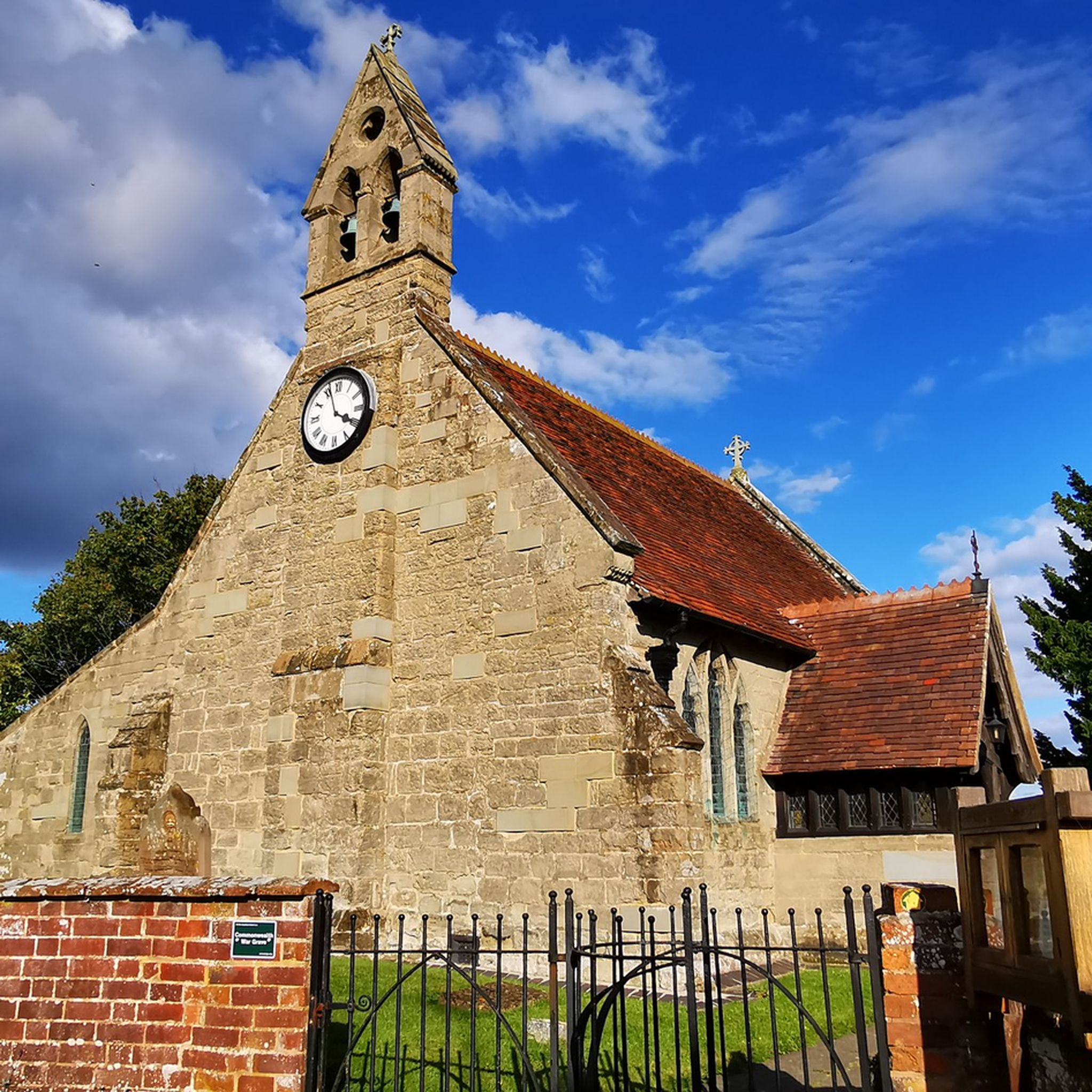
The war memorial in the village of Barford is set into the wall surrounding the churchyard of St Peter’s church, at the corner of Church Street and Church Lane. Five stone plaques are set into the wall; the three central ones commemorate World War I and two smaller ones either side of this, World War II. This section of the wall is heightened and a stone cross on a triple plinth rises from the top of the wall above the plaques. The dedication on the World War I plaque reads IN MEMORY OF THE MEN OF THIS PARISH WHO DIED FOR KING AND COUNTRY 1914 – 1919 The names of the fallen are listed below this: GEORGE HIRONS JOHN SMITH M.M. REUBEN BARNBROOK ARTHUR HOPKINS H. DENNIS SMITH-RYLAND Capt. HARRY WOODWARD FRANCIS H. FREEMAN Wm HENRY REEVE FRANCIS H. TALBOT ALBERT E. WINSTON L-C FREDERICK PILKINGTON WILLIAM CARTER Cpl FREDERICK BARTLETT C WESLEY HUNT FRANK A. BAKER L-C MARY M. GRAHAM and are followed by the words THEY POSSESS THE REWARD OF THEIR VALOUR WITH GOD IN HEAVEN AND LEAVE TO THE WORLD THE RICH INHERITANCE OF THEIR MEMORY The two World War II memorial plaques have the dates 1939 – 1945 and record names of the fallen. MAURICE S BARKER Major LAURENCE E W BYAM Mid JOHN FINCH RICHARD H HADLEY WILLIAM PUMFREY AUBREY A UPSTONE Hon GUSTAVUS L HAMILTON-RUSSELL Lt The original (World War I) memorial, was first unveiled on Sunday 18th September 1921. By 2003 the old bricks had deteriorated beyond repair and the stone plaques were becoming illegible due to spalling which necessitated significant restoration work. The restored memorial was rededicated prior to the Remembrance Day service on Sunday 9th November 2003.
0
0
Frequently Asked Questions
How many running routes are available around Sherbourne?
There are over 560 running routes around Sherbourne, offering a wide variety of options for different preferences and fitness levels. These include easy loops, moderate trails, and some more challenging paths through historic landscapes and parkland.
Are there any easy running routes suitable for beginners or a quick jog?
Yes, Sherbourne offers several easy running routes. A great option for a quick and straightforward run is the Running loop from Warwick, which is about 2.3 miles (3.8 km) long and takes approximately 24 minutes to complete. This route provides an accessible path for all skill levels.
What are some longer running trails for more experienced runners?
For those seeking a longer and more engaging experience, the Cemetery – Hospital of St Michael Remains loop from Warwick Castle is a moderate 6.9-mile (11.2 km) path that combines historic sites with varied terrain. Another excellent choice is the Hatton Locks Drydock loop from Budbrooke, which spans over 9 miles and features moderate elevation changes.
Can I find circular running routes in the Sherbourne area?
Absolutely. Many of the running paths around Sherbourne are circular, allowing you to start and finish at the same point. For example, the Millennium Pond loop from Warwick Castle is a popular 5.3-mile (8.7 km) circular trail that takes you through scenic parkland and past water features.
Are there any scenic running routes with good views around Sherbourne?
The region around Sherbourne, particularly near Warwickshire, is known for its beautiful views over the heart of England countryside. Many routes offer picturesque parkland and historic landscapes. The St Peter's Church, Barford loop from Barford provides lovely rural scenery and views of the local architecture.
What kind of natural features or landmarks can I expect to see while running in Sherbourne?
Jogging routes around Sherbourne often pass through historic landscapes and parkland. You might encounter natural features like the Oxpen Meadow Lake or the Waterfall and Lake at Charlecote Park. Historic landmarks such as Kenilworth Castle and the charming architecture of market towns are also part of the scenic experience.
What do other runners say about the jogging trails in Sherbourne?
The running routes in Sherbourne are highly rated by the komoot community, with an average score of 3.9 stars from over 130 reviews. Reviewers often praise the diverse landscapes, the blend of historic charm with natural surroundings, and the variety of paths suitable for different abilities.
Are there any parks or green spaces ideal for running in Sherbourne?
Yes, the area boasts several beautiful parks and green spaces. Jephson Gardens and Abbey Fields Park are popular spots that offer pleasant environments for a run, often featuring well-maintained paths and scenic views.
Are the running routes around Sherbourne generally accessible by public transport?
Many routes around Sherbourne are accessible from towns like Warwick, which typically have public transport links. While specific public transport details for each trail vary, starting points near urban centers often provide better access. It's advisable to check local transport schedules for specific route starting points.
What is the terrain like on the jogging routes in Sherbourne?
The terrain around Sherbourne is quite varied, ranging from mostly paved surfaces and even paths suitable for all skill levels to more uneven surfaces with mild inclines. You'll find a mix of historic landscapes, parkland, and countryside paths, offering diverse running experiences.
Are there any routes that pass by water features or lakes?
Yes, several routes incorporate water features. The Millennium Pond loop from Warwick Castle, for instance, leads through parkland and past water features. Additionally, the region has lakes like Oxpen Meadow Lake and the Waterfall and Lake at Charlecote Park that can be explored.
Most popular attractions around Sherbourne

Get inspired with the komoot mobile app


Explore more
Browse the best Running Trails & Routes in other regions.
