Attractions and Places To See around Staple - Top 20
Attractions and places to see around Staple, Kent, include a variety of historical sites and natural landscapes. This charming village in East Kent is surrounded by historic churches and medieval towns. The region offers a mix of rural settings and coastal proximity, providing diverse exploration opportunities. Visitors can explore ancient architecture, coastal paths, and historic settlements.
Best attractions and places to see around Staple
- The most popular attractions is Deal Seafront, a coastal area known for its pebble beach…
Last updated: June 23, 2026
Pilgrims Way from Patrixbourne to Canterbury
Highlight (Segment) • Trail
Translated by Google •
Tip by

Sandwich Town Centre
Highlight • Settlement
Tip by

Sign up now to discover places like this
Get recommendations on the best single tracks, peaks, & plenty of other exciting outdoor places.
Sign up for free
Deal Seafront
Highlight • Cycleway
Tip by

St Mary's Church, Patrixbourne
Highlight • Religious Site
Translated by Google •
Tip by
Church of St Nicholas, Barfreston
Highlight • Religious Site
Translated by Google •
Tip by
Sign up for free to discover even more attractions around Staple.
Sign up for free
Already have an account?
Start today with a free account
Your next adventure awaits.
Login or Signup



Tips from the Community

Those who wish to experience the Pilgrim's Way to Canterbury Cathedral not just as a leisurely long-distance hike (whether on foot or the faster option by bicycle), but who consciously wish to travel in the medieval tradition as pilgrims, may find some inspiration on this website =>> https://www.pilgrimways.org.uk/the-pilgrims-way-winchester-southwark-to-canterbury
0
0

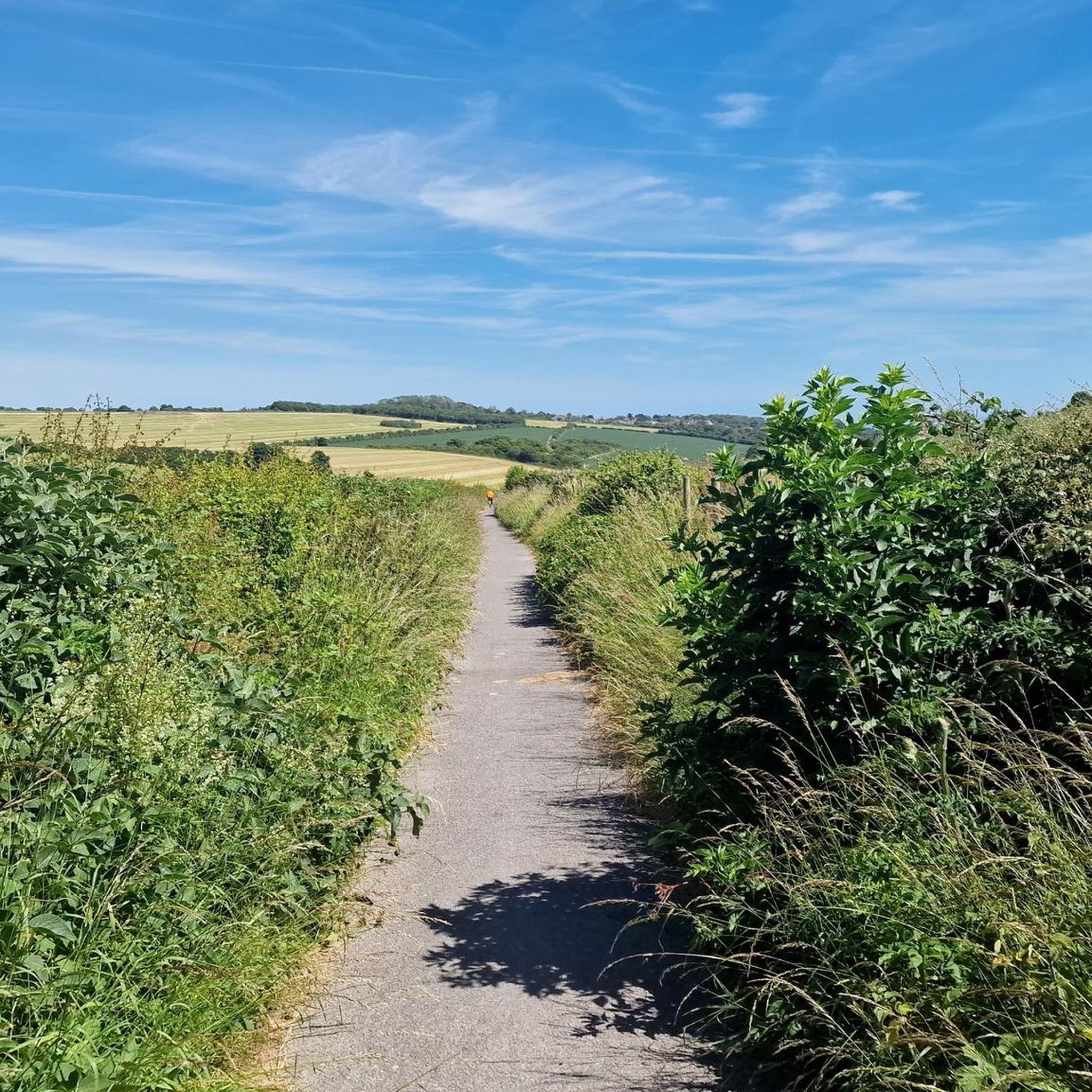
Fab way to head out of Canterbury. Direct link between the City and Patrixbourne
1
0

Nice gravely path, look out for dog walkers and runners.
1
0

The history of this village runs back to the time of the Roman invasion, B.C. 55, for it was just here that the battle raged when Romans and Britons fought the great pitched battle, the Romans advancing from their camp on Barham Downs, and by the sheer force of the weight of their legions swept down into this valley, slaughtering and scattering the British forces, who never again made such a determined stand against the invaders as they did at “Old England’s Hole” on the north-east side of this parish, when the Stour, then a rapid river, was reddened with blood, and the bodies of our British forefathers were buried in impromptu graves which their heroism hallowed. Of Saxon days, the church is the most tangible record left. Most of its fabric and its architectural adornment is now Norman, but the church itself was built in the Saxon period, and the rude but massive masonry of the piers of the south aisle are probably a portion of the early work. The beauty of the situation and the fertility of the land made Patrixbourn attractive to Odo, Bishop of Baieux, who included it in his many possessions. At the beginning of the Norman period it was held by Richard, son of William, under lease from Odo, and there were then attached to the manor six sulings (about 1400 acres), and in addition to Richard’s household there were on the manor 47 other families, 43 being villiens and four borderers—a population quite equal to that of to-day. These facts, taken from the Domesday survey, were recorded in the year 1084, and four years later, on the disgrace of Odo, the manor was broken up into sections of Merton, Cheney, Renville, and Higham, which were for many generations accounted separate manors. The Manor of Merton, afterwards called the Manor of Patrixbourn, was first held by the de Bornes, and Margerie, a daughter of the last of the Bornes, carried it in marriage to a Norman named John de Pratellis, who gave it to the Priory of Beaulieu in Normandy, with whom the possession remained until the time of Henry IV., when by the King’s licence it was given to the Merton Priory, Surrey, and so remained until the 31st year of the reign of Henry VIII, when the manor, coming into the hands of the Crown, was granted to Sir Thomas Cheney, as a Knight’s fee, and Edward VI. confirmed the Cheney’s in the freehold possession of it. Very soon after, however, the property was several times sold—first to Sir Thomas Herbert, and next to William Partherich. The grandson of the latter, Sir Edward Partherich, of Bridge, sold it in 1638 to Mr., afterwards Sir Arnold Braems, a Dover merchant, who built the Elizabethan Dover Custom House, and his son, Walter Braems, sold the manor in 1704 to John Taylor, Esq.. At that time the manor, which had been known as Merton, came to be called the Manor of Patrixbourne, and was united with other manors of the parish. The other part of the ancient manor, called Cheney, after the disgrace of Odo was held by the Say family, until Sir Edward de Say in the reign of Henry III. sold it to Sir Alexander Cheney, who resided there for several generations, and the Manor of Merton was united with it in the possession of Sir Thomas Cheney in the 31st year of Henry VIII., both Manors of Merton and Cheney taking the same line of succession and possession, until this also came into the possession of Edward Taylor, Esq., beforenamed. There was also the subsidiary Manor of Hode, or Hothe, which was anciently the possession of a family named Isaac. John Isaac was its owner in the time of Edward III, and continued in that family till the reign of Henry VIII., when by special Act of Parliament the lands were disgovelled. It afterwards went to the Palmers of Howlets, then by sale to Edward Merriweather, who in 1680 sold it to Thomas Adrian, who in 1694 sold it to John Taylor, Esq. There were also the two other small Manors of Renville and Higham. The separate possession of the former is recorded from the time of James I., when it was owned by the Crippens, next by the Naylors, and in 1638 it was sold to Archdeacon William Kingley, of Canterbury, who left a numerous issue, and it continued in that family’s possession until the Nineteenth Century. Higham Manor, which adjoins the northern side of Barham Downs, was in the possession of William de Higham, and descended to his son Nicholas by deed in the 13th year of Edward III.; subsequently it seems for many generations, to have been possessed by the owners of the Manor of Bishopsbourne until the year 1768, when Ignatius Geohagan built the present house, called Higham Place, which in 1781 came into the possession of the Hallets, and it has continued in the possession of that family till the present time.
1
0
St Mary's, Patrixbourne is a beautiful church situated in to the south of Canterbury. St Mary's is the 'pilgrimage hub' of The Bridge Group Parish and sits on four pilgrimage routes accross the south east of the united kingdom. The North Downs Way, Via Francigena, The Old Way and The Royal Saxon Way all run through the village of Patrixbourne. Over the years various groups of Pilgrims have been to St Mary’s, some even staying overnight in pre-arranged groups before continuing their journeys to Canterbury.
2
0

St. Mary’s Church in Patrixbourne is a beautiful Norman church, located approximately four miles southeast of Canterbury. Built mainly of flint, the church has three impressive Norman doors made of Caen stone, the same material used for Canterbury Cathedral. The church dates from the 12th century and is famous for its richly decorated south door, with a tympanum depicting Christ in Majesty surrounded by a variety of carved animals, birds and mythical creatures. Inside there is beautiful stained glass windows, including Swiss glass from the 16th and 17th centuries. The church lies on the route of the Via Francigena, a historic pilgrimage route.
8
0
Narrow, quiet road along which the Via Francigena runs.
9
1
Patrixbourne is a charming village in Kent, England, situated approximately 3 miles south-east of Canterbury. The village is part of the civil parish of Bekesbourne-with-Patrixbourne and is known for its historic St. Mary’s Church, a Norman church with beautiful carvings and stained glass windows dating from the 16th and 17th centuries. Patrixbourne has a rich history dating back to the Domesday Book and was once owned by Bishop Odo. The village is surrounded by farmland and offers a picturesque rural setting.
9
0
Frequently Asked Questions
What historical sites can I visit around Staple?
The area around Staple is rich in history. You can explore the medieval architecture of Sandwich Town Centre, which was once an important trade hub. Don't miss the historic churches like St Mary's Church, Patrixbourne, a beautiful Norman church known for its carvings and stained glass, or the Church of St Nicholas, Barfreston, an exceptional example of 12th-century church architecture.
Are there family-friendly attractions near Staple?
Yes, several attractions are suitable for families. Sandwich Town Centre offers a charming historical experience for all ages. The Deal Seafront is perfect for a day out with its pebble beach and promenade. Historic churches like St Mary's Church, Patrixbourne and the Church of St Nicholas, Barfreston also welcome families to explore their ancient architecture.
What kind of outdoor activities can I do around Staple?
The region offers a variety of outdoor activities. You can enjoy road cycling on routes like the 'Elmstone Church – Sandwich Quay loop' or 'Micro Roastery Coffee House – Ham Sandwich Signpost loop'. For runners, there are trails such as the 'Little Stour River loop' or 'Goodnestone Park and Village loop'. Hikers can find easy paths like the 'Red Tractor in the Field – Miners' Way Trail loop'. You can find more details on these activities in the Road Cycling Routes around Staple, Running Trails around Staple, and Easy hikes around Staple guides.
Are there any good hiking trails near Staple?
Yes, there are several hiking opportunities. The Pilgrims Way from Patrixbourne to Canterbury offers a lovely route, part of the historic Via Francigena. For easier walks, consider trails like the 'Little Stour Paddling Spot – Little Stour River loop' or the 'Goodnestone Park and Village – Woodland Walk loop'. You can explore more options in the Easy hikes around Staple guide.
What is special about Deal Seafront?
Deal Seafront is a charming coastal area known for its beautiful pebble beach and historic buildings. It features a long promenade stretching from Sandown Castle to Walmer Castle, perfect for walks or cycling. Visitors often enjoy the spectacular sunrises over the sea, especially early in the morning, and there are dedicated cycle ways along the front.
Can I find cycling routes around Staple?
Absolutely. The area around Staple is great for cycling. You can find various road cycling routes, including moderate options like the 'Elmstone Church – Sandwich Quay loop' (40.7 km) or easier rides such as the 'Sandwich Quay – Sandwich Town Centre loop' (21.8 km). More details and routes are available in the Road Cycling Routes around Staple guide.
What makes Sandwich Town Centre a unique place to visit?
Sandwich Town Centre is a charming and historic town with well-preserved medieval architecture. Once an important trade hub and part of the Cinque Ports, its old city walls, the Guildhall, and the beautiful Church of St Peter offer a glimpse into its rich past. It's also famously tied to the invention of the sandwich by the 4th Earl of Sandwich.
What is the Pilgrims Way near Patrixbourne?
The Pilgrims Way from Patrixbourne to Canterbury is a scenic trail that follows a narrow, quiet road, forming part of the historic Via Francigena pilgrimage route. It offers a pleasant path for walkers and runners, connecting the village of Patrixbourne with the city of Canterbury.
Are there any notable churches to visit in the area?
Yes, two significant churches stand out. St Mary's Church, Patrixbourne, is a beautiful 12th-century Norman church known for its intricate carvings and Swiss stained glass windows. The Church of St Nicholas, Barfreston, dating from around 1180, is considered one of Europe's most important examples of late 12th-century church architecture, featuring impressive detailed carvings and a rare Norman wheel window.
What do visitors enjoy most about the attractions around Staple?
Visitors particularly appreciate the rich history and well-preserved medieval charm of places like Sandwich Town Centre. The scenic beauty of Deal Seafront, with its promenade and coastal views, is also highly rated. The unique architectural details and historical significance of churches such as St Mary's Church, Patrixbourne, and the Church of St Nicholas, Barfreston, are also frequently highlighted.
Most popular attractions around Staple

Get inspired with the komoot mobile app


Explore more
Still not found the Highlight you’re looking for? See guides of the top attractions in other regions:
