Attractions and Places To See around Tresigallo - Top 20
Best attractions and places to see around Tresigallo include its distinctive Rationalist architecture, earning it the nickname "the Metaphysical City." Located in Italy's Emilia-Romagna region, the town was transformed in the 1930s into an ideal rationalist city with pastel-hued, symmetrical buildings. Tresigallo is situated along the Po di Volano and is close to the Po Delta Park, a UNESCO World Heritage site. This unique urban design makes it an open-air museum, offering a distinct cultural experience.
Best attractions and places…
Last updated: October 10, 2026
Delizia del Verginese
Highlight • Historical Site
Translated by Google •
Tip by

Le Vallette di Ostellato Nature Reserve
Highlight • Natural Monument
Translated by Google •
Tip by

Sign up now to discover places like this
Get recommendations on the best single tracks, peaks, & plenty of other exciting outdoor places.
Gherardi The Cinema Village Murals
Highlight • Structure
Translated by Google •
Tip by

Belriguardo Castle
Highlight • Castle
Translated by Google •
Tip by
Villa della Mensa
Highlight • Historical Site
The Villa della Mensa is an ancient villa of the fifteenth century counted among the "delizie", residences linked to the Este family built in the surroundings of Ferrara. It …
Translated by Google •
Tip by

Sign up for free to discover even more attractions around Tresigallo.
Already have an account?
Start today with a free account
Your next adventure awaits.



Tips from the Community

A very particular country that tells the history of cinema through many murals
0
0

to visit, very pretty village. nice MTB tour
0
0

Built at the behest of Niccolò d'Este in 1435, it was the first of the famous Este residences to be built outside the walls of Ferrara and always remained the richest and most sumptuous. ... The castle of Belriguardo was arranged around two courtyards. In front of the majestic entrance tower, beyond the first large courtyard, was the so-called high court, the prince's residence, entirely built on two floors (today we unfortunately only see it at half its original height) with loggias and porticoes everywhere, the walls were plastered and painted with the Este weapons and at the back there were endless gardens marked by perfect geometric rhythms with waterways, fountains, bridges, exotic plants and hedge mazes, to make the stay of the guests and the Court as pleasant as possible Este. (Source: https://www.ferraraterraeacqua.it/it/voghiera/scopri-il-territorio/arte-e-cultura/ville-dimore-teatri-storici/delizia-di-belriguardo)
0
0
Originally a country farmhouse, the Verginese was transformed into a ducal residence in the early sixteenth century by Alfonso I d'Este and donated to Laura Eustochia Dianti. Upon the Duke's death, the lady retired there, making it her small private court and ordered its renovation, carried out mainly by Girolamo da Carpi. ... To the side there is a small eighteenth-century church, joined to the building via a portico, also from the same period. ... The nearby dovecote tower is a remnant of the appurtenances originally located around the delight and dates back to the 16th century. (Source: https://www.ferraraterraeacqua.it/it/portomaggiore/scopri-il-territorio/arte-e-cultura/ville-dimore-teatri-storici/delizia-estense-del-verginese)
0
0

The murals are on inhabited houses, observe and respect private properties.
1
0

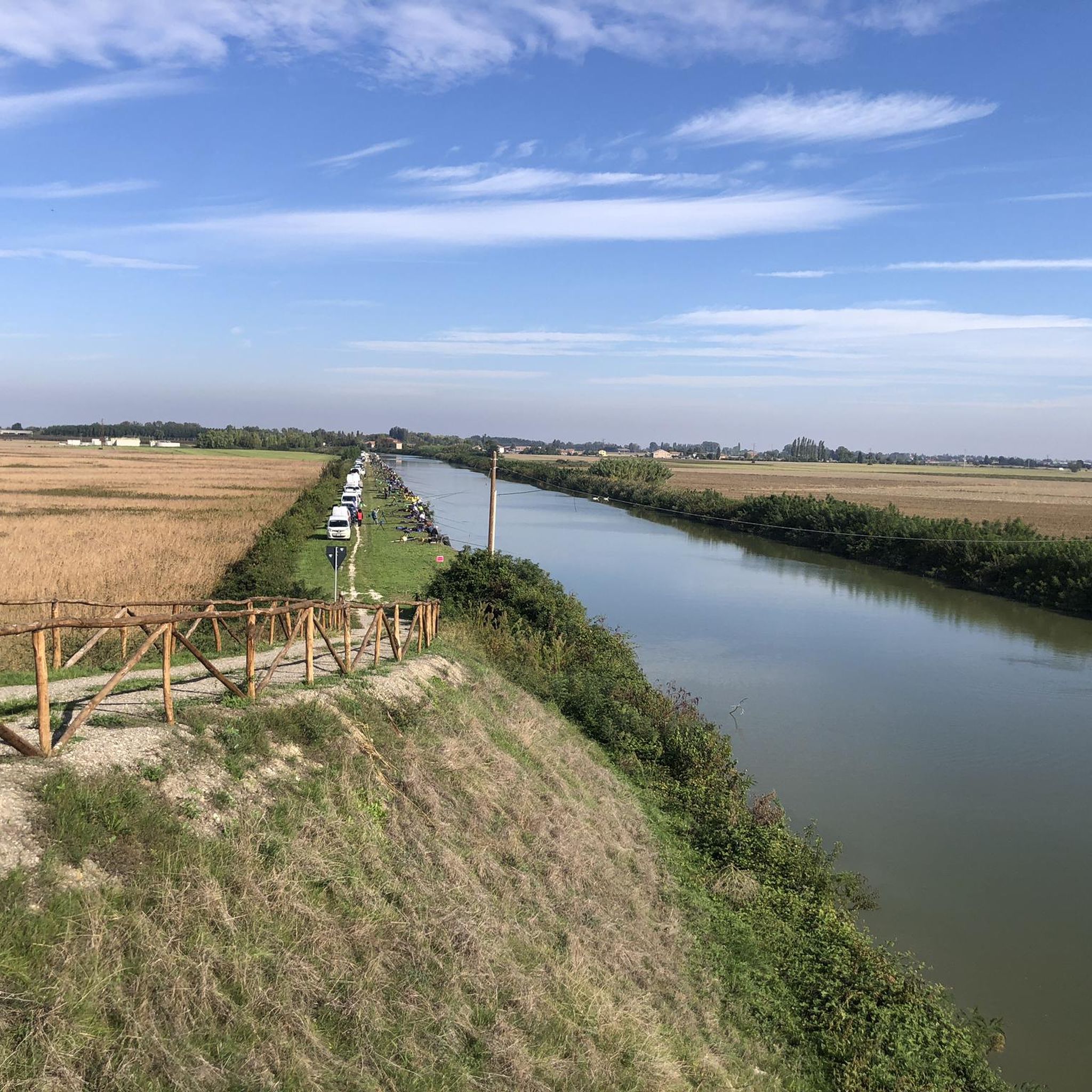
Beautiful villa. The best side is the one on the side of the Po di Volano - which already deserves in itself. If you arrive from the provincial road, you will notice a small road on the side of the Po. Take that and maybe take a ride in the park along the river
0
0

Scattered between land reclamations and rice fields, near Jolanda di Savoia, there is an almost uninhabited village called Gherardi. Bringing a country back to life through culture. This is the goal of "Gherardi the cinema village", a project conceived by Stefano Muroni, founder and president of the Ferrara La Città del Cinema creative chain. The hamlet of Jolanda di Savoia could be repopulated thanks to the filmmakers of tomorrow and the students of the Florestano Vancini School of Film Art in Ferrara, which today has about 150 students. The mission: The path was presented to Gherardi at the headquarters of the Controluce production company. In addition to Muroni and Valeria Luzi, companions in life and work, there were Elisa Trombin (deputy mayor of Jolanda di Savoia), Diego Carrara (director of Acer Ferrara), Daniela Sciarra (Bonifiche Ferraresi), Ruggero Villani (Confcooperative), some inhabitants of the town and ten students of Vancini representing the school. Institutions and residents said they were enthusiastic about the Gherardese project. Muroni, who knows the hamlet well, explained: "The project was born to enhance the last foundation garden village conceived as a table in the early 1900s, the result of the great reclamation works that began in the Lower Ferrara area in 1872; this year it's 150 years ". Then, he adds: "Our goal is to help repopulate and regenerate the village of Gherardi through the creativity of the new generations, where you can live in full sustainability". Gherardi wants to become a pilot project and demonstrate how, through art and culture, it is possible to revive internal areas burdened by depopulation. Act one: Color first. From 1 to 5 September 2022, nationally renowned street artists worked to create five murals with a cinematic flavor. The works are inspired by "The snow in the glass" by Florestano Vancini, "Bitter rice" by Giuseppe De Santis, "The woman of the river" by Mario Soldati, "The garden of the Finzi Contini" by Vittorio De Sica and "E. T. - The extraterrestrial "by Steven Spielberg. The works were signed respectively by Wasp, Mozone, Giulia Pasa Frascari, Basik, Bolo and Paolo Psiko. "These are the first five, the goal - Muroni underlines - is to get to twenty murals". The Cinema Village will not be a showcase, but a living and community place: a student residence, an editing room, training rooms, abandoned buildings will be recovered and even the village restaurant could be reborn. Not only that, Acer and Jolanda di Savoia have signed an agreement to grant a first accommodation that will host students of the Vancini school. (source: La Nuova Ferrara 31/08/2022 https://www.lanuovaferrara.it/ferrara/cronaca/2022/08/31/news/cosi-gherardi-rinasce-nel-nome-del-cinema-ripopoliamo-il -borgo-1.100081740)
0
0

one of the many very beautiful structures in the area, it would be nice to re-evaluate them for tourism
0
0
Frequently Asked Questions
What makes Tresigallo known as 'the Metaphysical City'?
Tresigallo earned its nickname, 'the Metaphysical City,' due to its distinctive Rationalist architecture from the 1930s. The town was transformed under Edmondo Rossoni's vision into an 'ideal rationalist city' featuring pastel-hued, symmetrical buildings with clean lines. This unique urban design makes it feel like an open-air museum, almost suspended in time, reminiscent of Giorgio De Chirico's metaphysical paintings. You can explore this unique urban design at Tresigallo Metaphysical City.
Which architectural landmarks should I visit within Tresigallo?
Within Tresigallo, you should explore several key Rationalist landmarks. Don't miss the iconic Urban Center SOGNI (Former Baths) with its large 'SOGNI' sign, and the vast, D-shaped Piazza della Repubblica. Other notable sites include Piazza Italia, the Casa del Fascio (now Carabinieri Barracks), the House of Culture (Former G.I.L. building), and the Teatro '900. Even the monumental entrance to the Sports Field and the Cemetery feature significant Rationalist elements.
Are there historical sites beyond Tresigallo's Rationalist architecture?
Yes, beyond Tresigallo's unique Rationalist style, the surrounding area offers several historical sites. You can visit the Delizia del Verginese, a historical site that was originally an agricultural farmhouse transformed into a ducal residence. Another significant historical residence is Belriguardo Castle, the first summer palace of the Este court. Additionally, the Palazzo Pio, a magnificent palace built between 1517 and 1533, is located just 2 km east of Tresigallo.
What natural attractions are there near Tresigallo?
Tresigallo is situated in the green Po Valley, offering proximity to several natural attractions. The town itself is nestled along the left bank of the Po di Volano. A must-see is Le Vallette di Ostellato Nature Reserve, a freshwater wetland biotope home to 150 species of aquatic birds. The region is also close to the Po Delta Park, a UNESCO World Heritage site, known for its rich natural landscapes and wildlife.
Are there opportunities for cycling around Tresigallo?
Absolutely, the area around Tresigallo is excellent for cycling. You can find various routes, including the 'Villa Mensa – Tresigallo Metaphysical City loop from Tresigallo' or the 'Tresigallo Metaphysical City – Chiusa di Valpagliaro loop from Formignana'. For more options, explore the dedicated guide for Cycling around Tresigallo, which also includes road cycling routes.
Can I go running near Tresigallo?
Yes, there are several running routes available near Tresigallo. You can find loops starting from various points like Formignana, Borgo Candelosa, or directly from Tresigallo. These routes offer different distances and difficulty levels. For a comprehensive list of options, check out the Running Trails around Tresigallo guide.
Are there family-friendly activities or attractions in the area?
Many attractions around Tresigallo are suitable for families. The Delizia del Verginese and Belriguardo Castle offer historical exploration. Nature lovers will enjoy Le Vallette di Ostellato Nature Reserve, which provides facilities for bird watching, walking, and cycling. Exploring Tresigallo Metaphysical City itself is also a unique experience for all ages, with its distinctive architecture and open-air museum feel.
Are there any unique cultural sites or 'hidden gems' to discover?
Beyond the main architectural highlights, Tresigallo offers unique cultural insights. The House of Embroidery on Via Verdi, historically a didactic-training center, provides a glimpse into local heritage. Approximately 6 km northeast, you can find Gherardi - Il Villaggio del Cinema, a unique 'Cinema Village' in the Ferrara countryside dedicated to cinematic masterpieces and local artists, offering an unexpected cultural experience.
When is the best time to visit Tresigallo to experience its unique architecture and natural surroundings?
To fully appreciate Tresigallo's 'open-air museum' architecture and enjoy the natural surroundings like the Po Delta Park, visiting during spring (April-May) or autumn (September-October) is generally recommended. The weather is typically mild and pleasant for walking and cycling, allowing for comfortable exploration of both the town's unique urban design and the nearby natural areas.
What do visitors appreciate most about Tresigallo?
Visitors are most captivated by Tresigallo's unique Rationalist architecture and urban planning, often describing it as a journey into a 'metaphysical' dimension. The town's pastel-hued, symmetrical buildings and clean lines create a distinct aesthetic that makes it feel like an open-air museum. The blend of historical significance and architectural uniqueness, combined with its peaceful setting near the Po di Volano and Po Delta Park, offers a compelling and distinct cultural experience.
What attractions are located just outside Tresigallo?
Just outside Tresigallo, you can find the magnificent Palazzo Pio, located about 2 km to the east. This historical 'Delizia Estense' features Renaissance frescoes and can be visited by reservation for special events. Another interesting spot, approximately 6 km northeast, is Gherardi - Il Villaggio del Cinema, a unique 'Cinema Village' in the Ferrara countryside that celebrates cinematic art and local artists.
Most popular routes around Tresigallo

Get inspired with the komoot mobile app


Explore more
Still not found the Highlight you’re looking for? See guides of the top attractions in other regions:
