Attractions and Places To See around Zerba - Top 20
Best attractions and places to see around Zerba, a small comune in the Province of Piacenza, Italy, are primarily found in the surrounding Ligurian Apennines. This region features several prominent summits and natural landmarks. The landscape is characterized by mountains, valleys, and historical points of interest. Visitors can explore a variety of natural and man-made structures in the broader area.
Best attractions and places to see around Zerba
- The most popular attractions is Monte Ebro, a summit that is…
Last updated: June 22, 2026
Monte Ebro
Highlight • Summit
Translated by Google •
Tip by

Monte Lesima and the ENAV radar
Highlight • Summit
Translated by Google •
Tip by
Sign up now to discover places like this
Get recommendations on the best single tracks, peaks, & plenty of other exciting outdoor places.
Sign up for free
Casa del Romano
Highlight • Mountain Pass
Translated by Google •
Tip by

Statue of Christ the Redeemer on Monte Giarolo
Highlight • Monument
Translated by Google •
Tip by
Monte Carmo Summit Cross
Highlight • Summit
between the municipalities of Gorreto (Liguria), Carrega Ligure (Piedmont) and Ottone (Emilia Romagna). It is …
Translated by Google •
Tip by

Sign up for free to discover even more attractions around Zerba.
Sign up for free
Already have an account?
Start today with a free account
Your next adventure awaits.
Login or Signup
Other adventures around Zerba

Tips from the Community

Each of these crosses, which travelers often encounter in the fields or, as here, on mountain peaks, is a reminder of the crucifixion and resurrection of Jesus Christ. “Here on earth, His memory exists, but in the Kingdom of Heaven is His presence: this presence is the joy of those who have already attained salvation. Remembrance is our comfort, we who are still wanderers, traveling toward our homeland.” (Saint Bernard of Clairvaux, c. 1090–1153)
0
0
The small sacred monument we encounter on Monte Carmo is perhaps the perfect place for a brief moment of reflection. A few years ago, Christiane Völkel commented on the wonderfully fitting sentence by the Italian poet Francesco Petrarch (who lived in the 14th century), "Everywhere one has heaven above oneself," as follows: "What is the use of prayer? This question moves me (...) I have found for myself the answer and the certainty that when I pray I am with the Lord, or rather, that when I pray he is often noticeably closer to me than usual. Thus, I retain the possibility of pouring out my heart to him (...) This intimacy with him makes me believe in him."
0
0

Starting point for trekking.
18
0
Up here, on Monte Giarolo, the hiker won't find the classic summit cross that crowns many mountains. Instead, on a pedestal divided into two sections, stands the figure of the Risen Christ, adorned with a cross. Christ raises one arm in greeting—or rather, in blessing—and with the other, he embraces the cross, that gruesome symbol of suffering and death, which, through his resurrection, he transformed into a glorious symbol of victory over death.
0
0

At 1,473 meters above sea level, the peak of Mount Giarolo is on the so-called Ligurian Apennines but in the province of Alessandria, Piedmont. It is the northernmost point of the Antola chain and divides the Borbera and Curone valleys. On the summit there is a statue of Christ the Redeemer.
1
0
The most famous crucifix in Italy is not found on the tops of the mountains, although of course there are many summit crosses all over the country, such as here on Monte CARMO, but in literature: The author Giovanni Guareschi, spiritual father of the protagonists 'Don Camillo' and 'Peppone', has included another main character in his stories - which are well-known and popular far beyond the country's borders: the crucified Christ, who speaks to Don Camillo from the high altar. The author himself makes the following comment on this: "So you have to explain: if the priests feel insulted by Don Camillo, they can smash a candlestick on my skull for all I care; if the communists are insulted by Peppone, they can break a club in two on my back; but if someone feels insulted by Christ's speeches, there's nothing you can do. Whoever speaks in my stories... is my Christ, that is, the voice of my conscience. My personal business, my affair. And therefore: each for himself and God for all.” (G. Guareschi)
2
0

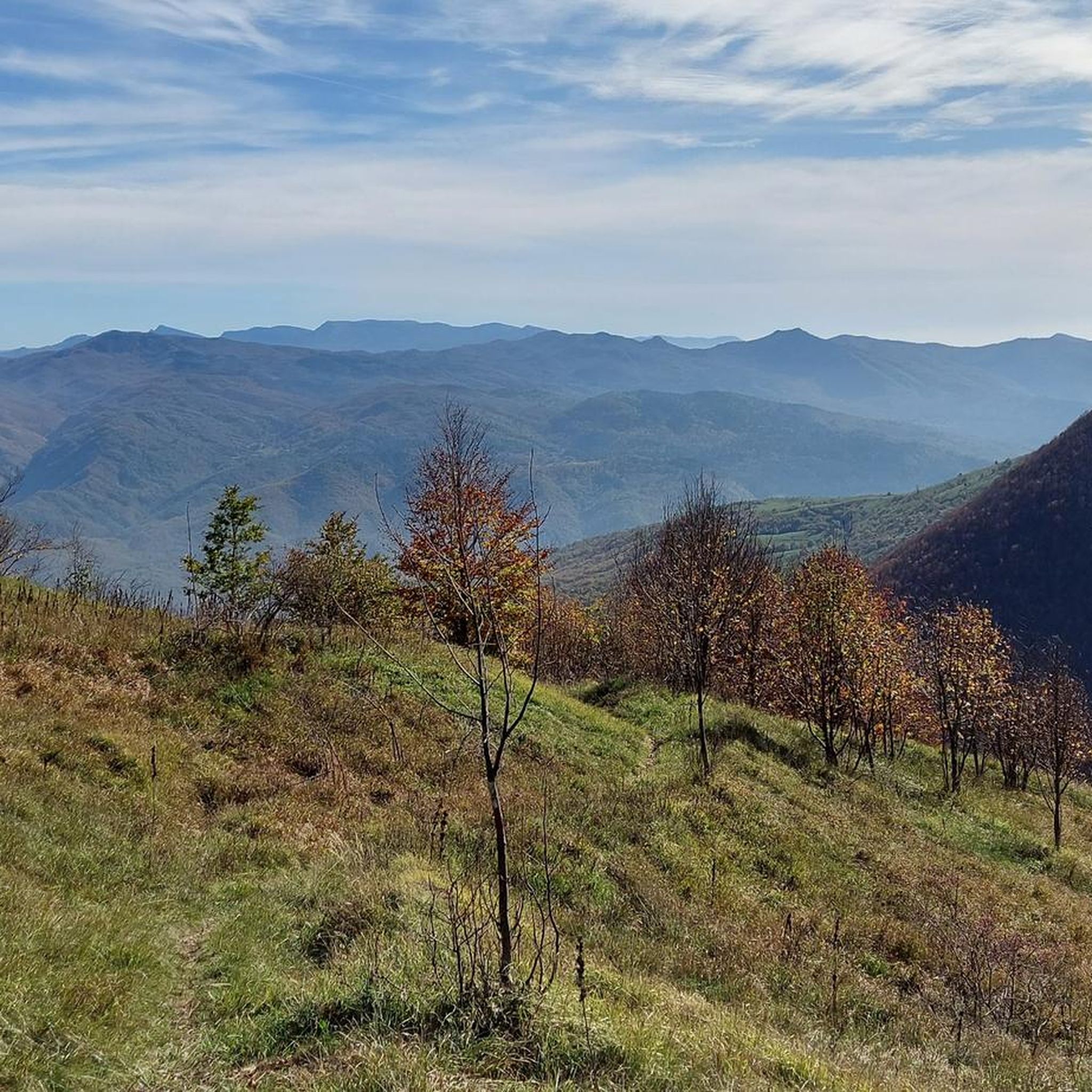
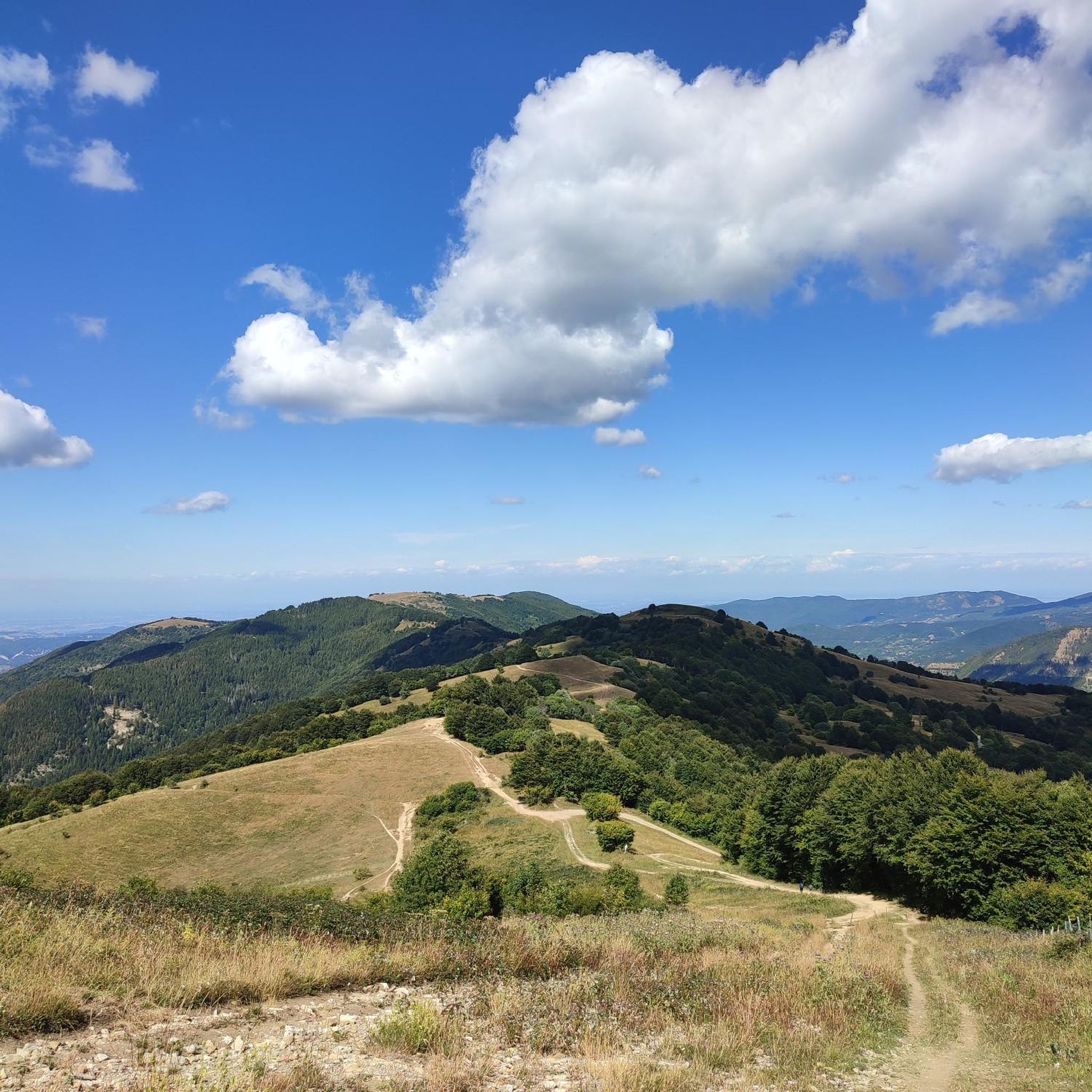
Mount Ebro (1700 m above sea level) is the most beautiful and panoramic mountain of the entire Ántola chain, and one of the most beautiful and panoramic of the entire Ligurian Apennines. It is a gigantic pyramid, mostly grassy, that rises on the watershed between Borbera and Curone, a short distance from the important node of Mount Chiappo. The slopes of the mountain are generally wide and slightly sloping, covered by thick woods at lower altitudes, and meadows above 1400-1500 meters. The imposing southern slope is an exception, which towers, very high and steep, over the village of Aie di Cósola.
4
0
The Feast of the Redeemer has been celebrated on Mount Giarolo since the beginning of the last century, when the first statue of the Redeemer was erected on August 11, 1901 (replaced with the new one exactly one hundred years later) in order to celebrate the 19th centenary of the birth of Christ. It was inaugurated by the Bishop of Tortona who, for the occasion, promoted a diocesan pilgrimage in which approximately 12,000 faithful participated. Since then, every year on the first Sunday of August tourists and faithful go to the top of the mountain to renew the tradition.
3
0
Frequently Asked Questions
What kind of natural attractions can I explore around Zerba?
The region around Zerba is rich in natural beauty, primarily within the Ligurian Apennines. You can visit prominent summits like Monte Ebro, known for its panoramic views, or Monte Lesima, the fourth highest peak in the Ligurian Apennines. These mountains offer stunning landscapes of valleys and hills.
Are there any historical or man-made landmarks to see near Zerba?
Yes, several man-made monuments with historical significance dot the landscape. A notable example is the Statue of Christ the Redeemer on Monte Giarolo, erected in 1901. Another unique landmark is the massive geoid-shaped ENAV radar near the summit of Monte Lesima, which has become an unmistakable symbol of the area.
Where can I find the best viewpoints around Zerba?
For breathtaking views, consider visiting Monte Ebro, which is considered one of the most panoramic mountains in the Ligurian Apennines. Monte Lesima also offers magnificent landscapes between the Oltrepò Pavese and Liguria. Additionally, Casa del Romano, a mountain pass, provides a wonderful view back to the Trebbia Valley.
What outdoor activities can I do near these attractions?
The area around Zerba is ideal for various outdoor activities. You can find numerous hiking, cycling, and running trails. For hiking, explore routes like the 'Monte Prenardo – Monte Ebro loop' or the 'Monte Lesima Summit Trail'. Cyclists can enjoy challenging routes such as the 'Capanne di Cosola – Casa del Romano loop'. You can find more details and routes on the hiking guide, cycling guide, and running guide for Zerba.
Are there any easy hiking trails around Zerba for beginners or families?
Yes, there are options for easier hikes. For instance, the 'Radar Station of Monte Lesima – Monte Lesima and the ENAV radar loop from Casale Staffora' is an easy hiking route. While many trails in the Apennines can be challenging, some sections or shorter loops offer a more accessible experience for those new to hiking or looking for a relaxed walk.
What is the best time to visit the attractions around Zerba?
The Ligurian Apennines are generally pleasant for outdoor activities from spring through autumn. Summer offers warm weather ideal for exploring summits and viewpoints, while spring and early autumn provide milder temperatures and vibrant scenery. Winter can bring snow to higher elevations, making some trails more challenging but also offering unique snowy landscapes.
Are there any places to eat or rest near the attractions?
Yes, at Casa del Romano, which is a mountain pass, you'll find an excellent refuge, a restaurant, and a cafe. This spot is also a popular starting point for trekking and offers amenities for visitors looking to refuel or rest during their explorations.
What makes Monte Ebro a significant attraction?
Monte Ebro, at 1700 meters above sea level, is celebrated as the most beautiful and panoramic mountain of the entire Ántola chain and one of the finest in the Ligurian Apennines. Its distinctive pyramidal shape, mostly grassy slopes, and commanding position on the watershed between Borbera and Curone valleys make it a highly rewarding destination for hikers seeking spectacular views.
What is the significance of the Statue of Christ the Redeemer on Monte Giarolo?
The Statue of Christ the Redeemer on Monte Giarolo is a significant man-made monument located at 1,473 meters above sea level. Erected in 1901, it marks the northernmost point of the Antola chain and divides the Borbera and Curone valleys. It's a site of both natural beauty and religious pilgrimage, with an annual Feast of the Redeemer celebrated there.
Can I find any unique or 'hidden gem' type of attractions in the area?
While the main attractions are well-known summits, the broader region offers charming spots. For instance, the Casa del Romano mountain pass not only provides amenities but also hosts an astronomical observatory, offering a unique experience, especially at night. Exploring the less-traveled paths around these highlights can also reveal secluded viewpoints and tranquil natural settings.
What is special about Monte Lesima and its radar?
Monte Lesima is the fourth highest peak of the Ligurian Apennines, separating the Scrivia Valley from the Trebbia Valley. Its unique feature is the massive geoid-shaped radar near its summit, used for air traffic control. This white globe has become an unmistakable symbol, visible from afar, blending modern technology with the ancient natural landscape.
Are there any religious monuments or sites in the Zerba area?
Yes, the region features several religious monuments. The most prominent is the Statue of Christ the Redeemer on Monte Giarolo, a significant pilgrimage site. Additionally, the summit of Monte Carmo features a summit cross, a common sight on many mountains in Italy, adding to the spiritual landscape of the Ligurian Apennines.
Most popular attractions around Zerba

Get inspired with the komoot mobile app


Explore more
Still not found the Highlight you’re looking for? See guides of the top attractions in other regions:
