The best traffic-free bike rides around Wonsees
4.5
(1792)
7,789
riders
199
rides
No traffic touring cycling routes around Wonsees are set within the Fichtelgebirge mountains, featuring diverse landscapes of rolling hills, dense forests, and clear lakes. The region is characterized by varied terrain, from gentle valley paths to more challenging climbs in elevated areas. Notable features include rock formations and river valleys, providing a scenic backdrop for cycling. The area's well-developed cycling infrastructure supports exploration of its natural and historical attractions.
Best no traffic touring cycling routes around Wonsees
- The most popular no traffic touring cycling route is Krögelstein Rock Village – Kainach Valley loop from Wonsees, a 15.5 miles (25.0 km) trail that takes 1 hour 46 minutes to complete. This route explores a rock village and winds through the scenic Kainach Valley.
- Another top favourite among local touring cyclists is Längerstein rock formation – Paradiestal loop from Wonsees, a moderate 21.2 miles (34.1 km) path. This route features distinctive rock formations and traverses a picturesque valley landscape.
- Local touring cyclists also love the Kainach Valley – Watermill on the Wiesent loop from Kainach, a 12.6 miles (20.2 km) trail leading through the Kainach Valley and past a watermill, often completed in about 1 hour 26 minutes.
- Touring cycling around Wonsees is defined by rolling hills, lush forests, and river valleys, offering routes suitable for various ability levels. The network includes both leisurely rides and more strenuous climbs.
- The routes in Wonsees are highly rated by the komoot community with an average score of 4.6 stars from over 1600 reviews. More than 7300 touring cyclists have used komoot to explore Wonsees's varied terrain.
Last updated: November 11, 2026
4.5
(13)
49
riders
25.1km
01:48
340m
350m
Moderate bike ride. Good fitness required. Mostly paved surfaces.
5.0
(7)
31
riders
34.7km
02:36
330m
330m
Moderate bike ride. Good fitness required. Mostly paved surfaces.

20
riders
Moderate bike ride. Good fitness required. Mostly paved surfaces.
4.3
(3)
11
riders
16.7km
01:09
210m
210m
Moderate bike ride. Good fitness required. Mostly paved surfaces.
5.0
(1)
5
riders
Easy bike ride. Mostly paved surfaces.
Get access to more routes and recommendations from other explorers.
Already have an account?
Our route recommendations are based on thousands of hikes, rides, and runs completed by other people on komoot.
Start today with a free account
Your next adventure awaits.




Tips from the Community

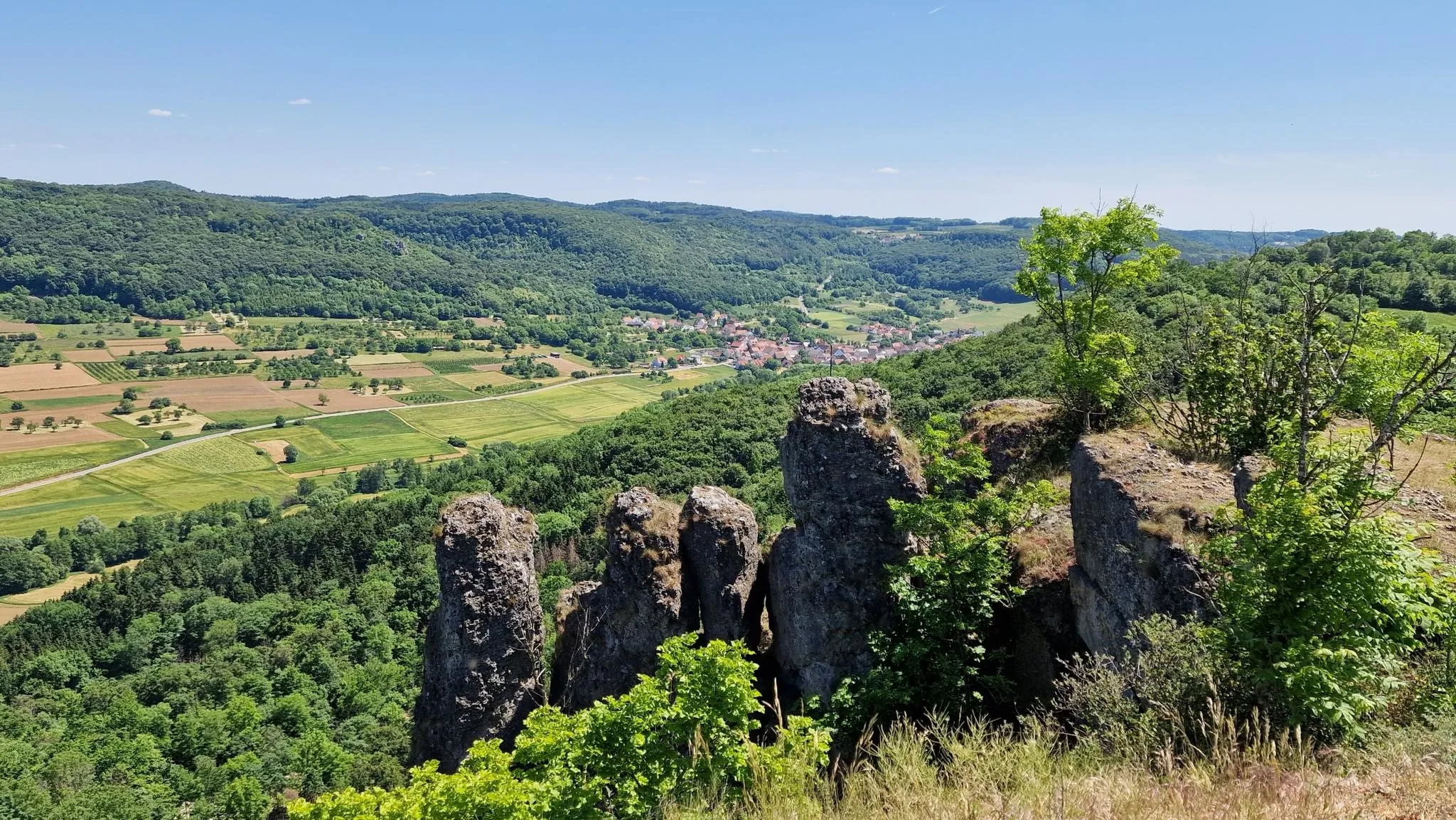
Krögelstein is more than a picturesque village nestled between Dolomite rocks: high above the Kaiserbach once stood the castle of the Lords of Krögelstein. Their history dates back to the Middle Ages. In 1523, the rock castle was destroyed by the Swabian League. The large watchtower is said to have been blown up with four tons of gunpowder. Today, remnants of walls above the rocky gorge are a reminder of the vanished castle. The houses of the village nestle directly against the striking Dolomite rocks: the "Alten Fritz", the Schwedenfelsen, and the Löwenfelsen.
5
0

The Catholic parish church of St. John the Baptist in Modschiedel, situated on a prominent hill on the northern edge of the village, is a historically significant fortified church that is counted among the so-called Slavic churches of Upper Franconia in regional historiography. Its origins as an independent parish date back to 1382, when an already existing chapel was elevated, and fathers from the nearby monastery of Langheim took over the arduous pastoral care on the Jura heights. For the protection of the population, the house of worship was built as a fortified choir tower church, of which remnants of a once four-meter-high defensive wall, including embrasures and a round tower, still bear witness today. While the late Gothic choir and the striking base of the tower were built between 1494 and 1508, the tower, after falling into disrepair in 1617, received its current pointed shape with an eight-sided kinked helmet. The Baroque nave was finally widened during renovations in 1694 and 1725/26 and extended westward in 1936. Inside, the historic house of worship impresses with its extraordinary furnishings, with the Baroque coffered ceiling of the nave, with its elaborately designed panel paintings, forming a visual highlight. Furthermore, the massive, two-story double galleries made of oak reflect the Protestant spirit of the time of the surrounding region, even though it is a Catholic church. The richly decorated baptismal font has been preserved in the church as the most valuable relic of the original late Gothic period. The slate-roofed choir tower houses a sonorous peal of a total of five church bells, in addition to a historic tower clock. Thanks to the continuous commitment of the village community, the structure is continuously maintained, with further in-depth exterior and interior renovations following extensive refurbishment in the 1980s from 2016 onwards.
3
0
The Gasthaus Herold „Zur Maich“, located in the Modschiedel district of Weismain, is a traditional, family-run village inn that is firmly rooted in the region. The restaurant is characterized by its rustic, cozy atmosphere and stands for handmade, Franconian home cooking according to old family recipes. The culinary offer changes depending on the day of the week, with the house starting the weekend from Friday evening with freshly prepared pizzas and hearty classics. Saturdays focus on traditional pan dishes and schnitzel variations, while Sunday is all about the classic Franconian Sunday roast with roasts and homemade dumplings. From November to April, the menu is also supplemented by a weekly schnitzel day on Wednesday. The inn opens on Friday and Saturday from 5:00 PM each day, and on Sunday from 11:00 AM for lunch guests. As the premises are also a popular venue for private family celebrations and company events, the team places great importance on personal service, which in individual cases may lead to private functions. It is also important for visitors to note that this is a cash-only establishment where card payment is not possible.
3
0

The Marienkapelle was donated in 1912 by the Betz couple, a mill owner from Weismain, and renewed by the local community in 1981. In front of the chapel, on a meadow, is the torso of a Bildstock (without a column).
0
0

The town fortifications of Weismain represent a significant historical feature of the town. Approximately three-quarters of them are preserved and encircle the historic town center in a striking ring. The construction of the town wall likely took place shortly after Weismain was granted town status in 1313. The core of the current structure dates from the 14th century. In the 15th century, the fortifications were expanded, particularly with the construction of the town moat and its retaining walls. Further renovations and reinforcements were carried out in the 18th century. The wall consists primarily of local sandstone ashlar masonry, which gives the town its characteristic appearance.
1
0

Beautiful rock formations 👍🚵♂️😉, in a scenic dry valley, on foot or by bike, no problem!
2
0

Attentive cyclists will have seen a grotto—whether formed by natural forces or perhaps artificially created—decorated with a statue of the Virgin Mary on numerous occasions. Very often, it is a depiction of Mary, as in Saint Bernadette's description of the apparition in Lourdes (in the French Pyrenees). Here, however, we encounter a different statue, possibly made of olive wood and not painted. The differently colored cross that the Virgin Mary holds in one hand is striking. Perhaps it did not originally belong to this figure and was added later.
1
0
The farm of the Weismain Kastner (the prince-bishop's tax collector) was first mentioned in 1479. Between 1701 and 1703, the bishopric's master builder Leonhard Dientzenhofer constructed the new building.
0
0
Frequently Asked Questions
How many no-traffic touring cycling routes are available around Wonsees?
There are over 200 dedicated no-traffic touring cycling routes around Wonsees. These routes cater to various skill levels, with 39 easy, 111 moderate, and 56 difficult options to explore the picturesque Fichtelgebirge region.
What is the best time of year for no-traffic touring cycling in Wonsees?
The best seasons for touring cycling in Wonsees are spring and summer. During these months, the landscapes are vibrant, and the mild climate is ideal for outdoor exploration. The region's well-maintained paths are generally in excellent condition.
Are there any family-friendly no-traffic cycling routes in Wonsees?
Yes, Wonsees offers several easy, no-traffic routes suitable for families. These often follow flatter terrain, such as sections along the Main-Danube Canal, providing a relaxed and safe cycling experience away from cars. Look for routes marked as 'easy' for the most suitable options.
What kind of terrain can I expect on no-traffic touring cycling routes around Wonsees?
The terrain around Wonsees is diverse. You'll find rolling hills and lush forests, with some routes offering leisurely rides along canals and lakes. For those seeking more challenge, areas like Ochsenkopf and Waldstein provide demanding routes with steeper climbs and panoramic views. Many routes, like the Kainach Valley – Watermill on the Wiesent loop from Kainach, feature gentle ascents and descents.
What notable landmarks or attractions can I visit along these no-traffic cycling routes?
Many no-traffic routes pass by significant cultural and natural attractions. You can cycle past historical sites like Zwernitz Castle and the unique Oriental Building within the Felsengarten Sanspareil. Other routes might lead you to the scenic Untreusee or along the tranquil Main-Danube Canal. The Wachstein Viewpoint – Plankenstein Castle Site loop from Schönfeld offers both historical interest and scenic vistas.
Are there any circular no-traffic touring cycling routes available?
Yes, many of the no-traffic touring cycling routes around Wonsees are designed as circular loops, allowing you to start and end at the same point. Examples include the moderate Krögelstein Rock Village – Kainach Valley loop from Wonsees and the Längerstein rock formation – Paradiestal loop from Wonsees.
What do other touring cyclists enjoy most about cycling in Wonsees?
The area is highly rated by the komoot community, with an average score of 4.5 stars from over 1600 ratings. Reviewers often praise the region's diverse landscapes, the well-signposted, traffic-free paths, and the opportunity to combine cycling with visits to historical castles and natural beauty spots.
Is it possible to reach the no-traffic cycling trails using public transport?
Wonsees is well-connected within the Fichtelgebirge region, and public transport options are available to reach various starting points for cycling routes. While specific details vary, local bus services often connect smaller towns and villages, providing access to the wider network of trails. It's advisable to check local transport schedules for routes that accommodate bicycles.
Are there specific parking facilities for cyclists near the no-traffic routes?
Yes, many trailheads and popular starting points for cycling routes in and around Wonsees offer designated parking facilities. These are often located in or near villages and attractions, providing convenient access for cyclists arriving by car. Look for signs indicating 'Radwanderparkplatz' (cycling parking) or general public parking areas.
Can I find cafes or accommodation along the no-traffic touring cycling routes?
Yes, the region around Wonsees is well-equipped for visitors. Many villages and towns along the cycling routes offer cafes, restaurants, and traditional Bavarian pubs where you can take a break and refuel. Accommodation options, ranging from guesthouses to hotels, are also available, particularly in larger towns, making it easy to plan multi-day touring adventures. For specific options, you can explore komoot's highlight categories for huts and cabins or search for restaurants.
Are there any routes that feature old railway lines or unique historical infrastructure?
Yes, some no-traffic routes in the region utilize former railway lines, which are often converted into smooth, flat cycle paths. An example is the Ziegenfelder Cycle Path – Old Railway Bridge, Plankenfels loop from Kleinhül, which incorporates an old railway bridge, offering a unique historical element to your ride.
Most popular attractions around Wonsees

Get inspired with the komoot mobile app


Explore more
Browse the best Cycling routes in other regions.
