The best traffic-free bike rides around Dahmetal
4.5
(140)
993
riders
15
rides
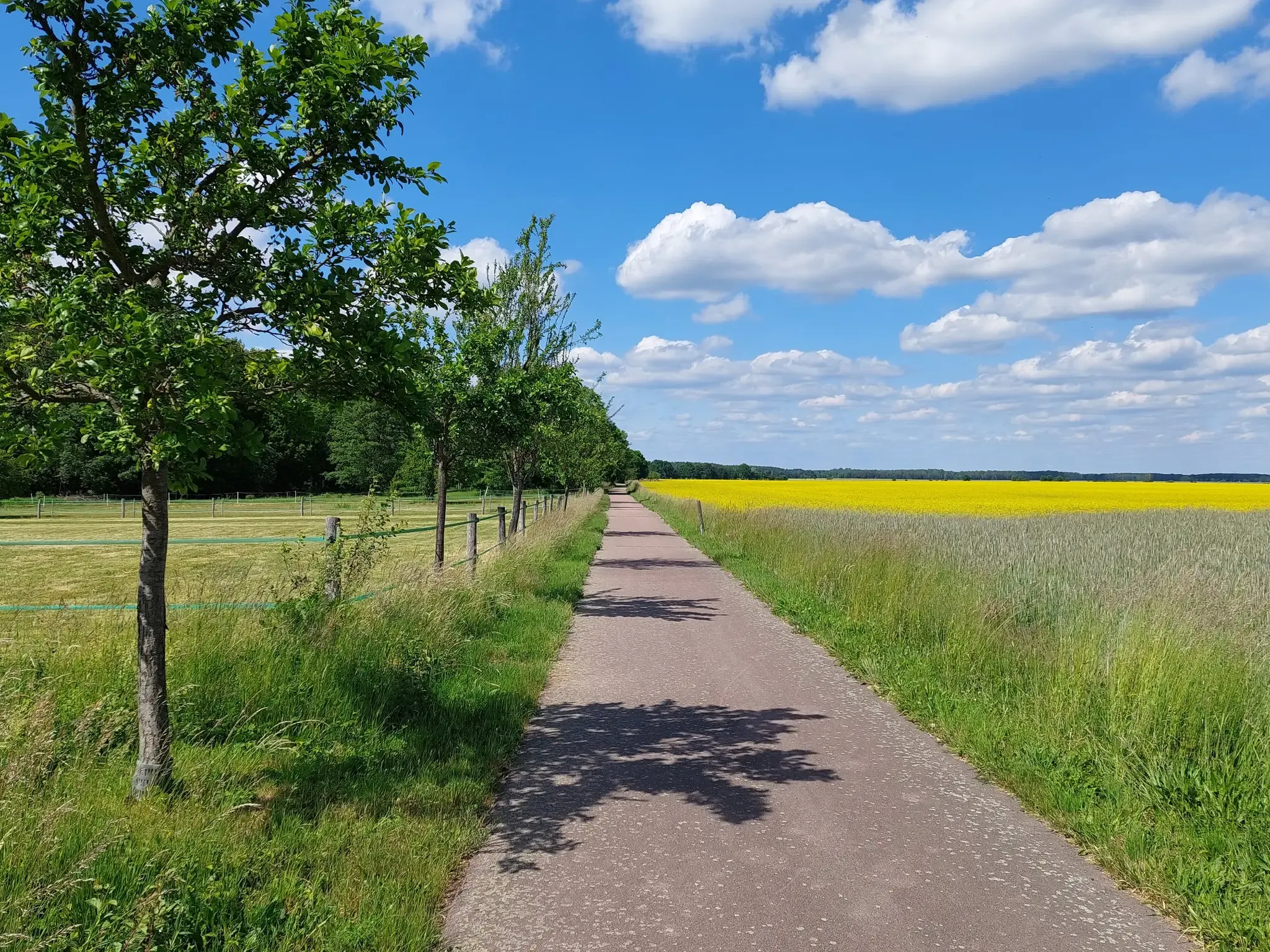
No traffic road cycling routes around Dahmetal traverse a landscape characterized by the largely natural course of the Dahme river, featuring old arms and meanders. The region is part of an 800-hectare Flora, Fauna, Habitat area, encompassing natural oak-hornbeam forests and isolated beech stands along valley edges. Cyclists will also encounter dry sand dunes and sand dry grasslands on drier hilltops. The area benefits from well-paved sections of the Fläming-Skate, offering routes ideal for road cycling.
Best no traffic road…
Last updated: July 11, 2026
4.3
(7)
24
riders
32.2km
01:18
120m
120m
Moderate road ride. Great for any fitness level. Some segments of this route may be unpaved and difficult to ride.
18
riders
Easy road ride. Great for any fitness level. Mostly well-paved surfaces and easy to ride.

Sign up for free
3.0
(2)
12
riders
43.6km
01:46
190m
190m
Moderate road ride. Great for any fitness level. Some segments of this route may be unpaved and difficult to ride.
4.0
(2)
16
riders
23.1km
00:58
60m
60m
Easy road ride. Great for any fitness level. Mostly well-paved surfaces and easy to ride.
5.0
(1)
12
riders
Easy road ride. Great for any fitness level. Mostly well-paved surfaces and easy to ride.
Get access to more routes and recommendations from other explorers.
Sign up for free
Already have an account?
Our route recommendations are based on thousands of hikes, rides, and runs completed by other people on komoot.
Start today with a free account
Your next adventure awaits.
Login or Signup
Other adventures around Dahmetal

Tips from the Community

A beautiful, easy and short tour, which can also be ridden well in intense sunshine, as there is a lot of shade. Even the roads to be ridden are not busy. I didn't see any places to stop during the week.
0
0

The furnishings include an altarpiece, which was created around 1700 and restored in 1975. Regrettably, no consideration was given to its original character.[4] It shows the Last Supper of Jesus in the predella and the crucifixion of Christ in its main image, divided into three panels by vine leaf columns, flanked by the birth and resurrection of Jesus Christ. Above the main image, the Ascension is depicted between two angels with instruments of the Passion. The side altarpieces have been missing since the restoration; some remnants were in the possession of a restorer in 2023. The altar was created by the Calau cabinetmaker Georg Wolschke and the Lübben painter Michael Scharbe,[5] who were also active, for example, in the parish church of St. Sebastian (Baruth/Mark) and in Gollmitz (Calau). The pulpit is decorated with corner columns; above it hangs a sounding board with a trumpeting angel. These include altar stalls with the coat of arms of Siegmund Seyfried von der Dahm, the governor of the Margraviate of Lower Lusatia, who died after 1710/1716.[6] The font is made of wood, hexagonal, and shaped like a table. It dates from the 18th century. A 16th-century crucifix is attached to the south wall. It is flanked by two stained glass windows on the south wall from 1911, a gift from Margarethe von Uckro (1859–1934), sister of the entail lord Paul von Uckro auf Uckro (1862–1919), and depicts "The Sinking Peter" and "Christ in Gethsemane." Next to the west gallery, there is also a Gothic sacrament niche on the east wall. In the patron's lodge hangs a memorial tablet for Ernst Siegmund von Rex, who died in 1756[7], as well as two of the family's children's gravestones at the lodge entrance. The flat interior ceiling is plastered and decorated with a stucco molding. Source: https://de.wikipedia.org/wiki/Dorfkirche_Uckro
3
0
On the western side of the box, two windows, each at the same height, are blocked with red brick. In the western section of the north wall of the nave, there is a pointed arch portal, blocked with fieldstone and brick. The fieldstone church tower was also rebuilt. On the north and south sides, there is a segmental-arched window on the ground floor. Approximately at the height of the nave's eaves, the observer can see a small, blocked opening. This opening is still present on the south side. Above the eaves, the builders did not use fieldstone, but rather an octagonal framework made of dark wood, the interstices of which were filled with reddish brick. On four of the eight sides, there is a rectangular arcade, which culminates in a curved tower cap with a lantern, turret ball, weather vane, and cross. Source: https://de.wikipedia.org/wiki/Dorfkirche_Uckro
3
0
The hall church was built from fieldstones with a rectangular floor plan. The building is one of a series of boulder buildings west of the Luckau-Golßen line.[3] They are unhewn except for the cornerstones and are layered in the lower section. The lines run through the upper half of the building. The choir is rectangular and recessed, while the church tower, although also rectangular in plan, protrudes noticeably from the alignment of the nave walls. On the south side of the nave there are two large, segmental-arched windows, the shape of which is further emphasized by plastered surrounds. Between the two windows there is a much smaller opening blocked up with bricks. Between the nave and choir is the aforementioned staircase to the pulpit. It is built from unevenly layered fieldstones and here too a blocked opening can be seen in the eastern section. In the choir, there are two additional windows on the north and south sides, while in the east wall, the original lancet-shaped triple window group was filled with fragments of brick. The gable is also constructed of unevenly layered, small fieldstones, which were supplemented with fragments and bricks. The Baroque patron's lodge dominates the north side of the nave. The rectangular building, made of fieldstone and brick, is strictly structured on its north side with three large windows on the upper floor. Below each of the outer walls is a rectangular door with a rectangular window in between. All openings, as well as the corners of the building, are highlighted with light plaster and a keystone. Source: https://de.wikipedia.org/wiki/Dorfkirche_Uckro
3
0
The exact construction date of the sacred building is unknown. The Dehio handbook only vaguely indicates the end of the 14th or beginning of the 15th century as the date of its construction. The church received an organ around 1700. In the first third of the 18th century, the parish added a patron's lodge and built a chancel staircase at the southeast corner of the nave. The top of the west tower was probably rebuilt at the same time. Between 1904 and 1905, the Schuke company from Potsdam installed a new organ for 2,044 Reichsmarks. It was restored in 1981, 1995, and 2005. Since 1970, the parish has used the patron's lodge as a parish hall. The church underwent extensive restoration in 1995, followed by the lodge in 2010 and 2011. The building and the surrounding cemetery served as hereditary burial sites for the former patron families, including the von Trosky family.[1][2] Source: https://de.wikipedia.org/wiki/Dorfkirche_Uckro
3
0
The Uckro Village Church is a fieldstone church in Uckro, a district of the town of Luckau in the Dahme-Spreewald district of Brandenburg. It belongs to the Evangelical Church District of Lower Lusatia. Source: https://de.wikipedia.org/wiki/Dorfkirche_Uckro
4
0

Kasel-Golzig. The old church in the town.
1
0

The Falkenberg post mill is a monument in the Falkenberg district of the Brandenburg municipality of Heideblick near Pitschen-Pickel. The post mill, built in 1853, stands on a hill on the edge of the village and is visible from afar. It is the landmark of the Falkenberg district.
0
0
Frequently Asked Questions
How many no-traffic road cycling routes are available in Dahmetal?
Dahmetal offers a selection of 13 dedicated no-traffic road cycling routes. These routes are designed to provide a peaceful and enjoyable experience away from vehicular traffic, allowing you to fully immerse yourself in the region's natural beauty.
What makes Dahmetal a good region for no-traffic road cycling?
Dahmetal is an excellent destination for no-traffic road cycling due to its designation as an 800-hectare Flora, Fauna, Habitat (FFH) area, ensuring preserved natural landscapes. You'll find picturesque routes along the largely natural Dahme River, through diverse forests, and across sand dry grasslands. Key sections of the famous Fläming-Skate, known for its very well-paved surfaces, also run through the region, offering ideal conditions for road cyclists.
What is the best time of year to enjoy no-traffic road cycling in Dahmetal?
The spring and autumn months generally offer the most pleasant conditions for road cycling in Dahmetal, with mild temperatures and beautiful scenery. Summer is also suitable, though it can be warmer. While some routes may be accessible in winter, always check local weather conditions as surfaces can be affected by ice or snow.
Are there routes suitable for beginners or families looking for easy, car-free rides?
Yes, Dahmetal features several easy no-traffic road cycling routes perfect for beginners or families. For example, the Village Church of Zützen – Church of Krossen loop from Golßen is an easy 25 km ride with minimal elevation gain. Another great option is the Kümmritz Village Church – Golßen Town Hall loop from Kümmritz, which is just over 23 km and also rated easy.
What kind of surfaces can I expect on the no-traffic road cycling routes in Dahmetal?
You can expect predominantly well-paved surfaces, especially on sections of the Fläming-Skate, which are ideal for road bikes. Some routes might include parts of the Gurkenradweg, where you should be aware of concrete sleepers that can be challenging for racing cyclists. The region generally offers a mix of asphalt, with some occasional sand and dirt tracks on certain paths, so checking route details is always recommended.
What natural sights can I discover along the no-traffic road cycling routes in Dahmetal?
While cycling in Dahmetal, you can explore various natural highlights. The region is home to the largely natural Dahme River, offering scenic waterside views. You might also encounter the Dahme Spring, the source of the river. Other natural features include the Rochauer Heide forest and the tranquil Körbaer Teich lake, providing beautiful spots for a break.
Are there any historical or cultural points of interest to visit while cycling in Dahmetal?
Yes, Dahmetal offers charming local spots. You can visit the historic Golßen Market Square for a break or to explore the old town. The Kanow Mill in Sagritz, dating back to the 13th century, is another picturesque stop where you can learn about traditional linseed oil production. Additionally, you might pass by the Bachmühle Görsdorf, a historical site, or the Schlosspark Dahme/Mark.
Where can I find parking for these no-traffic road cycling routes in Dahmetal?
Parking is generally available near the starting points of many routes, particularly in towns like Golßen, Drahnsdorf, or Dahme/Mark. For routes that utilize the Fläming-Skate, you'll often find well-maintained rest areas with parking facilities. It's advisable to check specific route descriptions for detailed parking information.
Are there places to stop for refreshments or a meal along the routes?
Yes, you'll find opportunities for refreshments in the towns and villages along the routes. Golßen Market Square is a good place to stock up on provisions or find a cafe. Many rest areas along the Fläming-Skate also provide convenient spots for picnics. For specific recommendations, check the highlights and points of interest marked on individual route maps.
Can I bring my dog on the no-traffic road cycling routes in Dahmetal?
While many outdoor areas in Dahmetal are dog-friendly, specific rules may apply to certain protected areas or private lands. Generally, dogs on a leash are welcome on public paths. Always ensure your dog is well-behaved and that you clean up after them. It's best to check local signage or specific route details for any restrictions.
What do other road cyclists enjoy the most about road cycling in Dahmetal?
The area is highly rated by the komoot community, with an average score of 4.46 stars. Reviewers often praise the peaceful, car-free nature of the routes, the well-maintained surfaces of the Fläming-Skate, and the beautiful, varied landscapes that include forests, river views, and open fields. The ability to enjoy long, uninterrupted rides is a frequently highlighted aspect.
Are there any longer no-traffic road cycling routes for more advanced riders?
While many routes are moderate, you can combine shorter segments or explore the broader Fläming-Skate network for longer rides. For example, the Kasel-Golzig Village Church – Zützen Village Church loop from Drahnsdorf offers a 37 km ride, and the Wildau-Wentdorf Village Church – Dammühle Watermill loop from Dahme/Mark is a moderate 32 km route, providing good options for those looking for more distance.
Most popular attractions around Dahmetal

Get inspired with the komoot mobile app


Explore more
Browse the best Road cycling routes in other regions.
