The best city hikes and walks around Pirmasens
4.5
(6525)
23,080
hikers
24
hikes
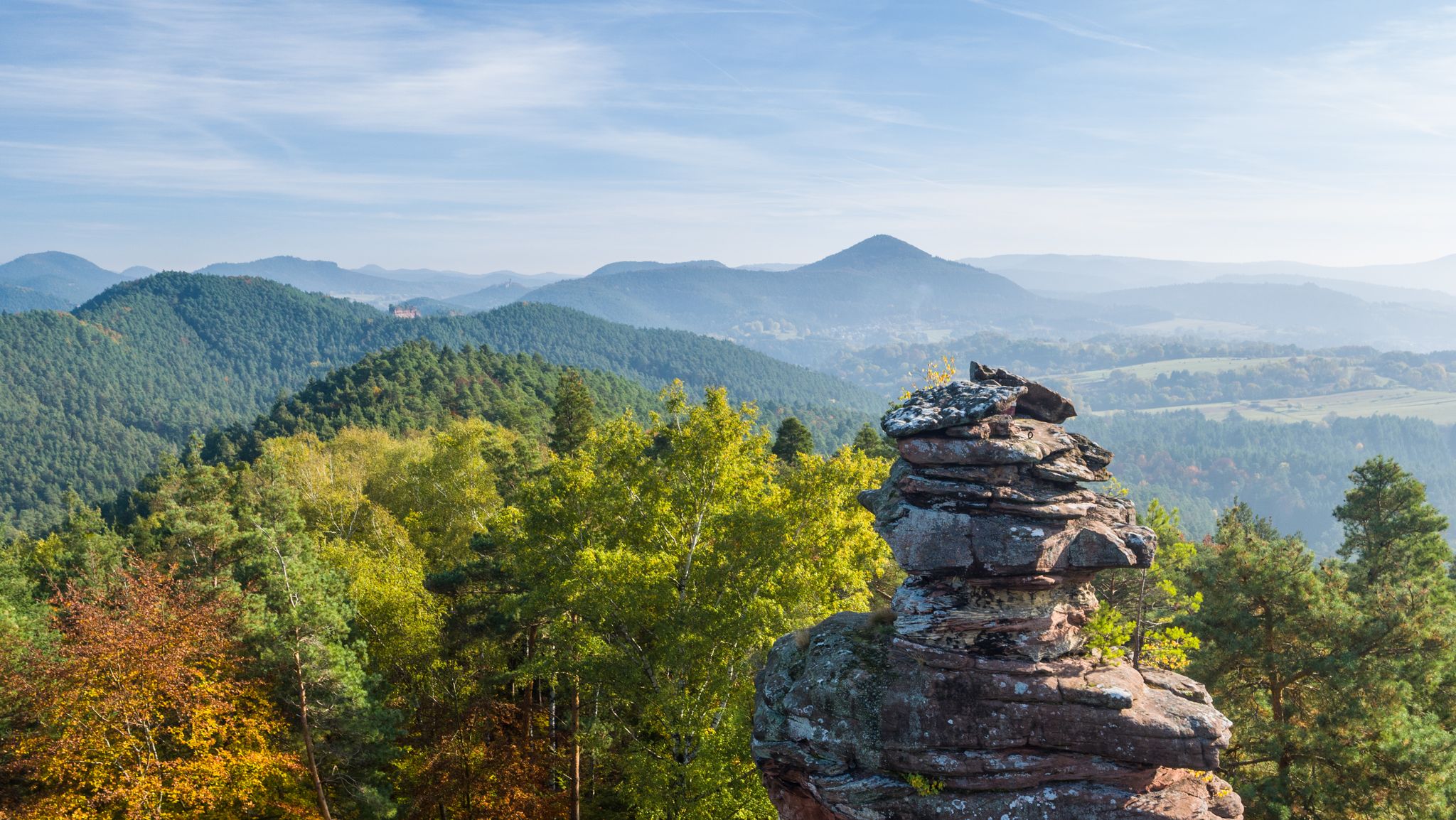
Urban hiking trails around Pirmasens are situated on the edge of the Palatinate Forest, offering a blend of urban exploration and natural surroundings. The region features extensive forests and is known for its red sandstone rock formations. Trails often incorporate sections through wooded areas and along water-rich valleys. The city's location provides access to varied terrain, from city paths to the fringes of the Biosphere Reserve Palatinate Forest/Northern Vosges.
Best urban hiking trails around Pirmasens
- The most popular urban hiking…
Last updated: July 10, 2026
4.6
(7)
13
hikers
4.23km
01:08
50m
50m
Easy hike. Great for any fitness level. Easily-accessible paths. Suitable for all skill levels.
12
hikers
Easy hike. Great for any fitness level. Easily-accessible paths. Suitable for all skill levels.

Sign up for free
5.0
(2)
7
hikers
5.93km
01:33
40m
40m
Easy hike. Great for any fitness level. Easily-accessible paths. Suitable for all skill levels.
4.5
(2)
7
hikers
6.66km
01:49
100m
100m
Easy hike. Great for any fitness level. Easily-accessible paths. Suitable for all skill levels.
5.0
(1)
6
hikers
7.38km
02:02
130m
130m
Moderate hike. Good fitness required. Easily-accessible paths. Suitable for all skill levels.
Get access to more routes and recommendations from other explorers.
Sign up for free
Already have an account?
Our route recommendations are based on thousands of hikes, rides, and runs completed by other people on komoot.
Start today with a free account
Your next adventure awaits.
Login or Signup


Tips from the Community

According to legend, the Iro-Scottish monk is said to have preached and built a small church. The city name Pirmasens is said to go back to this monk around 750 AD..?
0
0

St. Anthony's Church is an impressive example of Neo-Romanesque architecture and a building of exceptional resilience. Constructed between 1923 and 1928, it was severely damaged by fire in both World War II and 1971 – and rebuilt each time. Today, it stands as a listed landmark in the Winzler district and forms an important spiritual and cultural center for the parish of Blessed Paul Josef Nardini. https://de.wikipedia.org/wiki/St._Anton_(Pirmasens)
2
0

What would the (former) shoe town of Pirmasens be without the shoemaker Jean Joss? After completing his apprenticeship as a shoemaker in Paris, he settled in Pirmasens and laid the foundation for the local shoe industry. It is said that he sent his wife to the Prussian Rhine Province to sell shoes as early as the beginning of the 19th century. When other Pirmasens shoemakers saw how much money the Joss couple had earned from this trade, they too began to follow their example. And thus began the rise of the "shoe town" – or so the legend goes. Today, a bronze statue on the Shoemaker's Fountain in front of Luther Church commemorates Jean Joss. The fountain statue initially stood on the Upper Castle Square from 1921 before being moved to its permanent location here in 1981 following the construction of the pedestrian zone. Pithy sayings adorn the octagonal fountain basin, which at least in part also express the pride the people of Pirmasens have in their history. For example, one reads: "The shoe has made us great here, so don't despise the shoe and the cobbler!" or "If the shoe leaves the city limits, it shall be a praise for Pirmasens!" And then—and this is debatable— "True life is work, a German man never forgets!" Today, only a few of the shoe factories that once provided jobs for several thousand people remain. Low-cost production, initially in Southern and Southeastern Europe and now in South and East Asia, has led to the decline and to the fact that Pirmasens, as the "Shoe City of Germany," is now history. Source: https://ludwigunterwegs.wordpress.com/2019/10/27/huldigung-an-den-mit-begruender-der-pirmasenser-schuhindustrie-der-schuster-joss-brunnen/
1
0
Legend After the death of Landgrave Ludwig IX, Pirmasens faced hard times. According to legend, the former grenadier (soldier) Jean Joß sought ways to escape poverty. He came up with the idea of manufacturing "Schlappen" (shoes) and, after sending his wife to trade, succeeded in selling his products in the neighboring Rhineland. When Mrs. Joß finally returned with a handsome profit, other Pirmasens residents also took up the shoemaking trade, and thus, the "German Shoe Metropolis" gradually developed. Decision to Erect the Fountain The origins of the monument thus date back to 1809. At the city council meeting on July 12, 1910, the then mayor, Otto Strobel, announced that a gentleman, whose name shall remain unmentioned, had donated 8,000 marks to erect a fountain symbolizing the shoe industry. The mayor's office had submitted a request to the State Ministry of the Interior for Church and School Affairs in Munich (the Palatinate belonged to Bavaria from 1816 to 1946) for a grant for the construction of a fountain monument. The Bavarian State Ministry of the Interior wrote on April 10, 1913: "In the name of His Majesty the King. His Royal Highness Prince Ludwig, Regent of the Kingdom of Bavaria, has most graciously deigned to approve the allocation of 9,600 marks from the state budget for the care and promotion of art as a grant for the construction of a fountain monument in Pirmasens, subject to the following provisions: 1. The monument shall be erected as a smaller fountain monument relating to the development of the Pirmasens shoe industry on the upper Schlossplatz (market square) in Pirmasens [...]." Further provisions included the cost allocation and the announcement of an artistic competition for the monument project. .... Source: https://www.kuladig.de/Objectansicht/KLD-345956
1
0
Schuster-Joß Fountain ⛲ at night 🌜⭐ - Beginning of the local shoe industry - in front of the Luther Church - In front of the Luther Church - Pirmasens Inscription on the base: If the shoe leaves the city limits, it shall be a praise for Pirmasens
1
0
Landgrave Ludwig IX had the church built as a transverse church in 1757/1758 by the Zweibrücken master builder Schweighöfer, and he found his final resting place here in 1790. The church was called the "Lower Church" from 1818 and "Luther Church" from 1931. The church is a listed building and today serves as the deanery church of the Evangelical Church District of Pirmasens. The church is the oldest Protestant church in the city. Its furnishings include a historic altar cloth and a meditation lamp made by Erwin Würth of Petersbächel. The organ in the gallery was built by the Oberlinger company in the 1950s. The Landgrave's coat of arms is above the entrance; the tower bears a cross with a lion and a swan as heraldic animals. The church is open daily. The tower of Luther Church houses a four-part peal, supplied in 1957 by the Rincker bell foundry in Sinn/Dillkreis (Hesse). The bells are named after the four evangelists and bear their names and symbols as inscriptions: Matthew (F-sharp) – Mark (E-sharp) – Luke (C-sharp) – John (A-sharp). The peal possesses a rich sonority and surprises the unprepared listener with its depth of tone, which many cathedrals cannot match. The St. John's bell is particularly impressive, for example, when it rings solo in the Good Friday service or closes the plenary session with its solemn downward ring. Compared to other bells of this pitch, it can be considered a distinctly "lightweight," weighing 3001 kg. Source: https://de.wikipedia.org/wiki/Lutherkirche_(Pirmasens)#cite_note-3
0
0
The Old Cemetery is an abandoned cemetery in Pirmasens that has been converted into a park. As a listed monument, the Old Cemetery includes numerous 19th-century gravestones, three war memorials, and a partially preserved Jewish section, which are part of the city's list of historical monuments. The former consecration hall is now an event venue known as the Carolinensaal. The grounds of the former cemetery are located directly outside the city center, south of Mount Horeb. The park is bordered by Friedhofstraße and Buchsweilerstraße to the south, and Ottostraße to the north. Darmstädter Straße and Strobelallee form the western and eastern boundaries, respectively. South of the park, toward Kirchberg, lies the Wilhelminian-era Landauer-Tor district, and to the west, the city center begins on Bergstraße. The cemetery was established outside the city walls around 1763. The exact year is unknown; the cemetery first appears in a drawing from 1762, albeit at a different location. There, it was intended to be located directly in front of the Buchsweiler Gate at what is now the corner of Hauptstrasse and Bergstrasse, but was ultimately laid out at a higher location at the continuation of Alleestrasse. The cemetery already existed by 1765 at the latest. The oldest surviving relics in the cemetery are the gravestones for two Prussian officers who fell in the Battle of Pirmasens in 1793, Albrecht Otto Johann von Möllendorff and Hans Friedrich Georg von Borstell. The cemetery was expanded in 1858 and 1871. From 1876 onward, a Jewish section was established to replace the fully occupied cemetery on what is now Zeppelinstrasse. Despite these expansions, space for new graves was once again running out, so plans to create a new cemetery began in 1911. It wasn't until after the First World War that the plans were realized, and the new forest cemetery was consecrated in 1924. From around 1927, burials in new graves took place only there, and the old cemetery was abandoned. However, burials in existing family graves were still possible until 1953. Under the Nazi regime, the Jewish section of the cemetery was devastated and leveled. A fire pond was built in its place for the neighboring fire station of the Pirmasens Fire Department. .... Source: https://de.wikipedia.org/wiki/Alter_Friedhof_(Pirmasens)
1
0
The eastern part of the city lies within the Palatinate Forest Nature Park, which in turn is part of the Palatinate Forest-Vosges du Nord Biosphere Reserve. Pirmasens has three large parks near the city center. These include the Old Cemetery, which was abandoned after the completion of the Forest Cemetery in the 1920s and later converted into a park. It contains gravestones from the 19th and early 20th centuries, as well as a modern sculpture park. The former funeral hall is used as the Carolinensaal for cultural events. Source: https://de.wikipedia.org/wiki/Alter_Friedhof_(Pirmasens)
1
0
Frequently Asked Questions
How many urban hiking trails are available in Pirmasens?
Pirmasens offers a good selection of urban hiking opportunities, with over 20 routes available for exploration. These trails range from easy strolls to slightly more challenging paths, providing diverse options for city explorers.
What kind of natural features can I expect on urban hikes in Pirmasens?
Even within the urban landscape, Pirmasens' trails often incorporate elements of its natural surroundings. You can expect to encounter green spaces, parks, and sometimes even glimpses of the extensive forests and striking red sandstone rock formations that characterize the wider Palatinate Forest region. Some routes might lead you past tranquil ponds or streams, offering a refreshing natural contrast to the city environment.
Are there any easy urban hiking routes suitable for beginners in Pirmasens?
Yes, Pirmasens is very beginner-friendly for urban hiking. The majority of the urban trails, specifically 18 out of 21, are rated as easy. Routes like the Carolinensaal – Schuster Joss Fountain loop from Pirmasens offer gentle terrain and manageable distances, perfect for those new to hiking or looking for a relaxed walk.
Can I find circular urban walks in Pirmasens?
Absolutely. Many of the urban hiking trails in Pirmasens are designed as circular routes, allowing you to start and end at the same point without retracing your steps. Examples include the Schuster Joss Fountain – Carolinensaal loop from Pirmasens Hbf and the Statue of Landgrave Ludwig IX – Schuster Joss Fountain loop from Pirmasens, which are ideal for exploring the city's highlights.
Are the urban hiking trails in Pirmasens suitable for families?
Yes, many urban hiking trails in Pirmasens are well-suited for families. The prevalence of easy-rated routes, often with paved or well-maintained paths, makes them accessible for children. Look for shorter circular routes that offer points of interest or playgrounds along the way to keep younger hikers engaged.
Are dogs allowed on urban hiking trails in Pirmasens?
Generally, dogs are welcome on urban hiking trails in Pirmasens, especially in public parks and green spaces. However, it's always advisable to keep your dog on a leash, especially in more populated areas or near wildlife. Please be mindful of local regulations and clean up after your pet to ensure a pleasant experience for everyone.
What are some notable landmarks or viewpoints along Pirmasens' urban trails?
Urban hikes in Pirmasens often weave through areas with historical and cultural significance. While specific viewpoints might be more prominent on trails outside the immediate city center, you can expect to encounter various statues, fountains like the Schuster Joss Fountain, and other architectural features. The city itself is known for its unique combination of nature and urban life, offering a blend of sights.
How can I reach the urban hiking trailheads in Pirmasens using public transport?
Pirmasens has a well-connected public transport system, making it convenient to access many urban trailheads. The Pirmasens Hauptbahnhof (main train station) is a central hub, and several routes, such as the Schuster Joss Fountain – Carolinensaal loop, start directly from there. Local bus services can also take you to various points around the city, providing easy access to different starting points.
Is parking available near the urban hiking trails in Pirmasens?
Yes, parking is generally available in and around Pirmasens city center, often within reasonable walking distance of urban trailheads. Look for public parking garages or designated parking areas. Some routes might have specific parking spots indicated near their starting points, especially those that venture slightly further from the immediate city core.
What do other hikers say about the urban trails in Pirmasens?
The komoot community highly rates the hiking experiences around Pirmasens, with an average score of 4.5 stars from over 6,500 ratings. Hikers often praise the accessibility of the trails, the blend of urban exploration with green spaces, and the well-maintained paths that make for enjoyable walks within the city's unique setting.
Are there places to eat or drink along the urban hiking routes in Pirmasens?
As you'll be hiking within an urban environment, you'll find numerous cafes, restaurants, and pubs conveniently located along or very close to the trails, especially in the city center. This makes it easy to grab a coffee, enjoy a meal, or simply take a break and refuel during your urban hike.
What is the best time of year to go urban hiking in Pirmasens?
Urban hiking in Pirmasens can be enjoyed year-round. Spring brings blooming flowers to city parks, while autumn offers pleasant temperatures and colorful foliage. Summer is great for longer daylight hours, and even winter can be charming with crisp air and potentially snow-dusted urban landscapes. Choose a time that suits your preference for weather and scenery.
What should I bring for an urban hike in Pirmasens?
For urban hikes in Pirmasens, comfortable walking shoes are essential. Depending on the weather, bring appropriate layers, a light jacket, and perhaps a small backpack for water and snacks. While amenities are usually close by, having your own hydration is always a good idea. Don't forget your phone for navigation and photos!
Most popular routes around Pirmasens
Most popular attractions around Pirmasens

Get inspired with the komoot mobile app


Explore more
Browse the best Hikes in other regions.
