Top 5 Castles around Carmignano
Best castles around Carmignano are found in a municipality in Tuscany, known for its historical fortifications and grand villas. The area features a landscape of hills and plains, strategically important throughout history, offering panoramic views. Carmignano's rich past is evident in its medieval fortresses and Renaissance architecture, providing a blend of historical and natural exploration. Visitors can discover sites that played crucial roles in regional conflicts and served as residences for powerful families.
Best castles around Carmignano
- The most popular…
Last updated: June 30, 2026
Emperor's Castle
Highlight • Castle
On the site of today's …
Translated by Google •
Tip by

Malmantile Fortified Castle
Highlight • Castle
Translated by Google •
Tip by

Sign up now to discover places like this
Get recommendations on the best single tracks, peaks, & plenty of other exciting outdoor places.
Sign up for free
Viewpoint from the Rocca di Carmignano
Highlight • Viewpoint
Translated by Google •
Tip by

Larciano Castle Tower
Highlight • Castle
Translated by Google •
Tip by

Cecina village (Larciano)
Highlight • Settlement
Translated by Google •
Tip by

Sign up for free to discover even more castles around Carmignano.
Sign up for free
Already have an account?
Start today with a free account
Your next adventure awaits.
Login or Signup

Other adventures around Carmignano

Tips from the Community

The Emperor's Castle (also known as the Fortress of Santa Barbara or Swabian Castle) is located in the historic center of Prato, in Piazza Santa Maria delle Carceri. It is the only example of Swabian (Frederickian) architecture in central-northern Italy, built between 1237 and 1248 by the architect Riccardo da Lentini at the behest of Emperor Frederick II of Swabia. The fortress served to guard the communication routes between Germany and southern Italy. Structure and Architecture: Square plan: the sides measure approximately 40 meters, with walls two and a half meters thick made of alberese stone. Eight towers: four main towers at the corners corresponding to the cardinal points and four central towers. Guelph battlements: the walls are decorated with classic swallowtail battlements. [1] Bichrome portal: the main entrance combines Gothic style with Romanesque-Tuscan elements, characterized by alternating bands of white and green marble and protected by two lions
0
0

The small village of Malmantile has one of the best preserved examples of medieval city walls in Tuscany. Its origins are unknown, it was essentially a military center located along the ancient and very important road that connected Florence to Pisa and only later became an inhabited center. Legend has it that the episode that gave rise to its name dates back to the 4th century! St. Ambrose, bishop of Milan, was traveling towards central Italy while St. Zanobi, bishop of Florence, was in the area. The two met where the commemorative tabernacle of the meeting stands and stayed for a few days to talk in a farmhouse. Upon leaving, St. Ambrose was so dissatisfied with the welcome he received from the locals that he cursed the place so much that the farmhouse sank into a crevasse. Once word of what had happened spread, the town was called 'Malmantile', which literally meant 'bad tablecloth' but in a broader sense 'bad reception'. The late Gothic walls of the town date back to 1424 and are one of the first examples of a wall equipped with a projecting device, the most used type in Tuscany for the entire following century. It seems that Brunelleschi also supervised their construction. The walls have a layout of 125x70 meters and form an almost perfect rectangle, oriented with the longer sides to the north-west and south-east and with the short ones, in the center of which are the two gates, joined by the single road axis, to the north-east and south-west. Although the entire perimeter of the loose stone wall is preserved, little remains of the projecting defensive device. This is made up of stone corbels of the type with four rounded projections to support the slightly pointed brick arches. Compared to the nearby circle of Lastra a Signa, here there are, in alternating arches, the machicolations for the plunging defense. The wall is completed by square towers placed at the four corners plus two other towers, without an internal front, placed at the center of the longer sides, the largest of which is the one on the north-west side, the one facing the external road and also the best preserved as it is completely free from overlapping of subsequent buildings. The two gates, both with round arches, are obtained by projecting a section of the walls themselves outwards and equipped with a series of slits on both sides. The one towards Florence is currently in need of restoration with the arch at risk of collapse. To the west of the gate facing Pisa (southwest) we find the only still intact section of the projecting apparatus, crowned by a parapet made of finer stone than that of the walls. Along the entire perimeter the escarpment joins the upper part plumb without a roundabout. To the south of the gate and along the walls they are in some places pierced by the windows of the houses leaning against them. The north-west side is internally free from buildings but partially covered by buildings built externally.
0
0
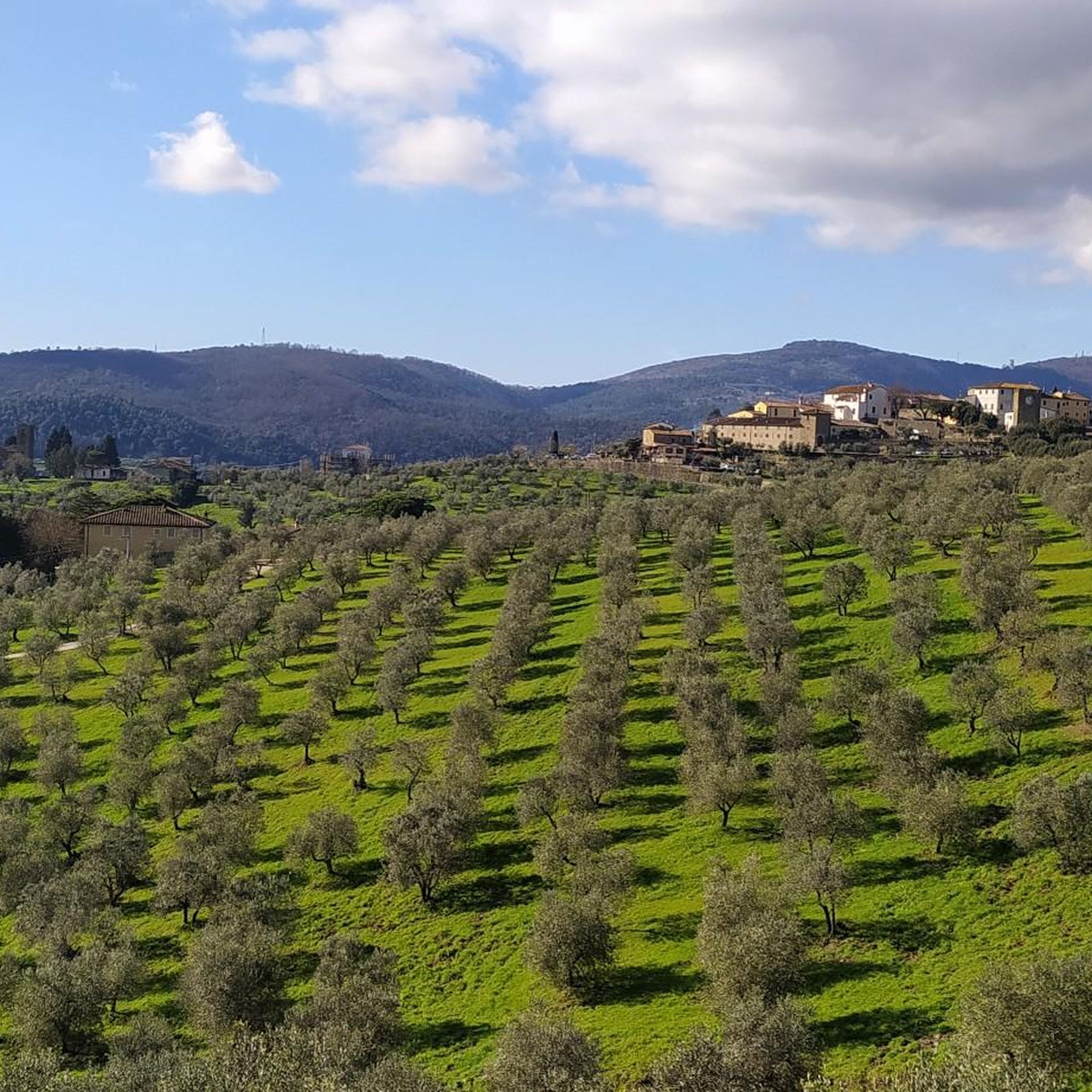
The Rocca or Castle of Carmignano has dominated the village from above for over a thousand years: the bastion was in fact mentioned for the first time in the year 998, in a document by Otto III of Saxony which granted ownership to the bishop of Pistoia. The Rocca was the object of continuous battles between Pistoia, Florence and Prato, due to its strategic position in the political-military context of the Middle Ages: from up here, in fact, you can admire the entire plain between the three cities. After having resisted, in 1154, a siege conducted by troops from Prato and Florence, the castle was destroyed for the first time in 1228 by the Florentines. Having regained possession of Pistoia in 1242, the fortification was rebuilt and in the early fourteenth century sold again to Florence, which proceeded to demolish the fortress and the castle walls once again. After a new parenthesis in Pistoia (1315-1324) the castle returned to Florentine hands, only to be besieged and conquered by Castruccio Castracani, who made it his own stronghold until 1328, when it finally returned to Florence. The Rocca di Carmignano can be accessed via a pedestrian path (starting from the church of San Michele, where Pontormo's famous Visitation is kept) that climbs the hill full of olive trees, where you can enjoy a beautiful view of Montalbano. Few remains of the medieval walls around the Rocca remain, partly rebuilt as the Campano, with the bell tower and clock, while in the center stands a medieval tower, called the Maschio della Rocca. (www.visittuscany.com)
0
0

Beautiful, tranquil place that invites you to linger!👍
0
0

La Rocca above The village of Carmignano is worth a visit and not just for the view. From this fortress there were two arms that the Pistoiesi had placed and that "made the figs" towards Florence. For more information, consult the Divine Comedy.
0
0

Built on previous Roman settlements, the Castle was a possession of the Guidi Counts attested from the mid-10th century, then sold by them to the Municipality of Pistoia in 1225. Contested several times between the Pistoiesi and the Florentines until 1401 when Pistoia definitively submitted to Florence and Larciano became headquarters of one of the podesterias in which the administration of the territory was divided.
1
0

The Emperor's castle is located in Prato in Piazza delle Carceri. It is an example of Frederick architecture, built by order of Emperor Frederick II of Swabia, in the context of the struggle for dominance in Tuscany between the empire and the papacy which characterized the decades between the 1200s. Source: https://it.wikipedia.org/wiki/Castello_dell'Imperatore
1
0
It is the Roccadi Carmignano
0
0
Frequently Asked Questions
What kind of historical sites can I explore in Carmignano?
Carmignano is rich in history, offering a blend of medieval fortresses and Renaissance villas. You can explore sites like the Emperor's Castle, a unique example of Hohenstaufen architecture, or the medieval Larciano Castle Tower. The area also features the Rocca di Carmignano, an ancient fortress, and the magnificent Villa Medicea La Ferdinanda, a UNESCO World Heritage site.
Which castles offer the best panoramic views of the region?
For breathtaking panoramic views, the Viewpoint from the Rocca di Carmignano is highly recommended. Perched atop a hill, it offers expansive vistas of the plain, including Florence, Prato, and Pistoia, extending to the Montalbano hills. The Villa Medicea La Ferdinanda also provides unique panoramic views from its high knoll, stretching from the Arno valley to the Pistoia plain and even the Apuan Alps.
Are there family-friendly castles to visit in Carmignano?
Yes, several castles in the Carmignano area are suitable for families. The Emperor's Castle and Malmantile Fortified Castle are both categorized as family-friendly. Exploring these historical sites can be an engaging experience for visitors of all ages.
What is the Rocca di Carmignano and can I visit it?
The Rocca di Carmignano is an ancient medieval fortress, also known as Castello di Carmignano, that has overseen the town for over a millennium. It played a crucial strategic role due to its commanding position. You can visit the Rocca; admission is free, and it is open on weekends. It's accessible via a scenic pedestrian path starting near the Church of San Michele.
Can I visit the Villa Medicea La Ferdinanda?
The Villa Medicea La Ferdinanda, also known as the 'Villa of the Hundred Chimneys' and a UNESCO World Heritage site, is a private property. However, guided tours and public events are periodically organized, allowing visitors to experience its grandeur and unique architecture. It's advisable to check local listings for current tour availability.
What outdoor activities can I do near the castles around Carmignano?
The Carmignano area offers various outdoor activities. You can find numerous routes for road cycling, mountain biking, and general cycling. For example, there are challenging road cycling routes like the 'Carmignano Town Center – Pinone Pass loop' or moderate MTB trails such as the 'Etruscan Source – Start of Etrusco Trail loop'. You can explore more options on the Road Cycling Routes around Carmignano, MTB Trails around Carmignano, and Cycling around Carmignano guide pages.
Are there hiking trails near the castles?
While specific hiking trails directly linked to the castles aren't detailed, the Rocca di Carmignano is reached via a scenic pedestrian path. The region's natural landscape of hills and plains provides ample opportunities for walking and exploring. Many of the cycling routes mentioned in the Cycling around Carmignano guide may also be suitable for walking or offer scenic views.
What is the best time to visit the castles in Carmignano?
The Carmignano area, being in Tuscany, generally enjoys pleasant weather in spring (April-May) and autumn (September-October), which are ideal for exploring historical sites and enjoying the panoramic views. These seasons offer comfortable temperatures and beautiful natural scenery. The Rocca di Carmignano is open on weekends, so plan your visit accordingly.
What do visitors enjoy most about the castles around Carmignano?
Visitors particularly appreciate the historical significance and the stunning panoramic views offered by sites like the Viewpoint from the Rocca di Carmignano. The tranquil atmosphere of places like Larciano Castle Tower also invites visitors to linger and soak in the history.
Does the Rocca di Carmignano have a bell tower?
Yes, a prominent feature of the Rocca di Carmignano is the Campano, a bell tower with a clock. This adds to the medieval charm of the fortress.
Where can I find parking near the castles in Carmignano?
Parking availability varies by location. For the Rocca di Carmignano, visitors typically park in the town and access the fortress via a pedestrian path. For other sites like the Villa Medicea La Ferdinanda, specific parking arrangements may be available for guided tours or events. It's best to check local signage or event information for precise parking details.
How long should I plan for a visit to the castles?
The duration of your visit depends on the specific castle and your interest. For the Rocca di Carmignano, you might spend 1-2 hours exploring the site and enjoying the views. A visit to the Emperor's Castle could also take a couple of hours. If you plan to visit multiple sites or include a guided tour of the Villa Medicea La Ferdinanda, allocate a half to full day.
Most popular routes around Carmignano
Most popular attractions around Carmignano

Get inspired with the komoot mobile app


Explore more
Looking for the best castles somewhere else? Discover other guides around Carmignano:
