Top 6 Caves around Muros
Best caves around Muros, a municipality in Galicia, Spain, offers a coastal landscape within the Ría de Muros e Noia. While Muros itself is known for its beautiful coastline, prominent natural cave systems are not directly within the municipality. The broader region of Galicia does feature notable caves, though these require travel from Muros. This guide focuses on specific cave-related historical sites.
Best caves around Muros
- The most popular cave-related site is The tomb of Molafà (Sardinia, Italy), a…
Last updated: August 10, 2026
The tomb of Molafà (Sardinia, Italy)
Highlight • Historical Site
Translated by Google •
Tip by

Noeddale Necropolis, Ossi
Highlight • Historical Site
Tip by

Sign up now to discover places like this
Get recommendations on the best single tracks, peaks, & plenty of other exciting outdoor places.
Sign up for free
Necropolis of Mesu ‘e Montes
Highlight • Historical Site
Left Ossi in the direction of Florinas, after …
Tip by
Hypogeum Sas Puntas at Tissi (Sardinia)
Highlight • Historical Site
Tip by
Domus de Janas of S’Elighe Entosu
Highlight • Historical Site
Translated by Google •
Tip by

Sign up for free to discover even more caves around Muros.
Sign up for free
Already have an account?
Start today with a free account
Your next adventure awaits.
Login or Signup

Tips from the Community

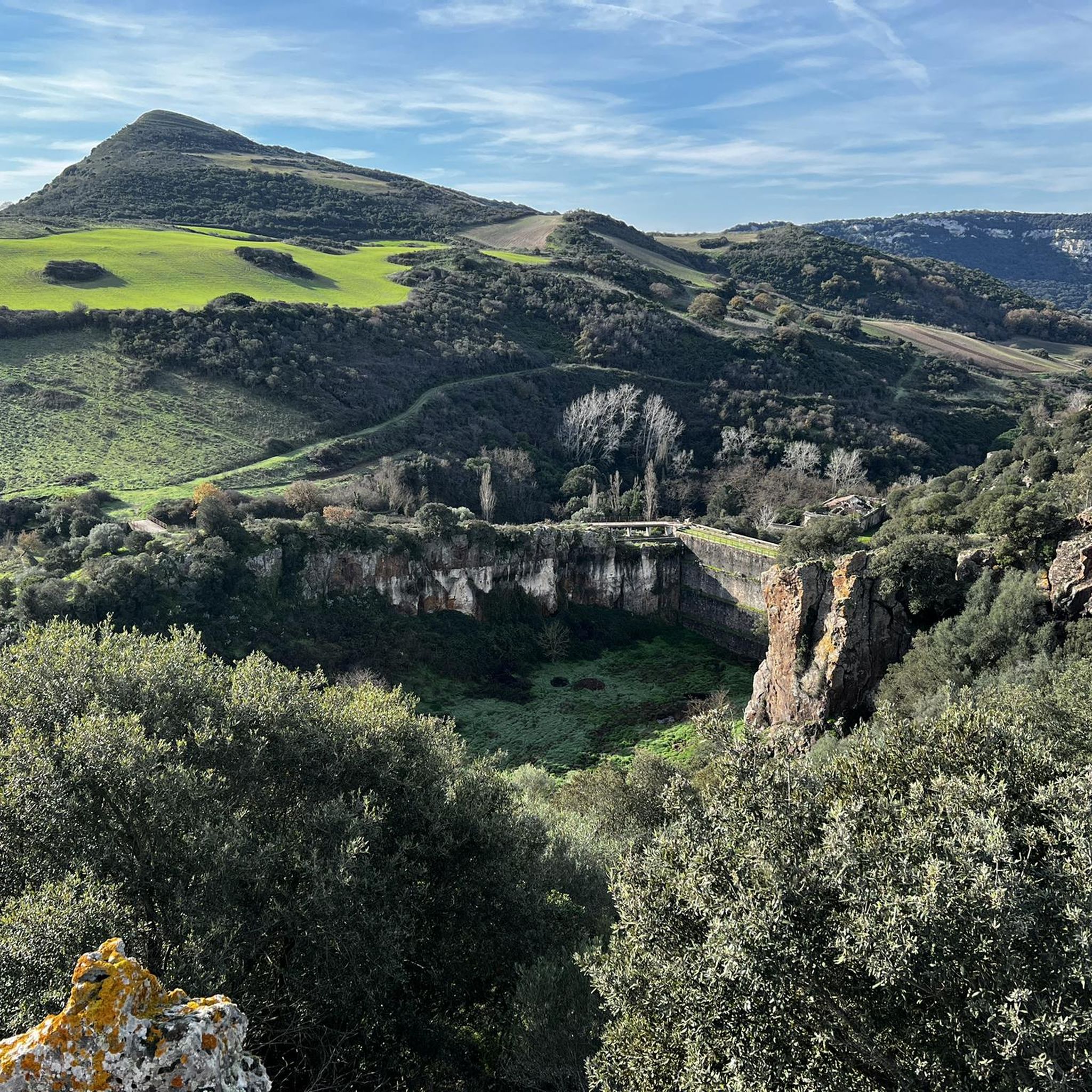
The domus de janas necropolis of S’Elighe Entosu is located near the southern border of the municipal territory of Usini. The necropolis consists of 7 late Neolithic hypogea, to which are added a poorly preserved cave and a tomb that is part of the architecturally-oriented hypogea.
0
0

Prehistoric archaeological site located in the municipality of Sassari, in the locality of Molafà. particular interest
5
0


The necropolis of Noeddale is an archaeological site located in the territory of Ossi (in the province of Sassari in north-western Sardinia). It is an area rich in evidence of the island's hypogean architecture (4th-3rd millennium BC). The necropolis consists of six hypogea, three of which are preceded by dromoi (access corridors also carved out of the rock). The most interesting are those called the "tomb of the house" (made up of 11 rooms) which reproduces the architectural structure and the ceiling of the pre-nuragic houses, and the "tomb of the spirals" enriched by numerous relief decorations: spirals, taurine protomes, frames ... The area is open and has free entry; it is accessed from the last houses of Ossi towards Florinas
2
0
In the territory south of Ossi there is an imposing necropolis on a limestone ridge of the southern slopes of Mount Mamas. Left Ossi in the direction of Florinas, after 10 km on the SP 3, on the left you see a dirt road that leads quickly to a large open space, where you can leave your bike under a big oak tree. Here a path, well delimited by low dry stone walls, climbs (for 400 m.) to the funeral complex. The necropolis consists of 18 domus de janas, all multicellular (in two of them there are up to 12 rooms), richly adorned with pilasters, panels, false doors, taurine protomes, spiral or wolf teeth motifs. Some tombs reproduce the structure of the pre-nuragic houses with great realism: horizontal, or single or double sloping roofs, central beams and lateral joists, support pillars, zigzag and sawtooth motifs, fireplaces… everything carved in the rock. Remember to bring a torch. The place is free to access and is clearly indicated by a sign at the beginning of the dirt road.
1
0
The tomb of Sas Puntas is located in the territory of Tissi (province of Sassari, Sardinia). Following from Sassari the road sp. 3, after a double curve which marks the beginning of the outskirts of Tissi, there is a lane with an (unreadable) sign indicating on the left the direction to the site. Where the lane ends, follow to the right a rocky and irregular path that runs along the ravine on the left. When it reaches a high limestone boulder with a deep vertical crack, go down some rough steps and then a steep path for about twenty meters up to a clearing near a large reef of limestone where the hypogeum is excavated. The exterior is characterized by an exedra with a seat along its entire length and the typical stele. The oval-shaped interior shows two opposite niches and on the floor two cups pecked into the rock surface. This tomb is defined “a prospetto architettonico”, that is, a grave of the Nuragic age, excavated in the rock (such as the pre-Nuragic domus de janas) which reproduces in the outer facade both a stele and an exedra, that are typical elements of the Giants' Tombs. This type of grave is widespread in the territory of Sassari, but is nearly absent in the rest of Sardinia. Access is free. But the indications are almost non-existent. You can contact the Municipality of Tissi to request a guided tour.
1
0
The tomb of Molafà is located within the municipal territory of Sassari (Sardinia). Leaving Sassari towards Alghero on state road 127 bis, after about 5 kilometers from the city center, you reach a level crossing and the very small station of Molafà. Not far away, on the slopes of the hill on your right, lies the tomb, which takes its name from the place. In early Middle Ages it was used and known as a rock church, but in reality it was a grave dating back to the nuragic era . This tomb is defined “a prospetto architettonico”, that is, a grave excavated in the rock (such as the pre-Nuragic domus de janas) which reproduces in the outer facade both a stele and an exedra, that are typical elements of the Tombs of the Giants. Inside, there are several burial cells. This type of grave is widespread in the territory of Sassari, but is absent elsewhere in Sardinia. There are no fences or gates, so you can visit it freely. Near the tomb of Molafà stands the homonymous, mono-towered nuraghe.
3
0
Frequently Asked Questions
What kind of 'caves' are featured in this guide for Muros?
While the municipality of Muros in Galicia, Spain, is known for its beautiful coastline, it does not have prominent natural cave systems directly within its borders. This guide focuses on cave-related historical sites, primarily ancient necropolises and archaeological hypogea, which offer insights into prehistoric burial practices and rock-cut architecture. These sites are located in Sardinia, Italy, and are presented as points of interest for those exploring cave-like historical structures.
Are there any natural caves in the broader Galicia region that I can visit?
Yes, the broader region of Galicia is home to several notable natural caves, though they require travel from Muros. The most renowned is the Cova do Rei Cintolo in Mondoñedo, Lugo, which is the largest natural calcareous cave in Galicia. Other significant natural caves include Cova de Eirós (a prehistoric site with cave paintings), O Burato dos Mouros, Cova da Doncela (a sea cave), and the extensive network of caves in the Serra da Enciña da Lastra Natural Park in Ourense.
What are some of the most popular cave-related historical sites mentioned in this guide?
Visitors frequently explore sites like The tomb of Molafà, a prehistoric archaeological site in Sardinia known for its architectural facade. Another popular spot is Noeddale Necropolis, Ossi, an archaeological site with six hypogea, including the 'tomb of the house' and the 'tomb of the spirals'. The Necropolis of Mesu ‘e Montes, with its 18 multicellular domus de janas, is also highly appreciated.
What historical period do these cave-related sites represent?
The cave-related sites featured in this guide, such as the necropolises and hypogea, primarily date back to the Nuragic era and the late Neolithic period. They provide a glimpse into ancient burial practices and rock-cut architecture from the 4th-3rd millennium BC, showcasing structures like domus de janas and tombs that reproduce architectural elements of prehistoric houses.
Are these historical cave sites suitable for families?
These historical sites, being archaeological necropolises, can be interesting for families with an interest in history and ancient cultures. While they are generally open for exploration, some may involve walking on uneven terrain. For example, the Necropolis of Mesu ‘e Montes requires a walk up a path to the complex, and bringing a torch is recommended for exploring inside.
What kind of archaeological features can I expect to see at these sites?
You can expect to see various archaeological features such as hypogea (underground chambers), domus de janas (fairy houses), and tombs carved into rock. Many feature intricate details like pilasters, panels, false doors, taurine protomes, spiral or wolf teeth motifs, and even reproductions of ancient house structures with roofs, beams, and support pillars carved into the rock.
What outdoor activities can I do near these cave-related historical sites?
Near these historical sites, which are located in Sardinia, you can find various outdoor activities. For cycling enthusiasts, there are routes like 'From Sassari towards Sennori and San Lorenzo – ring tour' or 'Coastal Road to Porto Torres – Balai Beach loop'. Running trails are also available, such as 'Running loop from Tàttari/Sassari'. For more adventurous cycling, consider gravel biking routes like 'San Lorenzo Forest Trail – Cliffs of San Lorenzo valley loop'. You can find more details on these activities in the Cycling around Muros, Running Trails around Muros, and Gravel biking around Muros guides.
Are there any specific tips for visiting the Necropolis of Mesu ‘e Montes?
When visiting the Necropolis of Mesu ‘e Montes, it's recommended to bring a torch to explore the interiors of the domus de janas. The site is freely accessible, and a path well-delimited by low dry stone walls leads up to the funeral complex. It's located on a limestone ridge, offering a unique setting.
What is the significance of the Cova do Rei Cintolo in Galicia?
The Cova do Rei Cintolo, located in Mondoñedo, Lugo, is highly significant as the largest natural calcareous cave in Galicia. It features an impressive 8 kilometers of galleries across three levels, complete with stalactites, stalagmites, labyrinths, and an underground lake. It also holds archaeological importance, with evidence of human remains, tools, and medieval settlements found within its chambers. Guided tours are available for visitors.
Can I visit the Cova de Eirós in Galicia?
Yes, the Cova de Eirós in Triacastela, Lugo, is a significant prehistoric site and unique in Galicia for preserving cave paintings and engravings. It also contains archaeological finds, including Neanderthal stone objects and evidence of continuous occupation by both Homo Sapiens and Homo Neanderthalensis. It offers a deep dive into the region's ancient history.
What are 'domus de janas' and where can I see them?
'Domus de janas' translates to 'fairy houses' and refers to prehistoric rock-cut tombs found primarily in Sardinia. These are often multicellular, richly adorned with carved motifs, and sometimes reproduce the architectural structure of ancient houses. You can see them at sites like the Necropolis of Mesu ‘e Montes and the Domus de Janas of S’Elighe Entosu.
Are there any sea caves in the Galicia region?
Yes, the Cova da Doncela in Viveiro, Lugo, is a notable sea cave located on the coast between Punta Ínsua and Punta do Cabalo, overlooking Abrela beach. Access requires crawling for about 15 meters to reach a larger opening that faces a cliff, offering a unique coastal exploration experience.
Most popular attractions around Muros

Get inspired with the komoot mobile app


Explore more
Extend your search for the best caves by checking out these guides of the top ones around Muros:
