Top 9 Caves around Winkel (Eifel)
Best caves around Winkel (Eifel) are situated within the broader Vulkaneifel region, known for its volcanic history and diverse geological formations. This landscape features ancient volcanic cones, deep valleys, and natural rock formations. The region's caves offer insights into its geological past, historical mining activities, and prehistoric human settlements. These sites provide a factual look into the natural and human history of the Eifel.
Best caves around Winkel (Eifel)
- The most popular caves is Falkenlay Stone Age Caves, a…
Last updated: October 13, 2026
Elf Grotto and Elbesbach Waterfall
Highlight • Cave
The …
Translated by Google •
Tip by

Falkenlay Stone Age Caves
Highlight • Cave
Showing Translation
Tip by

Sign up now to discover places like this
Get recommendations on the best single tracks, peaks, & plenty of other exciting outdoor places.
The old Lippi
Highlight • Structure
Translated by Google •
Tip by

Kobesloch Hut – View over the Lieser Valley
Highlight • Mountain Hut
Translated by Google •
Tip by
Elfengrotte and Teufelsbrücke at Elbesbach, Bad Bertrich
Highlight • Cave
Translated by Google •
Tip by

Sign up for free to discover even more caves around Winkel (Eifel).
Already have an account?
Start today with a free account
Your next adventure awaits.
Other adventures around Winkel (Eifel)

Tips from the Community

The success of the film "Tatort Falkenlay" inspired the idea of building a concrete replica of the main character, the old Lippi, for the film crew, the community, and guests. Apparently, it's located in the cave of events, and so the idea was born! What should it look like? He prefers to indulge in his favorite pastime: relaxing around the campfire! A friendly neighbor lent his face and hands to create lifelike casts. They constructed the upper body skeleton from strong wire. The legs were made from plumbing pipes and attached to the body. Now the hard work began. Everything had to be filled with scrap paper, wrapped several times, and then rewired. After dressing Lippi in old pants, they could begin the concrete work. Now the fine details of the body were modeled. The head, face, hands, and feet, which had been pre-cast, were placed in their designated places. The masterpiece was complete! With the kind support of the Kennfus volunteer fire department, Lippi then moved to his cave beneath the Falkenlay!
1
0


There is so much to discover on this section
1
1

If you want to enjoy a very personal view, you can take a small, secured steep path to the left of the hut to the actual Kobesloch. The path is not long, but you should be sure-footed and not afraid of heights. A must for climbing enthusiasts.
3
0

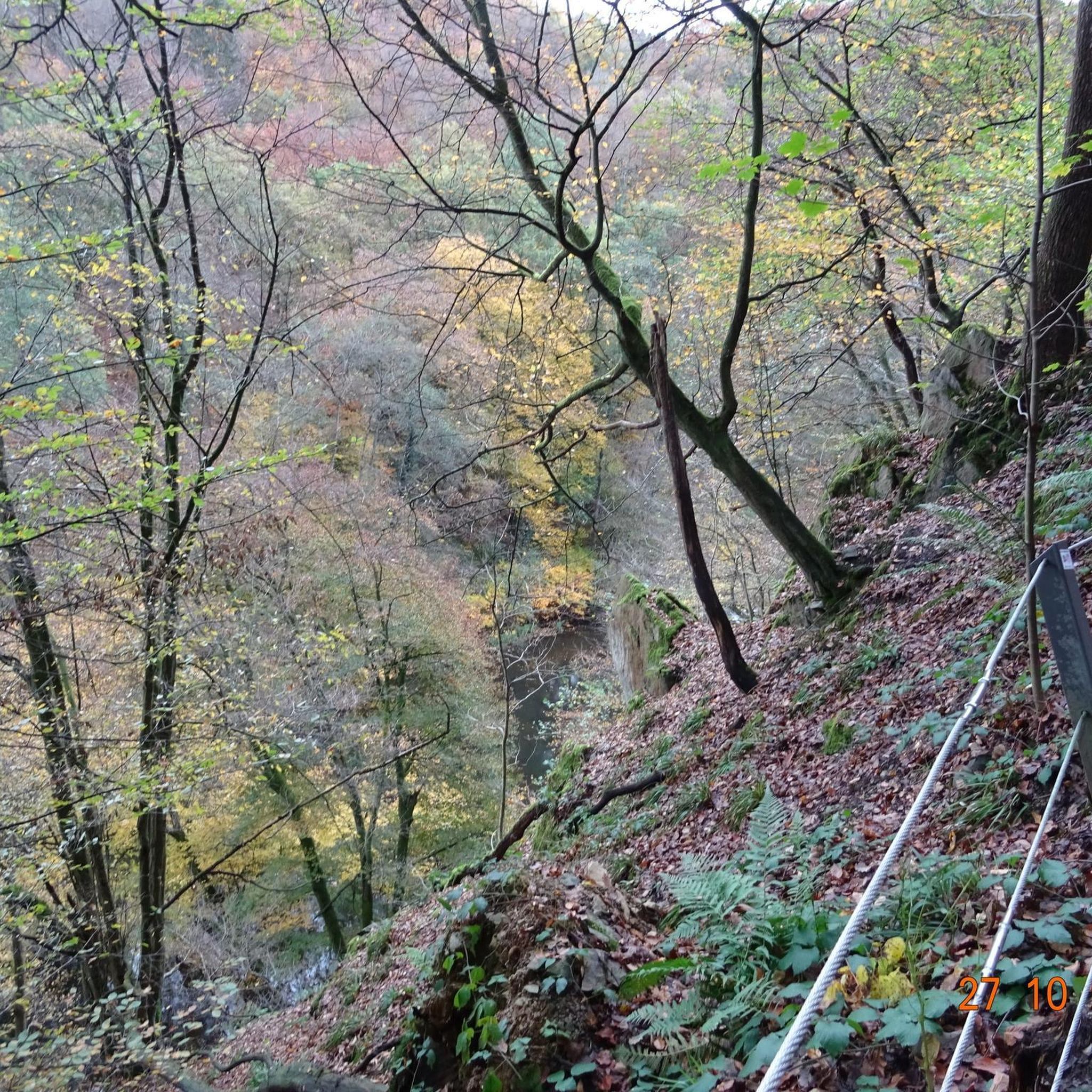
The Kobesloch and the associated hut give us the last kick: A steep, steel cable-secured path leads to the Kobesloch - space for two - that's all the path and the hole offers. This change is just great.
5
0

Caves and a nice rest area with information board
2
0

Beautiful and wide panoramic view
5
0

I really liked the story of the cave under the Kobeslochhütte. I haven't looked at the cave, but I find it very exciting.
2
0
Frequently Asked Questions
Which caves around Winkel (Eifel) are suitable for families with children?
Several caves in the region are great for families. The Falkenlay Stone Age Caves are particularly engaging, offering smaller caves in volcanic rock that children can explore, with evidence of Stone Age hunters. The Elf Grotto and Elbesbach Waterfall and the Elfengrotte and Teufelsbrücke at Elbesbach, Bad Bertrich are also family-friendly, featuring unique rock formations and waterfalls that are easily accessible.
What is the historical significance of the caves in the Eifel region?
The Eifel region's caves offer a rich historical tapestry. The Falkenlay Stone Age Caves show evidence of Stone Age hunter settlements from 2000 to 4000 BC. Further afield, the Buchenloch Cave was used by Neanderthals, and the Genoveva Cave has evidence of human use from the Palaeolithic era through the Middle Ages. The Kakushöhle is one of Europe's oldest archaeological sites, with traces of Neanderthal hunter-gatherers from 80,000 B.C.
Are there any caves in the Eifel region that are related to mining history?
Yes, the Eifel region has a significant history of mining, particularly for millstones. The Birresborn Ice Caves, also known as 'millstone caves,' were artificially created through millstone mining and are now a listed building. Similarly, the Millstone Caves of the Rother Kopf, located northwest of Gerolstein, were extensively mined for millstones from the 13th century onwards, offering deep insights into the region's industrial past.
What unique natural features can be found in the caves around Winkel (Eifel)?
The caves showcase diverse natural phenomena. The Elf Grotto is a hollow path formed by volcanic activity around 50,000 years ago, where basalt lava solidified into unique columns resembling stacked cheese wheels. The Birresborn Ice Caves are notable for their consistently low temperatures, allowing icicles and ice columns to persist well into summer. The Buchenloch Cave, a prehistoric rock cave, was formed by the dissolving action of groundwater over millions of years.
What outdoor activities can I combine with a visit to the caves?
The Eifel region offers numerous outdoor activities. You can find various running trails, such as the 'Mürmesbach Moor – Schalkenmehrener Maar loop' or the 'Pulvermaar – Pulvermaar loop'. For cyclists, there are road cycling routes like the 'View of the Moselle – Bremmer Calmont Vineyard loop' and MTB trails including the 'Kennfuss-Maisch Spring – Pulvermaar loop'. Many of these routes are accessible from Winkel (Eifel) and can be found in the Running Trails around Winkel (Eifel), Road Cycling Routes around Winkel (Eifel), and MTB Trails around Winkel (Eifel) guides.
Are there any caves in the area known for their unique geological formations?
Yes, the Eifel region, being volcanic, features fascinating geological formations. The Elf Grotto is a prime example, where cooling basalt lava formed distinctive columns. The Falkenlay Stone Age Caves are situated at the foot of the Falkenlay, the oldest cinder cone in its volcanic system, showcasing the results of scoria eruptions.
What is the best time of year to visit the caves in the Eifel region?
The best time to visit depends on the specific cave. For caves like the Birresborn Ice Caves, which serve as important winter quarters for bats, they are temporarily closed from October 1st to March 31st. Generally, spring to autumn offers pleasant weather for exploring the outdoor areas around the caves and accessing those that are open year-round, such as the Buchenlochhöhle. Always check specific opening times if planning to visit guided caves.
Are there any caves that are particularly easy to access or require a guide?
Some caves are easily accessible, while others require guidance. The Elfengrotte and Teufelsbrücke at Elbesbach, Bad Bertrich is easily reached by bike or on foot. For the Birresborn Ice Caves, visitors can explore with a guide, equipped with a helmet and torch, to experience their unique features. The Millstone Caves of the Rother Kopf also advise visitors to bring warm clothing, sturdy footwear, and a flashlight, suggesting a more rugged exploration.
What are the 'ice caves' in the Eifel region, and what makes them special?
The 'ice caves' in the Eifel region, such as the Birresborn Ice Caves and the Millstone Caves of the Rother Kopf, are unique due to their consistently low temperatures. These caves, often formed through mining, trap cold winter air, allowing ice formations like icicles and ice columns to persist even into the summer months. They also serve as crucial winter habitats for bats, leading to seasonal closures for their protection.
Can I find viewpoints near the caves to enjoy the Eifel landscape?
Yes, many cave locations are integrated into scenic landscapes with viewpoints. For instance, the Kobesloch Hut, near some cave formations, offers a great view over the Lieser Valley and is an ideal spot for a break. The Elf Grotto and Elbesbach Waterfall is also listed as a viewpoint, allowing visitors to appreciate the surrounding natural beauty.
Are there any legends or folklore associated with the caves in the Eifel?
Yes, some caves are steeped in local legends. The Genoveva Cave, for example, is famously associated with the legend of Countess Genoveva and her son, who supposedly found refuge there. The Kakushöhle also has a legend suggesting that a giant named Kaku once lived within its extensive cave system, adding a mythical dimension to its ancient history.
Most popular routes around Winkel (Eifel)
Most popular attractions around Winkel (Eifel)

Get inspired with the komoot mobile app


Explore more
Extend your search for the best caves by checking out these guides of the top ones around Winkel (Eifel):
