Top 16 Caves around Harbach
Caves around Harbach primarily consist of historical mining tunnels and unique grottoes, offering insights into the region's industrial past and local traditions. While not featuring natural limestone caves like those found in other parts of Germany, the area provides diverse underground experiences. Harbach is situated in a landscape characterized by its historical mining heritage, with many sites repurposed for visitor access. The surrounding terrain includes forests and valleys, typical of the Westerwald-Sieg region.
Best caves around Harbach
- The most popular…
Last updated: October 13, 2026
Crottorf Castle
Highlight • Castle
Translated by Google •
Tip by

Mariengrotte Mudersbach
Highlight • Religious Site
Translated by Google •
Tip by

Sign up now to discover places like this
Get recommendations on the best single tracks, peaks, & plenty of other exciting outdoor places.
Wilhelmslust Slate Mine
Highlight • Historical Site
Translated by Google •
Tip by

Bullenkamp Mine Entrance
Highlight • Historical Site
Mining of copper ore, pyrite and iron ore;
Length 130 m and …
Translated by Google •
Tip by
Grube Josefsglück and Unterer Grimmlack Waterworks, Brachbach
Highlight • Historical Site
Translated by Google •
Tip by

Sign up for free to discover even more caves around Harbach.
Already have an account?
Start today with a free account
Your next adventure awaits.
Tips from the Community

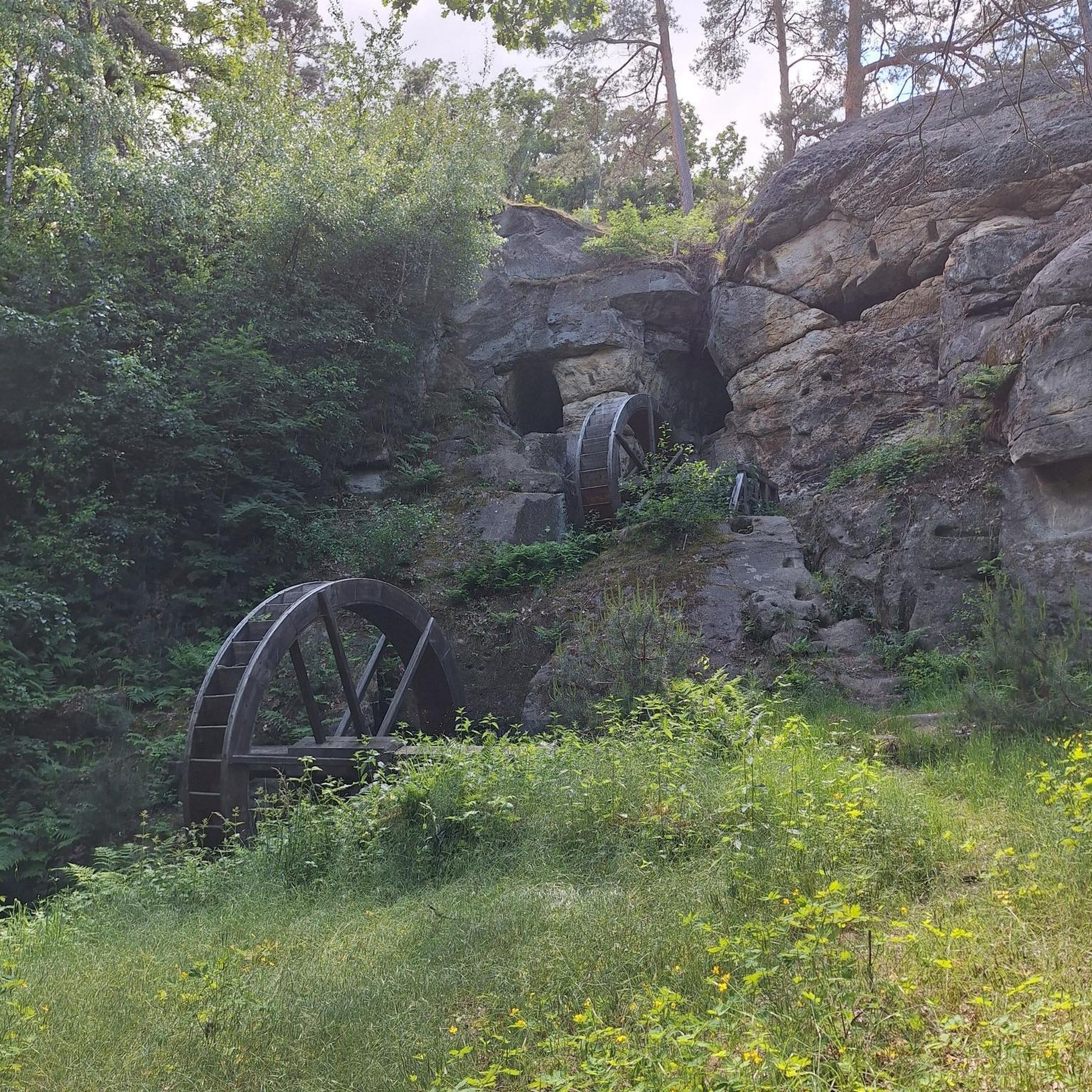
The Josefsglück slate visitor mine and the waterworks at the Unterer Grimmlack are located on the approximately 10-kilometer-long Wäller Tour Grubenwanderweg Brachbach trail in the municipality of Brachbach. Josefsglück Mine + History: The slate mine was operated from 1896 or 1903 until 1925. During World War II, it served as an air-raid shelter, after which it was operated again on a part-time basis from 1945 to 1948. + Current use: Since June 2011, it has been a visitor mine, the Schieferstollen Josefsglück. + Special features: Six mining halls and a unique presentation element worldwide, the so-called "rising sun", can be seen. + Opening hours: Open from May to October by prior arrangement with the Brachbach local history society. Tours last approximately 1 to 1.5 hours. Waterworks and Unterer Grimmlack + Location: The stations belong to the Grubenwanderweg (mining trail) created by the "Glück-Auf" Brachbach local history society, which leads past over 30 historical mining sites. + Function: Some of the old adits (such as the Stollen Untere Girnbach or Langgrube) are used in connection with the local water supply or as drinking water reservoirs. + Hiking: The circular route connects the heritage of ore and slate mining with nature stations and on-site information boards.
0
0
The Bullenkamp adit is a historic mine entrance in Brachbach in the district of Altenkirchen in Rhineland-Palatinate. Important details + History: Mining ended around 1875. Previously, copper, pyrite (sulfur ore), and iron ore were mined there. During World War II, the adit served as a shelter and emergency practice for the villagers. + Reconstruction: The Brachbach local history association rebuilt the collapsed adit entrance in 2009 with rubble stone and fitted it with a gate. + Location: The adit is about 130 meters long and is located directly on the Brachbach mining hiking trail (Wäller Tour) on the Sieg river.
0
0

Everything you need is there.
1
0

The route there isn't the best, but the rest area at the slate tunnel entrance is really great.
2
0

Quiet and beautiful place!
1
0

The slate tunnel is part of the slate-ore-iron path, the easy-to-drive path leads directly along the Sieg
3
0

A nice place to pause and switch off for a moment...
2
0

Please do not create duplicates of existing highlights, but rather add your own contributions to describe highlights.
1
1
Frequently Asked Questions
What kind of 'caves' can I explore around Harbach?
The 'caves' around Harbach are primarily historical mining tunnels and unique grottoes, offering insights into the region's industrial past. You won't find natural limestone caves here, but rather sites like the Bullenkamp Mine Entrance or the Wilhelmslust Slate Mine.
Are there any historical sites among the caves around Harbach?
Yes, the region is rich in historical sites. The Bullenkamp Mine Entrance is a historical site related to copper, pyrite, and iron ore mining, which also served as a bomb shelter during WWII. Additionally, Crottorf Castle, a moated castle first mentioned in 1326, is a notable historical landmark in the area.
What is the Mariengrotte Mudersbach?
The Mariengrotte Mudersbach is a religious building built into the rock, constructed in 1924 using stones from local mines. It's considered one of the most beautiful Marian grottoes in the region and is adorned with figures of the Virgin Mary.
Can I visit a historical mine tunnel around Harbach?
Yes, the Wilhelmslust Slate Mine is an old slate mine that has been made accessible to visitors. Guided tours are available by arrangement, offering a glimpse into the region's mining heritage.
What should I expect when visiting the Wilhelmslust Slate Mine?
When visiting the Wilhelmslust Slate Mine, expect temperatures around 8 degrees Celsius inside the tunnel, so dress warmly. Protective helmets are provided and must be worn during visits. The tunnel features two large mining halls and some stalactites and stalagmites.
Are there family-friendly options for exploring the caves around Harbach?
Many of the historical sites and grottoes, such as Mariengrotte Mudersbach and Crottorf Castle, are considered family-friendly and offer accessible experiences for all ages.
What outdoor activities can I do near the caves around Harbach?
The Harbach area offers various outdoor activities. You can find numerous routes for gravel biking, cycling, and running. For example, explore routes like 'Hohenhainer Tunnel – View of Rothemühle loop' for gravel biking, 'Hohenhain Railway Tunnel – Crottorf Castle loop' for cycling, or 'Freudenberg half-timbered trail' for running. You can find more details on these activities in the Gravel biking around Harbach, Cycling around Harbach, and Running Trails around Harbach guides.
Are there any specific trails or routes that lead to these cave sites?
The Sieg adventure trail "Erzquellweg" leads along the Mariengrotte Mudersbach. Additionally, the Bullenkamp Mine Entrance is part of the Mudersbacher SchieferErz-Eisen-Weg, a local mining trail.
What do visitors enjoy most about the caves and historical sites near Harbach?
Visitors appreciate the historical significance of the sites, such as the ancient Crottorf Castle and the mining heritage reflected in the tunnels. The unique religious architecture of the Mariengrotte Mudersbach also receives positive feedback.
Is it necessary to arrange visits in advance for the mine tunnels?
Yes, visits to the Wilhelmslust Slate Mine are possible by arrangement. It's recommended to contact them beforehand to schedule your guided tour.
Are there any viewpoints or natural features near the Harbach caves?
While the 'caves' themselves are man-made, the surrounding terrain includes forests and valleys typical of the Westerwald-Sieg region, offering natural beauty. Some highlights like Crottorf Castle and Mariengrotte Mudersbach are also listed as viewpoints.
Most popular routes around Harbach
Most popular attractions around Harbach

Get inspired with the komoot mobile app


Explore more
Extend your search for the best caves by checking out these guides of the top ones around Harbach:
