The best mountain hikes around Évires
4.9
(17)
114
hikers
11
hikes
Mountaineering routes around Évires are situated in the heart of the French Alps, offering a diverse range of alpine terrain. The region is characterized by prominent limestone massifs, challenging ascents to peaks like Mont Veyrier and The Mole, and extensive panoramic views. These routes often traverse varied landscapes, including high mountain passes and forested sections, providing a robust mountaineering experience.
Best mountaineering routes around Évires
- The most popular mountaineering route is Le Grand Montoir – Le Petit Montoir loop from…
Last updated: June 30, 2026
5.0
(4)
29
hikers
9.37km
04:15
660m
660m
Hard mountaineering route. Good fitness required. Sure-footedness, sturdy shoes and alpine experience required.
4.3
(6)
21
hikers
15.7km
07:17
1,180m
1,180m
Hard mountaineering route. Very good fitness required. Sure-footedness, sturdy shoes and alpine experience required.

Sign up for free
5.0
(4)
15
hikers
9.60km
04:31
750m
750m
Hard mountaineering route. Good fitness required. Sure-footedness, sturdy shoes and alpine experience required.
5.0
(1)
12
hikers
8.04km
03:51
640m
640m
Hard mountaineering route. Good fitness required. Sure-footedness, sturdy shoes and alpine experience required.
6
hikers
7.02km
03:16
590m
590m
Moderate mountaineering route. Good fitness required. Mostly accessible paths. Sure-footedness required.
Get access to more routes and recommendations from other explorers.
Sign up for free
Already have an account?
Our route recommendations are based on thousands of hikes, rides, and runs completed by other people on komoot.
Start today with a free account
Your next adventure awaits.
Login or Signup
Tips from the Community

La Corraterie is a narrow rocky ledge and cliff path on the west flank of Mont Salève (the so-called “Balcony of Geneva”) in Haute-Savoie (France). From here, you have breathtaking panoramic views of Lake Geneva, the city of Geneva, and the Jura Mountains. Highlights along the path besides the view ;-): ⭐ The passage cave Grotte d'Orjobet. ⭐ Trou de la Tine: An impressive natural rock arch and sinkhole formed by erosion in the cliffs of La Corraterie. ⭐ Numerous climbers can be observed on the vertical limestone walls. And here is the story behind the flag on the mountain path: It is not the Swiss flag, but the coat of arms of Savoy (meaning no white cross, but the bars extend to the edge). It all began in the late 1960s. American students from the nearby Adventist campus in Collonges-sous-Salève climbed the steep rock face after a night of revelry. Since the mountain offers a direct view of Geneva, they were firmly convinced they were in Switzerland. They painted a huge Swiss flag on the rocks. However, Mont Salève is geographically located in France (Haute-Savoie region). The local French residents found the Swiss flag on their mountain to be an affront. Local activists climbed up and painted over the Swiss cross, turning it into the coat of arms of Savoy (Cross of Savoy) to emphasize the French-Savoyard affiliation. To this day, unknown individuals (mostly from Geneva) regularly climb the wall at night to shorten the bars and turn the Savoy coat of arms back into a Swiss flag.
0
0

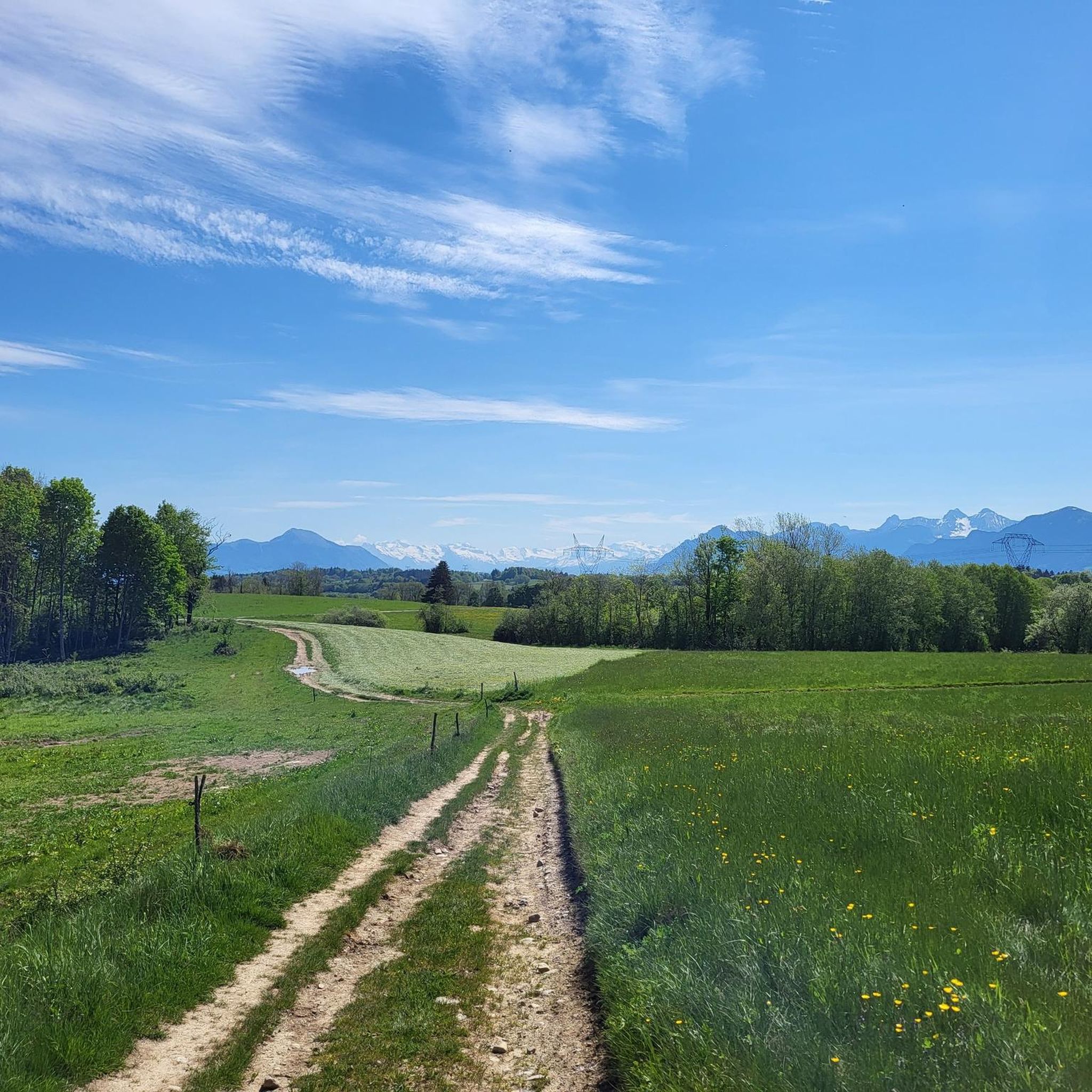
The section from La Muraz to Cruseille, passing through Le Sappey, and then the climb from Cruseille to La Croisette are really nice. Beautiful road, few cars and gentle slope!
0
0

Le Trou de la Tine (Trou of the Tine Cave) was formed by erosion on the flank of Mont Salève. It is a deep, sunken hole shaped like an open-topped barrel ("Tine" is an old dialect term for barrel, "trou" means hole). The cave's ceiling has collapsed due to erosion, revealing a natural "barrel" with a side opening. One can walk into the "barrel" through this side opening.
0
0

A great chalet run by a very kind family and where we were able to buy fresh tomme cheese.
0
0
A bit dizzying but when the weather conditions are good and you watch where you put your feet, everything is fine!
0
0


Col de Croissette. What a beautiful tour. A long climb with percentages up to 18% brings you to the plateau of the mountain. There with rolling roads and paths towards the west to enter the descent and via the North back to Geneva.
0
0
Frequently Asked Questions
How many mountaineering routes are available around Évires?
There are over 10 distinct mountaineering routes around Évires, offering a variety of challenges and scenic experiences. These routes are highly rated by the komoot community, with an average score of 4.9 stars.
What is the best time of year for mountaineering in Évires?
The best time for mountaineering in Évires is typically from late spring to early autumn (May to October). During these months, the weather is generally more stable, and trails are free of snow, making for safer and more enjoyable ascents. Winter mountaineering is possible but requires specialized equipment and experience due to snow and ice conditions.
Are there any beginner-friendly mountaineering routes in the Évires area?
While many routes around Évires are challenging, there are some moderate options suitable for those with some mountaineering experience looking to progress. For instance, the Montagne de Sous-Dîne loop from La Culaz is a moderate route covering about 10.8 km with an elevation gain of around 880 meters, offering a good introduction to the region's alpine terrain.
What kind of landmarks or natural features can I expect to see on these routes?
The mountaineering routes around Évires offer stunning views of the French Alps and access to notable natural features. You might encounter impressive mountain passes like Croisette Pass or Glières Pass, and even explore caves such as Orjobet Cave or The Trou de la Tine. Many routes provide panoramic vistas of Lake Annecy and the Mont Blanc massif.
Are there any circular mountaineering routes available?
Yes, several routes around Évires are circular, allowing you to start and end at the same point. A challenging example is the Tête du Parmelan – Le Grand Montoir loop from Villaz, which is a difficult 15.6 km path offering expansive views. Another option is the Le Grand Montoir loop from Crêt Châtillon, a difficult 7.7 km route.
What are the typical difficulty levels for mountaineering in this region?
Mountaineering routes around Évires range from moderate to difficult. The majority of routes are classified as difficult, featuring significant elevation gains, rugged alpine landscapes, and sometimes exposed sections. For example, the Crossing the trou de la roche – La Coraterie Cliff loop from Collonges-sous-Salève is a difficult 9.6 km trail with cliffside paths.
Is Évires a good base for exploring other major mountain areas?
Absolutely. Évires is strategically located in the Haute-Savoie, making it an excellent base. From here, you can easily access iconic areas like Mont Veyrier, The Mole, and the Col de la Colombière, which serves as a gateway to the Bargy range. The Mont Blanc massif is also less than an hour's drive from some climbing areas in Haute-Savoie, offering the ultimate challenge for experienced mountaineers.
What equipment is recommended for mountaineering in Évires?
Given the challenging nature of many routes, essential equipment includes sturdy mountaineering boots, appropriate layered clothing, navigation tools (map, compass, or GPS device), sufficient water and food, and sun protection. For more technical or exposed routes, a helmet, via ferrata kit, or even ropes might be necessary, especially if you plan to tackle areas like the Aravis massif or specific sections of the Col de la Colombière.
Are there any wild swimming spots near the mountaineering routes?
While the focus of these routes is mountaineering, the region is close to stunning water bodies. Lake Annecy, often called the 'Jewel of the Alps,' is nearby and offers various water-based activities. For a more secluded experience, Lake Dronières is another option for enjoying the natural waters of the area.
Where can I find accommodation or places to eat near the trails?
Évires and the surrounding villages offer various accommodation options, including gîtes and chambres d'hôtes, catering to outdoor enthusiasts. You'll find local restaurants and cafes in these communities where you can refuel after your mountaineering adventures. Larger towns like Annecy, a short drive away, provide a wider range of services.
Are there any family-friendly mountaineering options around Évires?
While many routes are challenging, families with older, experienced children might find some of the moderate trails suitable. However, true 'mountaineering' often implies significant elevation and exposure. For younger families, it's advisable to look for easier hiking trails in the valleys or around Lake Annecy, which offer beautiful scenery without the technical demands of high-alpine mountaineering.
Can I bring my dog on the mountaineering routes in Évires?
Dog-friendly policies can vary depending on the specific trail and protected areas. While many trails in the French Alps allow dogs, it's crucial to keep them on a leash, especially in areas with livestock or wildlife. Always check local regulations for the specific route you plan to undertake, as some high-alpine or nature reserve areas may have restrictions.
What are the parking options for accessing these mountaineering routes?
Access to mountaineering routes around Évires typically involves parking at designated trailheads in nearby villages or mountain passes. For example, routes like Le Grand Montoir – Le Petit Montoir loop often start from locations like Crêt Châtillon, where parking facilities are usually available. It's always recommended to arrive early, especially during peak season, as parking can be limited.
Most popular attractions around Évires

Get inspired with the komoot mobile app


Explore more
Browse the best Mountain Hikes & Routes in other regions.
