Top 7 Castles around Höheinöd
Castles around Höheinöd are situated within the Südwestpfalz district of Germany, a region characterized by its historical significance and diverse natural landscapes. The area is known for its gently rolling hills and the Palatinate Forest, offering a blend of cultural landmarks and outdoor exploration opportunities. Höheinöd serves as a base for discovering numerous castles and ruins scattered throughout this historically rich region. The terrain often features free-standing, steep cliffs and offers panoramic views from higher elevations.
Best castles around Höheinöd
…Last updated: July 1, 2026
Ruins of Steinenschloss Castle
Highlight • Castle
Translated by Google •
Tip by

Heidelsburg — Roman fortress ruins
Highlight • Historical Site
Translated by Google •
Tip by

Sign up now to discover places like this
Get recommendations on the best single tracks, peaks, & plenty of other exciting outdoor places.
Sign up for free
Steinen Castle Ruins Trail
Highlight (Segment) • Trail
Translated by Google •
Tip by

Münchweiler Ridge Trail
Highlight • Viewpoint
Translated by Google •
Tip by
View of Schlossberg and Gräfenstein Castle Ruins
Highlight • Viewpoint
Translated by Google •
Tip by

Sign up for free to discover even more castles around Höheinöd.
Sign up for free
Already have an account?
Start today with a free account
Your next adventure awaits.
Login or Signup
Popular around Höheinöd

Tips from the Community

According to Roman coin finds discovered in the 1970s, Heidelsburg Castle was built at the latest between the 2nd century AD (Emperor Hadrian) and 351 AD (Germanic invasions). However, based on the location and shape of the complex, as well as a Gallic coin find, historians consider it possible that a predecessor building dates back to Celts and dates back to as early as 100 BC. It cannot be ruled out that the building was further expanded in the late Carolingian period; certain features of the work on the chamber gate suggest this.[3] In 1355, Count Arnold of Homburg sold half of a rock in the Waldfischbach court, called Bunensteyn, to Count Walram II of Zweibrücken and allowed him to build a castle on the rock and a town at its foot, although this never came to fruition.[4] The original name has not been recorded. The name "Heidelsburg" is etymologically related to "Heiden" (heathens) and only arose in the Middle Ages, when the building had already been derelict for centuries. The forest survey (description) of Waldfischbach mentions the ruins around 1600.
0
0

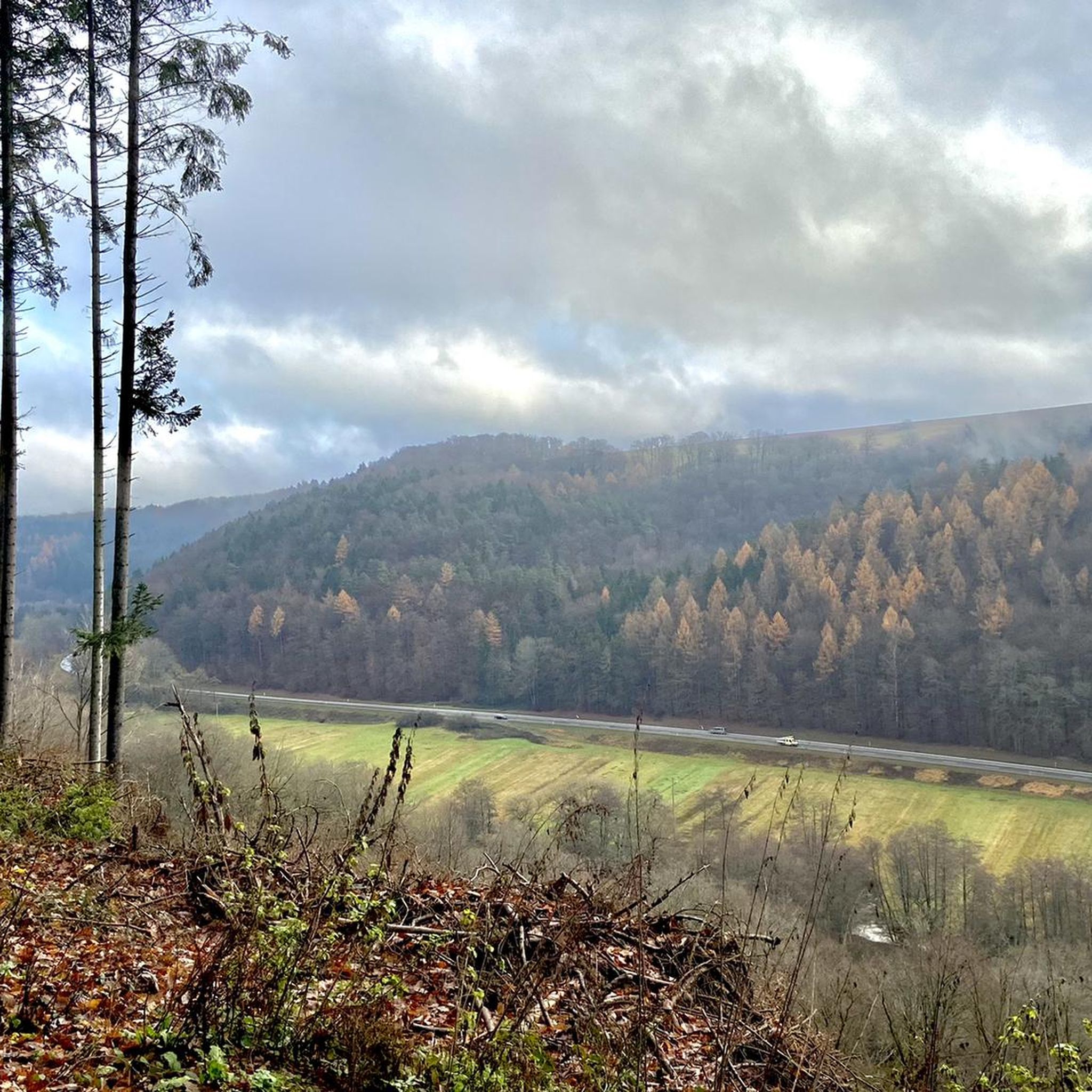
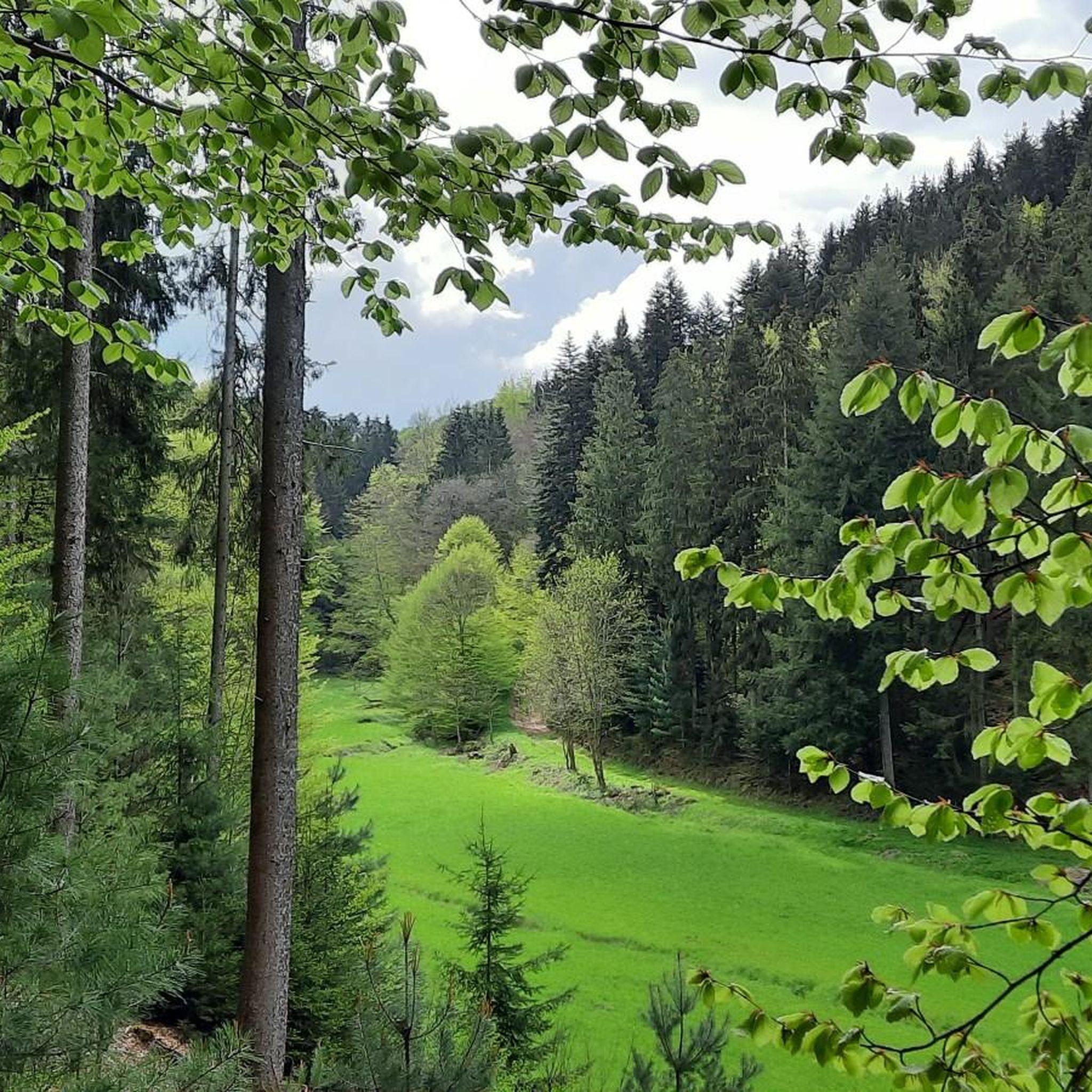
Over Merzalben, the view extends to the Schlossberg, on which the walls of the Gräfenstein castle ruins can be seen.
2
0
Some relics from the Roman era have been preserved in the so-called Heidelsburg. Some remains of walls and stairs can still be seen today. As can a copy of a gravestone excavated here. Based on the coin finds made in the 1970s, the beginnings of the Roman fortifications can be dated to the 2nd century. It is possible that an older Celtic fortification was used. In the local museum in Waldfischbach-Burgalben you can see a model of what the buildings might have once looked like.
1
1

A steep gradient from the direction of Esschwieler...
0
0

Caution quite steep and steps 🤪👍
1
0
The castle complex has the shape of an iron, the tip of which points to the south; the length is 70 meters, the width is about 46 meters. The 1.80 to 2.50 meter wide enclosing wall consists of hewn sandstone blocks, some of which are supplemented by hump blocks. The upper castle, situated on a sandstone rock, is separated from the lower castle by a rocky outcrop, which also contains the cistern. A bailey was west of the castle complex outside the ring wall. It stretched along the entire western side of the ditch, even a few meters further south. In addition to farm buildings and rooms presumably used as guard rooms, the lower castle also contained the entrance to the castle. It consisted of a gate 2.50 meters wide and 3.15 meters high, secured by a drawbridge and a moat. The upper castle is accessible through a passage carved into the rock. It housed the residential buildings, i.e. the palace, kitchen, toilet facilities, the armory and a mighty round tower that dominates the entire castle complex. With an inner diameter of 8.50 meters and 2.50 meter thick walls, it has an outer diameter of 13.5 metres. This tower probably served as a keep, but could also have been a residential tower due to its large diameter. In the north, the upper castle is protected by a broken shield wall, which was probably damaged in the 12th century. Its western half was rebuilt during the second half of this century, while the eastern part of the wall dates from the 11th century. Story The exact time when the castle was founded is not known. Excavation finds point to signs of settlement as early as the early Stone Age and the Hallstatt period. According to the masonry of the existing remains of the wall, the foundation of the castle took place around the year 1100. The builders were probably the Counts of Leiningen. A Roman villa about a kilometer away may have served as a source of building material for the late Salian castle complex. The massive round tower was built between 1125 and 1166, i.e. later than the castle. With its Salian-Staufen building elements, it is one of the largest in the Rhineland-Palatinate area of the time. Just a few years later a fire destroyed the castle; it could be one of the three Saarbrücken castles that Emperor Friedrich Barbarossa had razed in 1168 next to Saarbrücken Castle. In a document from 1237, the castle is said to have already been destroyed and was not rebuilt. From the 13th to the 18th century, the castle ruins changed hands several times. The counts of Leiningen-Dagsburg, Zweibrücken-Bitsch, Leiningen-Hardenburg are listed, from 1564 the estate of the counts of Leiningen-Hardenburg-Dagsberg, designated as a deserted settlement, and from 1570 Hanau-Lichtenberg. In the 19th century the ruins were used as a quarry and completely destroyed. The stones removed were used to build houses in the surrounding communities and, in 1875, to build the Pirmasens-Nord (Biebermühle) train station and the railway line. The ruin is currently state-owned and administered by the State Office for the Preservation of Monuments in Mainz. Excavations, reconstruction and finds In 1896/97, Mehlis carried out the first excavations, but had to stop the work due to a lack of funds. Under the supervision of the Office for Pre- and Early History, Speyer, excavation work was carried out by the doctor L.A. Hoffmann after the Second World War in 1956/57. This awakened public interest in the castle, which at that time was just a rubble dump overgrown with trees and forest plants. Excavation work began in the spring of 1968, and in 1973 the “Steinenschloss Castle Association” was founded. Today, the home club of Thaleischweiler-Fröschen oversees the excavations and work on the facility. In the meantime, the enclosing wall and palace area including toilet facilities have been renovated, the gate system of the lower castle has been reconstructed and the walls of some farm buildings have been made visible again. The tower, uncovered from 1985, was built up to a height of 10 meters from 1989/90 with stone blocks up to 1 m long and 55 cm high. The finds salvaged from the construction and fire debris of the ruins range from ceramic discs and game pieces made of sandstone or deer antlers to tools and weapon parts made of iron to door handles and keys. Gilded bronze decorative fittings also came to light; plus a double-headed eagle made of gilded bronze, probably also a decorative fitting. A stone work piece with a round-arched slit window was also recovered. A shell-like landmark was discovered during the excavation of the western perimeter. The extensive restoration and exposure work that has already taken place gives you an idea of what the former castle looked like.
1
0

@Felix: Is it worth visiting here even if you don't have a drone with you? That would be info that would probably be helpful for most Komoot users.
0
0

Climbing from the Schwarzbach valley at the eastern edge of Thaleischweiler-Fröschen, you soon reach an extraordinary castle complex: Steinenschloss. A mighty round tower, over 13 meters in diameter, rises above the partially restored Salian-Staufer castle ruins. Similar tower structures are otherwise only found in Central Germany. Steinenschloss was built during the reign of the Salian emperors, around 1024-1125. Now only a ruin, Steinenschloss, with its massive sandstone blocks at the confluence of the Schwarzbach and Rodalb rivers, is a testament to how the Salian emperor Conrad II subdued the dukes and the Church in their internal powers. https://www.suedwestpfalz-touristik.de/Burgen/burgruine-steinenschloss.html
7
1
Frequently Asked Questions
Which castles around Höheinöd offer the most historical significance?
The region around Höheinöd is rich in history. The Ruins of Steinenschloss Castle, built during the Salian emperors' reign (1024-1125), features a mighty round tower and massive sandstone blocks, testifying to its ancient origins. Another significant site is Heidelsburg — Roman fortress ruins, a Roman hilltop fortification also known as Germany's oldest forestry office. Further afield, the Gräfenstein Castle Ruins (visible from a viewpoint) and the Altdahn Castle Ruins, dating back to the 11th century, are notable for their extensive complexes and rock-carved features.
Are there any castles around Höheinöd that offer panoramic views?
Yes, several castles and viewpoints provide excellent panoramic views. The Wegelnburg Castle Ruins, the highest castle in the Palatinate at 571 meters, offers sweeping vistas of the Wasgau hills. The Ruppertstein Castle Ruins, though little remains of the structure, is known for its spectacular panoramic views from the climb. Additionally, the Heidelsburg — Roman fortress ruins includes a nice vantage point approximately 100 meters south of the remains.
What kind of outdoor activities can I do near these castles?
The area around Höheinöd is ideal for outdoor enthusiasts. You can find numerous hiking trails, including routes that lead directly to or past castle ruins. For example, there's a 'Small waterfall – Ruins of Steinenschloss Castle loop' and a 'Ruins of Steinenschloss Castle – Saufelsen Waterfalls loop'. You can explore more hiking options in the Hiking around Höheinöd guide. There are also various cycling and road cycling routes available, which you can discover in the Cycling around Höheinöd and Road Cycling Routes around Höheinöd guides.
Are there family-friendly castles or trails suitable for families around Höheinöd?
While specific 'family-friendly' designations for castles are not always explicit, many castle ruins in the region, like the Ruins of Steinenschloss Castle, are accessible via trails that can be enjoyed by families. The wooden ramp at Steinenschloss, for instance, makes it more accessible. Exploring the unique structure of Drachenfels Castle Ruins can also be an adventurous experience for families. When planning, consider moderate hiking loops like the 'Small waterfall – Ruins of Steinenschloss Castle loop' from Höheinöd, which is 8.47 km long and rated moderate.
What is the best time to visit the castles and hike in the Palatinate Forest?
The Palatinate Forest and its castles are beautiful throughout the year, but spring and autumn generally offer the most pleasant conditions for hiking and exploring. During these seasons, the weather is milder, and the natural scenery, with blooming flowers or vibrant fall foliage, enhances the experience. Summer can also be good, but be prepared for warmer temperatures. Winter visits are possible, but some trails might be slippery, and certain facilities could have reduced hours.
How accessible are the castles around Höheinöd by public transport or car?
While Höheinöd itself is a village, many castles in the Südwestpfalz district are reachable by car, often with parking facilities nearby. For example, the Ruins of Steinenschloss Castle is easily reachable from the P&R Biebermühle car park. The Heidelsburg — Roman fortress ruins can be reached in a few minutes on foot from its dedicated hiking car park. Public transport options to the more remote castle ruins might be limited, so checking local bus schedules to nearby towns like Dahn or Lemberg and then planning a hike from there is advisable.
Are there any unique architectural features among the castles in this region?
Yes, the castles in the Südwestpfalz region boast unique architectural elements. The Ruins of Steinenschloss Castle is notable for its mighty round tower, over 13 meters in diameter, a structure rarely seen elsewhere in Central Germany. The Altdahn Castle Ruins is a
Are there any unique architectural features among the castles in this region?
Yes, the castles in the Südwestpfalz region boast unique architectural elements. The Ruins of Steinenschloss Castle is notable for its mighty round tower, over 13 meters in diameter, a structure rarely seen elsewhere in Central Germany. The Altdahn Castle Ruins is a
Are there any unique architectural features among the castles in this region?
Yes, the castles in the Südwestpfalz region boast unique architectural elements. The Ruins of Steinenschloss Castle is notable for its mighty round tower, over 13 meters in diameter, a structure rarely seen elsewhere in Central Germany. The Altdahn Castle Ruins is a
Are there any unique architectural features among the castles in this region?
Yes, the castles in the Südwestpfalz region boast unique architectural elements. The Ruins of Steinenschloss Castle is notable for its mighty round tower, over 13 meters in diameter, a structure rarely seen elsewhere in Central Germany. The Altdahn Castle Ruins is a
Are there any unique architectural features among the castles in this region?
Yes, the castles in the Südwestpfalz region boast unique architectural elements. The Ruins of Steinenschloss Castle is notable for its mighty round tower, over 13 meters in diameter, a structure rarely seen elsewhere in Central Germany. The Altdahn Castle Ruins is a
Are there any unique architectural features among the castles in this region?
Yes, the castles in the Südwestpfalz region boast unique architectural elements. The Ruins of Steinenschloss Castle is notable for its mighty round tower, over 13 meters in diameter, a structure rarely seen elsewhere in Central Germany. The Altdahn Castle Ruins is a
Are there any unique architectural features among the castles in this region?
Yes, the castles in the Südwestpfalz region boast unique architectural elements. The Ruins of Steinenschloss Castle is notable for its mighty round tower, over 13 meters in diameter, a structure rarely seen elsewhere in Central Germany. The Altdahn Castle Ruins is a
Are there any unique architectural features among the castles in this region?
Yes, the castles in the Südwestpfalz region boast unique architectural elements. The Ruins of Steinenschloss Castle is notable for its mighty round tower, over 13 meters in diameter, a structure rarely seen elsewhere in Central Germany. The Altdahn Castle Ruins is a
Are there any unique architectural features among the castles in this region?
Yes, the castles in the Südwestpfalz region boast unique architectural elements. The Ruins of Steinenschloss Castle is notable for its mighty round tower, over 13 meters in diameter, a structure rarely seen elsewhere in Central Germany. The Altdahn Castle Ruins is a
Most popular routes around Höheinöd
Most popular attractions around Höheinöd

Get inspired with the komoot mobile app


Explore more
Looking for the best castles somewhere else? Discover other guides around Höheinöd:
