Top 17 Castles around Wackersdorf
Best castles around Wackersdorf are found in the surrounding region of this municipality in the Upper Palatinate, Bavaria. Wackersdorf is known for its natural landscapes, including the Oberpfälzer Seenplatte and various lakes. While the immediate area focuses on recreational offerings, the vicinity provides several historical castle ruins and castles. These sites offer historical significance and scenic beauty for visitors exploring the region.
Best castles around Wackersdorf
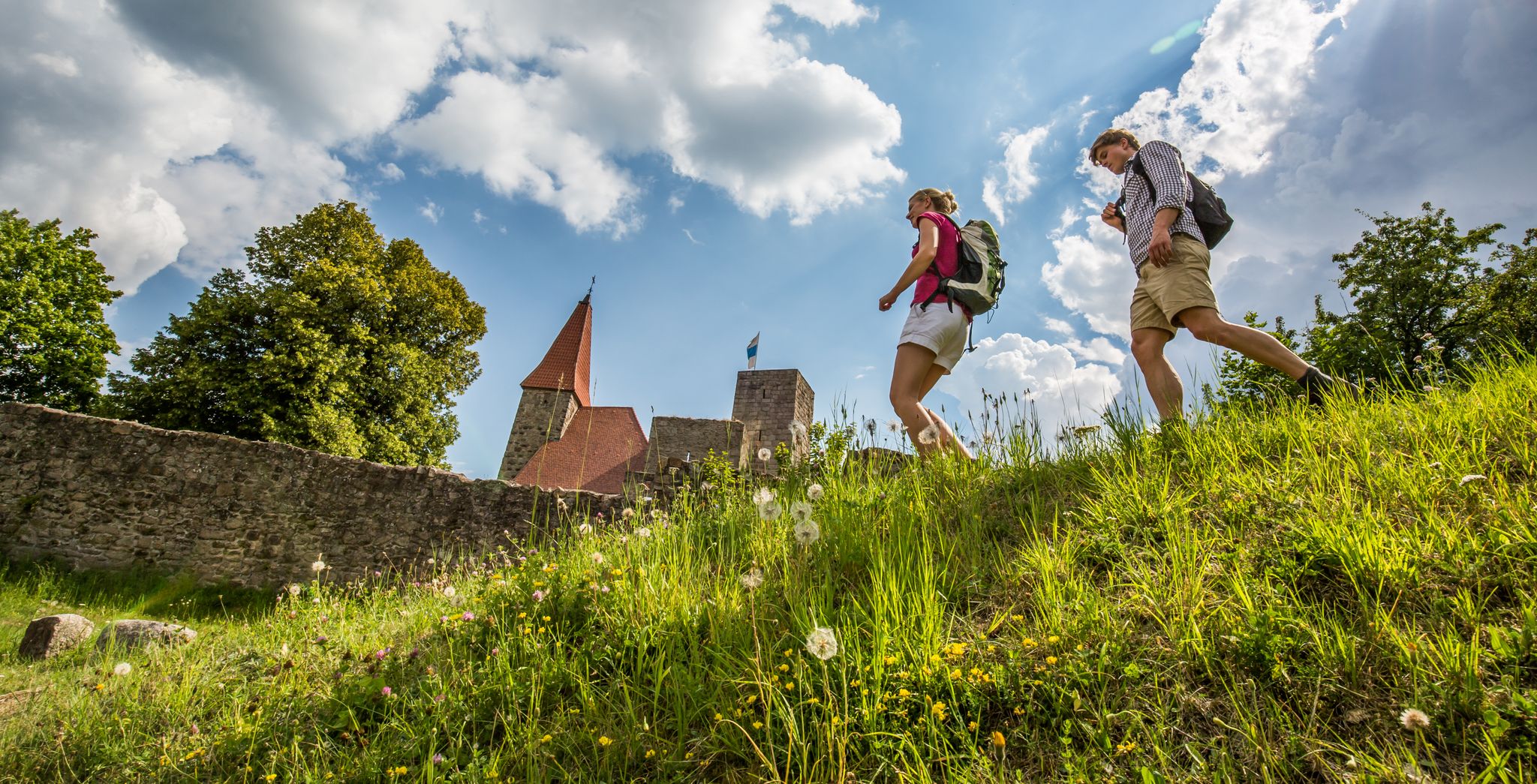
- The most popular castles is Stockenfels Castle Ruins, a castle that offers a…
Last updated: June 24, 2026
Stockenfels Castle Ruins
Highlight • Castle
Translated by Google •
Tip by

Stefling Castle
Highlight • Castle
Translated by Google •
Tip by

Sign up now to discover places like this
Get recommendations on the best single tracks, peaks, & plenty of other exciting outdoor places.
Sign up for free
Münchshofen Castle
Highlight • Castle
Translated by Google •
Tip by

Zangenstein Castle Ruins and Chapel
Highlight • Castle
Along the "Bavarian-Bohemian Friendship Cycle Path", which runs on the former railway line from Wölsendorf to Schönsee, there is only one place to stop during …
Translated by Google •
Tip by

Schwarzenfeld Castle
Highlight • Castle
Translated by Google •
Tip by

Sign up for free to discover even more castles around Wackersdorf.
Sign up for free
Already have an account?
Start today with a free account
Your next adventure awaits.
Login or Signup

Other adventures around Wackersdorf

Tips from the Community

Schloß Münchshofen Schloß Münchshofen had at least one medieval predecessor, of which at least one tower still existed in the 18th century, as a contemporary view shows. The year 1597 is chiseled into a door frame of the west wing. After severe damage during the Thirty Years' War, the complex was extensively redesigned in the second half of the 17th century. Schloß Münchshofen is one of the rare Renaissance-style monuments in the Upper Palatinate. The obelisks and volutes were added later. The complex forms a courtyard closed on three sides towards the Naab. In its floor plan, it is nine bays long. On the rear side, there is a smaller, three-sided arcaded courtyard. The steeply rising Münchshofener Berg here is provided with a two-story retaining wall. In the center of the complex stands the clock tower with the two-flight external staircase. The castle is directly connected to the former castle chapel. A gate passage to the economy yard, remains of the surrounding wall, and a brick barn have been preserved. In 1868, the castle passed to Julie Anna Reichsfreiin von Aretin, who brought it into the family of Reichsgrafen von Armannsperg. In 1910, Freiherr Alexander von Moreau, Royal Bavarian Chamberlain and Government Councilor in Bad Kissingen, acquired it. His son Maximilian Freiherr von Moreau continued the legacy. Today, the castle is privately owned by Antonius Freiherr von Moreau. The castle is privately owned and can only be viewed from the outside. An auction on September 27, 2011, was unsuccessful. Schloß Münchshofen is threatened by decay. Source: Excerpts from www.wikipedia.de
2
0

Good panoramic view, very nice!
2
0

Today, Schwarzenfeld Castle is a conference and recreation hotel with a beautiful park on the banks of the Naab.
3
0
Schwarzenfeld Castle The Schwarzenfeld seat was built and inhabited by Conrad Pullenhofer in 1372, before it became the property of the Plankenfelser noble family in 1389. They expanded the rather inconspicuous building and added four towers in the 15th century. In the 1580s, the Teuffel von Pirkensee family bought Schwarzenfeld. During the Thirty Years' War, the castle and the town were devastated. The castle's four towers were probably destroyed and have not been rebuilt since. From 1654, the imperial colonel Peter Pischer and his family were lords of Schwarzenfeld. In 1686, the baronial von Schneidau family took over Schwarzenfeld as a manor. In 1707, a fire destroyed the castle and the surrounding buildings, so that it had to be completely rebuilt elsewhere. A new building, called the "Plankenfelser Schlössl", was built on the foundations of the old castle. It was adapted to the period with stepped gables. In 1717, Schwarzenfeld was owned by the von Wildenau family, and in 1794 the property was purchased by the Counts of Holnstein. At the beginning of the 19th century, the main building was given its current shape by removing the stepped gables in favor of a hipped roof. Two small towers with onion tops were also added. In 1890 and 1892, Maximilian von Holnstein had the castle extended by Julius Hofmann to include the annex and the two towers in the style of the then popular historicist architectural style. At times, up to 160 workers were involved in the reconstruction, which gave the castle its final appearance. Surrounding buildings were also demolished to provide a view of the castle. Shortly after its completion, Count von Holnstein used the castle as a retirement home. He went blind in 1893 and died in the castle on February 1, 1895. After the Holnstein family moved out in 1907, the castle remained unused for a long time, except for short-term leases. The market acquired the castle in 1934, and after several changes of ownership, the main building of the castle burned down on the night of June 25, 1982 and lay abandoned for many years. In 1995, it was sold to private individuals Christine and Hans Dobler from Nabburg. They had the castle completely gutted, renovated and converted into a conference hotel, which opened in 1996 and is called "Hotel Schloß Schwarzenfeld". Source: Excerpts from www.wikipedia.de
3
0

Traditional village inn in Zangenstein Along the "Bavarian-Bohemian Friendship Cycle Path", which runs on the former railway line from Wölsendorf to Schönsee, there is only one place to stop during the weekday to Obervietach in the village inn Kellermann in the middle of Zangenstein. Since there are no signs along the cycle path, cyclists who do not know the restaurant pass the mostly open "refreshment station" unsuspectingly. Hence my tip: Simply cycle a few meters from the cycle path to the center of Zangenstein. Mondays are always closed, but guests are welcome on all other days of the week between 10am and 6pm. Edeltraud, a passionate landlady, provides her guests, who prefer to sit under the awning around the large table in the courtyard, with snacks and drinks. Franz, the landlord, is very knowledgeable about bikes and can help if someone has a problem with their bike. God preserve us beautiful village inns like that of the Edeltraud and Franz Stockerl families.
4
0
Traditional village inn Kellermann in Zangenstein Along the "Bavarian-Bohemian Friendship Cycle Path", which runs on the former railway line from Wölsendorf to Schönsee, there is only one place to stop during the weekday to Obervietach in the village inn Kellermann in the middle of Zangenstein. Since there are no signs along the cycle path, cyclists who do not know the restaurant pass the mostly open "refreshment station" unsuspectingly. Hence my tip: If you are hungry, thirsty or feel like taking a break, simply cycle a few meters from the cycle path to the center of Zangenstein. Mondays are always closed, but guests are welcome on all other days of the week between 10am and 6pm. Edeltraud, a passionate landlady, provides her guests, who prefer to sit under the awning in the courtyard around the large table, with snacks and drinks. Franz, the landlord, is quite knowledgeable about bikes and can help if someone has a problem with their bike. God preserve us beautiful village inns like that of the Edeltraud and Franz Stockerl families.
2
0
Traditional village inn "Kellermann" in Zangenstein, an ideal stop for cyclists: Along the "Bavarian-Bohemian Friendship Cycle Path", which runs on the former railway line from Wölsendorf to Schönsee, there is only one place to stop during the weekday to Obervietach in the village inn Kellermann in the middle of Zangenstein. Since there are no signs along the cycle path, cyclists who do not know the restaurant pass the mostly open "refreshment station" unsuspectingly. Hence my tip: If you are hungry or thirsty, just cycle a few meters from the cycle path to the center of Zangenstein. Mondays are always closed, but guests are welcome on all other days of the week between 10am and 6pm. Edeltraud, a passionate landlady, provides her guests, who prefer to sit under the awning around the large table in the courtyard, with snacks and drinks. Franz, the landlord, is quite knowledgeable about bikes and can help if someone has a problem with their bike. God preserve us beautiful village inns like that of the Edeltraud and Franz Stockerl families.
3
0
Branch Church of the Holy Cross and St. Margaretha The former palace chapel was completed in 1772. Today it is used as a branch church and is only open for services. The chapel is a simple Baroque style building. The hall building has a flat ceiling with stucco. The epitaph of the founder of the church, Joseph Antonius von Pachner zu Eggenstorff, has been preserved. The chapel's furnishings originally included the work Ecce homo, which is attributed to the school of Lukas Cranach the Elder. It is on permanent loan in the Historical Museum in Regensburg. Source: Wikipedia
4
0
Frequently Asked Questions
Which castles around Wackersdorf offer a glimpse into medieval history?
For a deep dive into medieval history, the Stockenfels Castle Ruins are highly recommended. They are hidden in the forest and offer a lot to discover. The Zangenstein Castle Ruins and Chapel also provide significant historical context, including a chapel.
Are there any castles near Wackersdorf that are family-friendly?
While many castles are ruins, Schwarzenfeld Castle, now a hotel, is noted as family-friendly. Its history dates back to the first millennium, offering an interesting visit for all ages.
What kind of outdoor activities can I do near these castles?
The region around Wackersdorf is excellent for outdoor activities. You can find numerous hiking trails, MTB trails, and gravel biking routes that often pass by or near historical sites and natural landscapes like the Oberpfälzer Seenplatte.
Are there any castles that are particularly scenic or offer good viewpoints?
The Stockenfels Castle Ruins are situated in a forest, with trails leading to them described as an additional treat, suggesting a scenic approach. The surrounding natural environment is a key part of its appeal.
Can I visit castles that are still well-preserved or restored?
While many are ruins, Schwarzenfeld Castle was rebuilt as a conference hotel after a fire, making it a well-maintained site. Münchshofen Castle follows the Renaissance style and is connected to a historically significant church, though it is privately owned and can only be viewed from the outside.
Are there any castles with religious significance or chapels?
Yes, the Zangenstein Castle Ruins include a chapel. Additionally, Münchshofen Castle is directly connected to a former castle chapel and the beautiful Church of Heilig Kreuz und St. Margarete. Hof am Regen Castle also features a Romanesque chapel with well-preserved Gothic wall paintings.
What are the best seasons to visit the castles around Wackersdorf?
The region's natural landscapes, including the Oberpfälzer Seenplatte, are beautiful year-round. Spring and autumn offer pleasant temperatures for exploring the ruins and trails. Summer is ideal for combining castle visits with activities at the nearby lakes. Even winter can be charming for a quiet, scenic walk to the ruins.
Are there any castles that are good for cyclists?
The area around the Zangenstein Castle Ruins and Chapel is particularly good for cyclists, especially those exploring the "Bayrisch-Böhmischer Freundschaftsradweg" (Bavarian-Bohemian Friendship Cycle Path). There's even a traditional village inn nearby that welcomes cyclists.
What do visitors enjoy most about the castles in this region?
Visitors appreciate the blend of historical discovery and the surrounding natural environment. The trails leading to ruins like Stockenfels Castle Ruins are often highlighted as an additional treat, offering scenic hikes alongside historical exploration.
Are there any hidden gem castles or less-known historical sites?
Hof am Regen Castle, with its rich history dating back to the 12th century and impressive tower, is a significant historical site. While not always open to the public, tours can be arranged for groups, and it's featured in local 'ghost hikes', offering a unique experience.
Is it possible to find food and drink near the castle sites?
Yes, near the Zangenstein Castle Ruins and Chapel, you'll find a traditional village inn, making it a pleasant stop. For Schwarzenfeld Castle, it is now a hotel, so amenities are available on-site.
Most popular routes around Wackersdorf
Most popular attractions around Wackersdorf

Get inspired with the komoot mobile app


Explore more
Looking for the best castles somewhere else? Discover other guides around Wackersdorf:
