The best cycling routes in Bois De La Casse À Robin
4.4
(101)
903
riders
111
rides
Touring cycling in Bois De La Casse À Robin offers a diverse landscape for outdoor enthusiasts. The region is characterized by a mix of agricultural plateaus, forest combes, and wetlands, providing varied terrain for cycling. Many Bois De La Casse À Robin cycling routes feature hard surfaces in some areas, suitable for touring bicycles. This natural environment supports an extensive network of Bois De La Casse À Robin bike trails.
Best touring cycling routes in Bois De La Casse À…
Last updated: July 11, 2026
5
riders
15.9km
01:18
80m
90m
Easy bike ride. Great for any fitness level. Mostly paved surfaces. Suitable for all skill levels.
3
riders
44.7km
02:38
260m
260m
Hard bike ride. Good fitness required. You may need to push your bike for some segments of this route.

Sign up for free
4
riders
Hard bike ride. Good fitness required. You may need to push your bike for some segments of this route.
3
riders
Hard bike ride. Good fitness required. You may need to push your bike for some segments of this route.
5.0
(1)
46
riders
43.3km
03:27
210m
210m
Hard bike ride. Good fitness required. You may need to push your bike for some segments of this route.
Get access to more routes and recommendations from other explorers.
Sign up for free
Already have an account?
Our route recommendations are based on thousands of hikes, rides, and runs completed by other people on komoot.
Start today with a free account
Your next adventure awaits.
Login or Signup


Tips from the Community

In summer, after 3 hours of cycling it's the best!
0
0

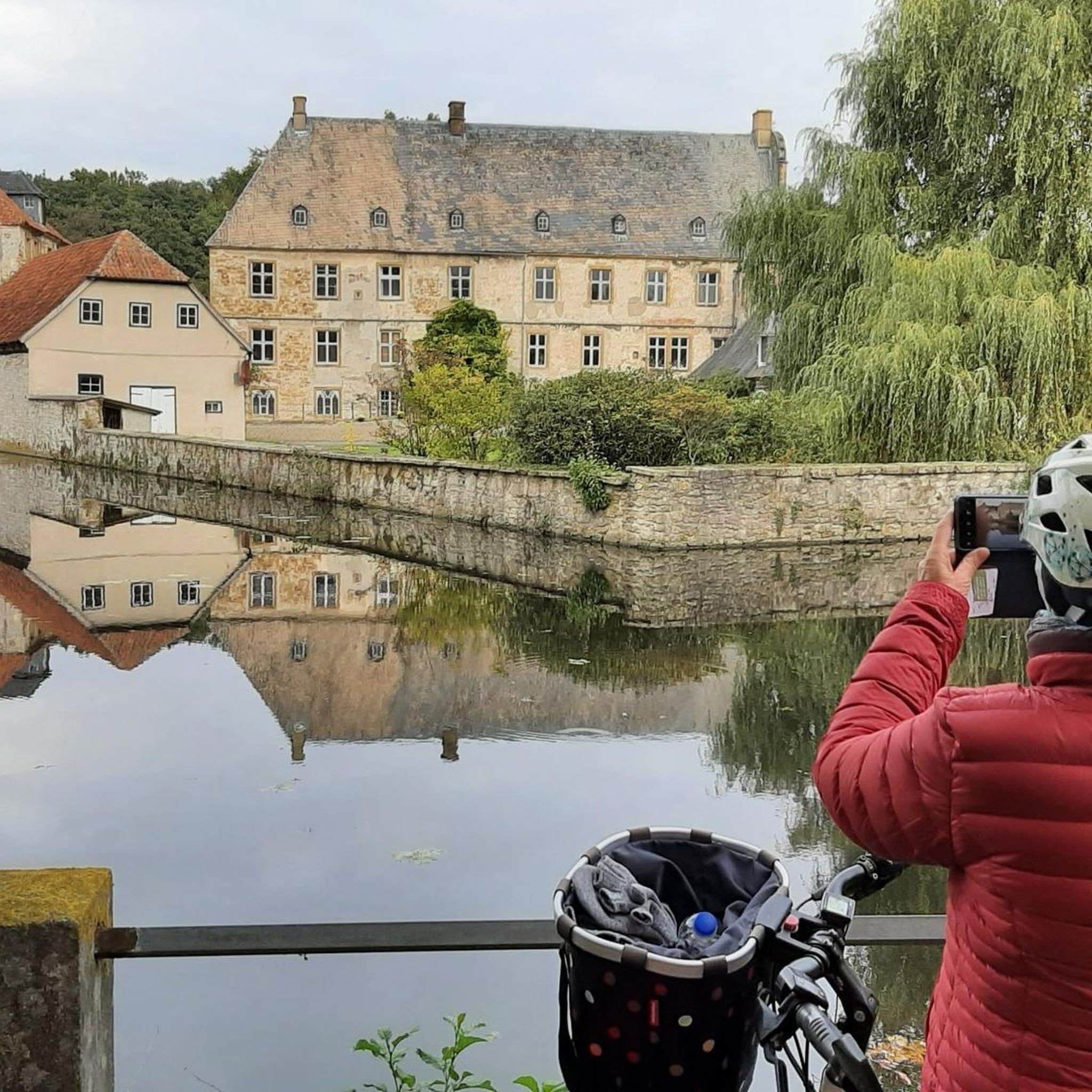
Courcoury is a natural island surrounded by the Charente and Seugne rivers, giving it a unique landscape setting between marshes and waterways, conducive to biodiversity and outdoor activities. It is also the only village in Charente-Maritime to have been awarded 4 stars by the "Villes et villages étoilés" label, recognizing its efforts to reduce light pollution through intelligent and environmentally friendly public lighting.
1
0
The Gallo-Roman amphitheater of Sainte, also called the Arena of Saintes, is an elliptical monument built between 40 and 50 AD, probably during the reigns of Tiberius and Claudius. It measures approximately 126 meters by 102 meters and could accommodate between 12,000 and 15,000 spectators, making it one of the largest and oldest amphitheaters in Gaul. Located in a natural valley called the "Arènes valley," it takes advantage of the topography to limit construction work, with stands backing onto the hill. The site has two monumental gates, the "Gate of the Living" to the east and the "Gate of the Dead" to the west, and has been the subject of a major restoration project since 2021 to preserve this exceptional heritage. Accessible on foot from the city center, it offers an immersion in Roman history with an educational trail and activities for families
1
0

I really enjoyed this ride. I’m 46, I did it on a 40 year old road bike, it’s more suited to a cyclocross bike!
0
0

The Basilica of Saint-Eutrope de Saintes is a true masterpiece of Romanesque art and amazes with its two superimposed choirs and its crypt, one of the largest in Europe.
5
0

The Saint-Quentin Church dates from the 12th century, but it bears numerous traces of constructions or partial reconstructions carried out in the 13th and 16th centuries. In 1610, a canon from Saintes provided the funds to redo the cover. His weapons appear on a keystone. On a strong square stump, erected to the left of the nave, rises an octagonal tower pierced on its third floor with a large window on each side and, on the smaller upper floor, small openings in the form of loopholes, all topped with an acute gable roof with eight spindles. The northern corner of the stump is accompanied by a square staircase tower at the bottom, cylindrical at the top and ending in a stone pyramid covered with jagged scales. The western facade, supported at the corners by two powerful buttresses, is decorated with a Romanesque portal with four semi-circular arches. The keys are bare. The three-bay nave has an eight-pointed pointed vault. The arches rest on four half-columns without capitals. The south wall is pierced with three Romanesque windows devoid of ornaments, the north wall with two smaller ones. A slight constriction of the nave is highlighted by two square pilasters against which are attached engaged columns which support a third-point arch. The recessed angles of the pilasters are garnished with smaller columns ending in hooked capitals. The third bay of the nave has a semi-circular opening on the left giving access under the bell tower to a porch communicating with the outside via a small square door. A large square and vaulted ossuary exists under this porch. The choir and the apse have pointed vaults. The left wall of the choir is pierced by a large bay window opening onto a stately chapel, itself vaulted in an ogive shape. The apse is lit by three semi-circular windows whose arches are simply decorated with a torus. A few meters from the north wall is a 15th century Hosannière cross.
0
0

The Santons people occupied Saintonge during the Gallic era. The Romans conquered the region and settled on the banks of the Charente. The town of Saintes (then designated Mediolanum), located at the western end of the Via Agrippa which linked Lyon (capital of the Three Gauls) to the Atlantic coast, quickly became monumental. At the time of Augustus (27 BC – 14 AD), the city probably became the capital of the province of Greater Aquitaine (Aquitania). This then extended from the Loire to the Pyrenees. Mediolanum is endowed with important public monuments: the amphitheater, the arch of Germanicus, the thermal baths and the aqueduct are still partially visible today. At the time of its peak (end of the 1st century – beginning of the 2nd century), the city must have had several thousand inhabitants. The amphitheater of Mediolanum is one of the earliest in Gaul. It is estimated that its construction began during the reign of Tiberius (14 – 37 AD), and was completed during the reign of Claudius (41 – 54 AD). Like many amphitheaters of the Roman Empire, that of Saintes was located on the outskirts of the ancient city in a chosen and developed site: the “vallon des Arènes”. Thanks to a favorable topography, the builders were relieved of part of their work, the amphitheater resting on the slope of the valley. This elliptical monument, with imposing dimensions (126 meters long and 102 meters wide), made it possible to accommodate several thousand spectators around bloody and violent representations such as gladiator fights (munera) or animal hunts (venationes ). In the 3rd century, the city declined and was entrenched within an impressive rampart, built from the remains of public and funerary monuments from previous decades. The amphitheater is then no longer used. Since the Middle Ages, it has been used, among other things, as a stone quarry. It was classified as a Historic Monument in 1840. It was from this moment that it was gradually restored. Today, despite the disappearance of the superstructures, the remains provide a faithful image of what this monument could have been at the time of its splendor. The site welcomes visitors all year round. Certain objects found during various excavations in the amphitheater district are visible at the archaeological museum.
1
0

To share with cars 🚗 on flood days
0
0
Frequently Asked Questions
How many touring cycling routes are available in Bois De La Casse À Robin?
Bois De La Casse À Robin offers a wide selection of touring cycling routes, with over 115 options to explore. These routes cater to various skill levels, ensuring there's something for everyone.
What are the typical difficulty levels of the touring cycling routes?
The routes in Bois De La Casse À Robin range from easy to difficult. You'll find approximately 42 easy routes, 49 moderate routes, and 24 difficult routes, providing options for all experience levels.
Are there any easy or family-friendly touring cycling routes?
Yes, there are numerous easy routes suitable for families or beginners. For instance, the Bike loop from Thénac is an easy 25.6 km path, and the Bike loop from Voiville is a shorter, easy 9.5 km option, perfect for a relaxed ride.
What kind of terrain can I expect while touring cycling in Bois De La Casse À Robin?
Bois De La Casse À Robin features a diverse landscape. You can expect a mix of agricultural plateaus, forest combes, and wetlands. Many routes include hard surfaces, making them well-suited for touring bicycles. This variety offers picturesque scenery and varied terrain.
What notable landmarks or points of interest can I see along the touring cycling routes?
Some routes pass by interesting landmarks. For example, the Chaniers chain bin – View of the Arch of Germanicus loop from Charente-Maritime offers views of the Arch of Germanicus. Another route, the Atypical bike path 😉 – Saint Blaise Church, Plassay loop from Charente-Maritime, passes by the Saint Blaise Church. The broader region also features historical points like castles, blending natural beauty with cultural interest.
Are there any circular touring cycling routes in Bois De La Casse À Robin?
Yes, many routes in the area are designed as loops, offering convenient circular tours. Examples include the Bois d'Allard – Bois de Thénac loop from Thénac, which is a 38.7 km trail, and the shorter Bike loop from Thénac.
What is the best time of year to go touring cycling in Bois De La Casse À Robin?
While specific seasonal conditions are not detailed, the diverse landscape of agricultural plateaus, forest combes, and wetlands suggests that spring and autumn would offer pleasant temperatures and vibrant scenery. Summer can also be enjoyable, but checking local weather forecasts is always recommended.
What do other touring cyclists say about the routes in Bois De La Casse À Robin?
The touring cycling routes in Bois De La Casse À Robin are highly regarded by the komoot community, holding an average rating of 4.5 stars from over 110 reviews. Cyclists often praise the varied terrain, which includes agricultural plateaus, forest combes, and wetlands, providing a rich and engaging experience.
Are there longer routes for experienced touring cyclists seeking a challenge?
Absolutely. For experienced touring cyclists, there are several challenging routes. The Chaniers chain bin – View of the Arch of Germanicus loop from Charente-Maritime is a difficult 44.7 km route, and the Atypical bike path 😉 – Saint Blaise Church, Plassay loop from Charente-Maritime is another difficult option spanning 40.1 km, offering significant distances and elevation gains.
Is it possible to reach Bois De La Casse À Robin by public transport for cycling?
While the region is well-suited for cycling, specific public transport links directly to trailheads within Bois De La Casse À Robin are not detailed. It's advisable to check local transport schedules for services to nearby towns like Thénac or Bourgoin-Jallieu, and plan your cycling route from there.
Where can I find parking for my car when visiting Bois De La Casse À Robin for cycling?
Specific parking locations for cyclists are not explicitly listed in the route details. However, when planning your tour, it's common to find parking in or near the starting points of routes, especially in towns or villages like Thénac or Voiville, which serve as common access points for the trails.
Most popular routes in Bois De La Casse À Robin

Get inspired with the komoot mobile app


Explore more
Browse the best Cycling routes in other regions.
