The best road cycling routes around Junça
5.0
(1)
82
riders
10
rides
Road cycling routes around Junça feature varied terrain, characterized by rolling hills and significant elevation changes. The region's landscape includes historical sites and river valleys, offering diverse backdrops for rides. Road cycling routes often pass by cultural landmarks, integrating historical interest with outdoor activity. The topography provides options ranging from moderate ascents to more demanding routes.
Best road cycling routes around Junça
- The most popular road cycling route is Almeida Castle – Castelo Rodrigo Village loop from Almeida, a…
Last updated: June 28, 2026
16
riders
89.2km
03:55
770m
770m
Moderate road ride. Good fitness required. Mostly well-paved surfaces and easy to ride.
13
riders
48.0km
02:12
490m
490m
Moderate road ride. Good fitness required. Mostly well-paved surfaces and easy to ride.

Sign up for free
5.0
(1)
9
riders
51.7km
02:39
690m
690m
Moderate road ride. Good fitness required. Some segments of this route may be unpaved and difficult to ride.
8
riders
Moderate road ride. Good fitness required. Mostly well-paved surfaces and easy to ride.
5
riders
58.9km
02:58
840m
840m
Moderate road ride. Good fitness required. Mostly well-paved surfaces and easy to ride.
Get access to more routes and recommendations from other explorers.
Sign up for free
Already have an account?
Our route recommendations are based on thousands of hikes, rides, and runs completed by other people on komoot.
Start today with a free account
Your next adventure awaits.
Login or Signup
Popular around Junça
Tips from the Community

The Alcázar Gate in Ciudad Rodrigo is one of the historic entrances to the city walls and has great heritage and scenic value. It was opened in 1507 by Antonio del Águila, warden of the Alcázar, when he built the defensive barrier in that area. It is located next to the Castle of Henry II of Trastámara, in the section of the wall facing the Águeda River, known as the Battery, due to the cannons that were once installed there.
4
0

Castelo Rodrigo holds millennia of history, from Paleolithic and Roman remains to the Muslim presence in the castle. Conquered and reconquered between the 12th and 13th centuries, it became a town and municipality under King Alfonso IX of León and passed definitively to Portugal in 1297, when King Dinis rebuilt and repopulated the castle. Marked by wars, charters, and restorations, it welcomed pilgrims on their way to Santiago and remains today one of the twelve Historic Villages of Portugal.
3
0
At the entrance to Castelo Rodrigo, the Monastery of Santa Maria de Aguiar rises among chestnut trees, founded in 1174 by King Afonso Henriques and handed over to the Cistercian Order. From the sober church to the monks' quarters and the guesthouse loggia with its 1704 coat of arms, everything testifies to centuries of faith and hospitality for pilgrims to Santiago. Despite the damage caused by the French invasions and its abandonment in 1834, the monastery's former beauty remains intact.
2
0
Malpartida stands serenely on the border plain, preserving in its main church, with its romantic bell tower, the most visible trace of its memory. But the past here goes far beyond the stones: from the cave tombs of the Nave de Mouros to the ancient watchtower of the Restoration, from the echoes of the Castilian sack of 1762 to the fierce battle against the French in 1808. Even generals left their mark; Ney established his headquarters here, and Brenier boldly escaped the siege of Almeida. Malpartida is, therefore, a land where every stone tells of battles, losses, and exploits.
2
0
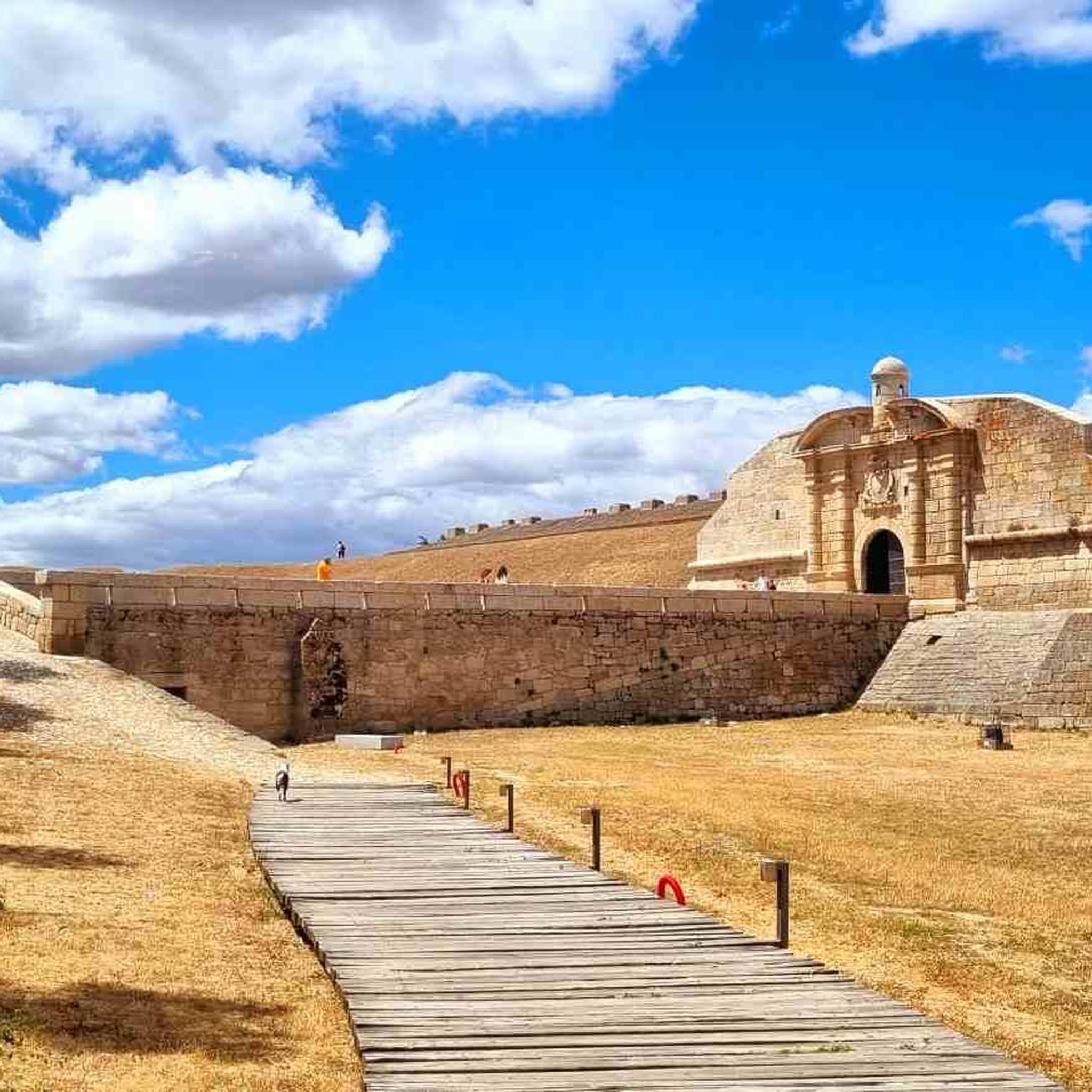
Almeida stands on the plateau like a table set for history: "Al-Mêda" was the name given to it by the Arabs. Previously, it had been a Lusitanian, Roman, and then Christian fort, conquered in 1190 and definitively Portuguese in 1297. Around the medieval castle grew the town, still marked by the Puerta do Sol. After the Restoration, the town transformed into a veritable war machine: the six-pointed star-shaped fortress, with bastions, ravelins, and underground galleries that served as both shelter and prison. It was the scene of decisive battles, devastated by the explosion of 1810 and contested in the liberal wars, always rising from the ruins.
3
0
For centuries, crossing the Côa Valley was only possible via two bridges: the São Roque Bridge and this one, the Ponte Grande, the gateway to Almeida. Built in the 17th century and renovated in the 19th century, the Ponte Grande was forever linked to the Battle of the Côa in 1810, when the Portuguese-British forces resisted the third Napoleonic invasion. Today, the bridge remains a silent guardian of that memory.
3
0
Castelo Mendo is a historic village with medieval roots, marked by two walls: the oldest, dating from the 12th century, surrounds the old town with its castle and the church of Santa Maria; the second, built by King Dinis in the 14th century, protected the Gothic suburb. The site was a living border between Portugal and León until the Treaty of Alcanices (1297), guarding strategic passages over the Côa River. At the entrance, two Vetón bellows, stone figures in the shape of wild boars, recall even more remote origins. Classified as a Property of Public Interest since 1984, Castelo Mendo today stands as a rare testament to the border region's history and Portuguese medieval splendor.
2
0
Freineda, a small border village, welcomed Lord Wellington between late 1812 and the spring of 1813, during the Peninsular War. In a stone house next to the church, the general established his headquarters, while the rest of the general staff dispersed to neighboring villages. Although described at the time as poverty-stricken, the village became the scene of major military decisions. Today, it remains modest and small, but keeps the memory of that time alive: on the facade of the house where Wellington lived, a plaque commemorates his visit.
2
0
Frequently Asked Questions
How many road cycling routes are available around Junça?
There are 7 road cycling routes documented around Junça on komoot, offering a range of experiences from easy loops to more challenging rides with significant elevation.
What kind of terrain and difficulty can I expect on road cycling routes in Junça?
Road cycling in Junça features varied terrain, characterized by rolling hills and significant elevation changes, making it suitable for cyclists seeking challenging climbs. You'll find options ranging from 3 easy routes to 3 moderate and 1 difficult route, ensuring there's something for different ability levels.
Are there any historical landmarks or interesting sights to see along the road cycling routes?
Yes, many routes integrate historical interest with outdoor activity. You can expect to pass by cultural landmarks such as the Almeida Castle, Castelo Mendo Historic Village, and the settlement of Vilar Formoso, offering scenic and cultural enrichment during your rides.
Are there any circular road cycling routes in Junça?
Yes, several routes are designed as loops. For example, the Almeida Castle – Castelo Rodrigo Village loop from Almeida is a popular moderate route connecting historical villages. Another option is the Fortress of Almeida – Almeida Castle loop from Fuentes de Oñoro, which features substantial elevation gain.
What is the best time of year for road cycling in Junça?
While specific seasonal recommendations are not detailed, the region's varied topography and outdoor attractions suggest that spring and autumn would likely offer the most pleasant temperatures for cycling, avoiding the extremes of summer heat or winter cold, especially given the challenging climbs.
Are there any easy road cycling routes suitable for beginners or a more relaxed ride?
Yes, Junça offers 3 easy road cycling routes. An example is the Vilar Formoso – Freineda loop from Vilar Formoso, which covers 27.5 km with moderate elevation, perfect for a less strenuous ride.
What do other road cyclists enjoy most about road cycling in Junça?
The area is highly rated by the komoot community, with an average score of 5.0 stars from more than 1 review. Cyclists often praise the varied terrain, the challenging climbs, and the integration of historical landmarks into the routes, offering a unique blend of sport and culture.
Are there any longer road cycling routes for endurance training?
For those seeking longer rides, the Castelo Mendo Historic Village – Vilar Formoso loop from Vilar Formoso is a substantial 58.9 km trail. This route leads through historical villages and open countryside, providing a good challenge for endurance.
Can I find routes that pass through different villages or towns?
Absolutely. Many routes are designed to connect and pass through various villages. For instance, the Almeida Castle – Castelo Rodrigo Village loop from Almeida links historical villages, allowing you to experience the local culture and scenery.
What are the elevation gains like on road cycling routes in Junça?
The routes around Junça are known for significant elevation changes. For example, the Fortress of Almeida – Almeida Castle loop from Fuentes de Oñoro features an elevation gain of over 720 meters, providing a substantial workout for cyclists.
Are there any routes that offer scenic viewpoints or picturesque landscapes?
The region's landscape, including historical sites and river valleys like the Côa River, offers diverse backdrops for rides. Routes often provide picturesque views of the countryside and historical architecture, especially those connecting villages or passing through elevated areas.
Is there parking available for cyclists at the start of routes?
While specific parking facilities for cyclists are not detailed, routes often start from towns or villages such as Almeida or Vilar Formoso, where public parking options are generally available. It's advisable to check local parking information for your chosen starting point.
Most popular routes around Junça
Most popular attractions around Junça

Get inspired with the komoot mobile app


Explore more
Browse the best Road cycling routes in other regions.
