The best cycling routes around Sainte-Foy-La-Longue
4.5
(324)
2,045
riders
85
rides
Touring cycling routes around Sainte-Foy-La-Longue traverse the Gironde department, offering a landscape shaped by the Dordogne River and its valley. The region features extensive vineyards and plum orchards, alongside rolling countryside with a mix of forests and fields. This area provides varied terrain suitable for exploring historic bastide towns and natural beauty by bicycle.
Best touring cycling routes around Sainte-Foy-La-Longue
- The most popular touring cycling route is Espiet tunnel – Canal latéral à la Garonne loop from Caudrot, a…
Last updated: July 13, 2026
4.3
(6)
43
riders
71.6km
04:20
600m
600m
Hard bike ride. Very good fitness required. Mostly paved surfaces. Suitable for all skill levels.
5.0
(5)
28
riders
40.3km
02:23
140m
140m
Moderate bike ride. Good fitness required. Mostly paved surfaces. Suitable for all skill levels.

Sign up for free
4.0
(4)
24
riders
24.5km
01:39
80m
80m
Hard bike ride. Great for any fitness level. You may need to push your bike for some segments of this route.
4.0
(2)
23
riders
94.1km
05:45
770m
770m
Hard bike ride. Very good fitness required. Mostly paved surfaces. Suitable for all skill levels.
5.0
(1)
13
riders
73.2km
04:29
550m
550m
Hard bike ride. Very good fitness required. Mostly paved surfaces. Suitable for all skill levels.
Get access to more routes and recommendations from other explorers.
Sign up for free
Already have an account?
Our route recommendations are based on thousands of hikes, rides, and runs completed by other people on komoot.
Start today with a free account
Your next adventure awaits.
Login or Signup


Tips from the Community

Lively small market town, with an arcaded market square
0
0

Majestic in its size and appearance, the Loubens mill is one of the most remarkable in the Entre-deux-Mers region. Its installation seems to date back to the 11th century. A square, medieval tower, built on an island, bears similarities to the Bagas mill located 2 km downstream. It includes three sets of millstones still in place. However, it is not a fortified building; it is a weir mill. To the north construction, a bridge with a double row of arches was added in the 18th century, containing two more pairs of millstones and a fulling mill (a machine used not for grinding grain, but for fulling textiles. These mills were often called "beating mills"). This southern part of the mill earned it the name "little Chenonceau". The mill has been classified as a Historic Monument since 2000.
0
0

Beautiful view of the ivy-covered mill.
1
0

Very pretty and well decorated, the prices are super affordable and the setting is ideal for a break
0
0

Sauveterre-de-Guyenne is a bastide. A bastide is a type of French medieval town, founded in the 13th and 14th centuries, primarily in southwestern France. A bastide is characterized by a rectangular street pattern that divides the town into eight blocks around a central market square. The Treaty of Paris (1229) prohibited the building of walls around new towns. Many bastides were provided with some form of fortification, such as gates, after their founding to provide some protection during turbulent times. Most bastides had only local significance and did not develop into large towns. As a result, many bastides, such as that of Sauveterre-de-Guyenne, have been preserved in their original state.
1
0

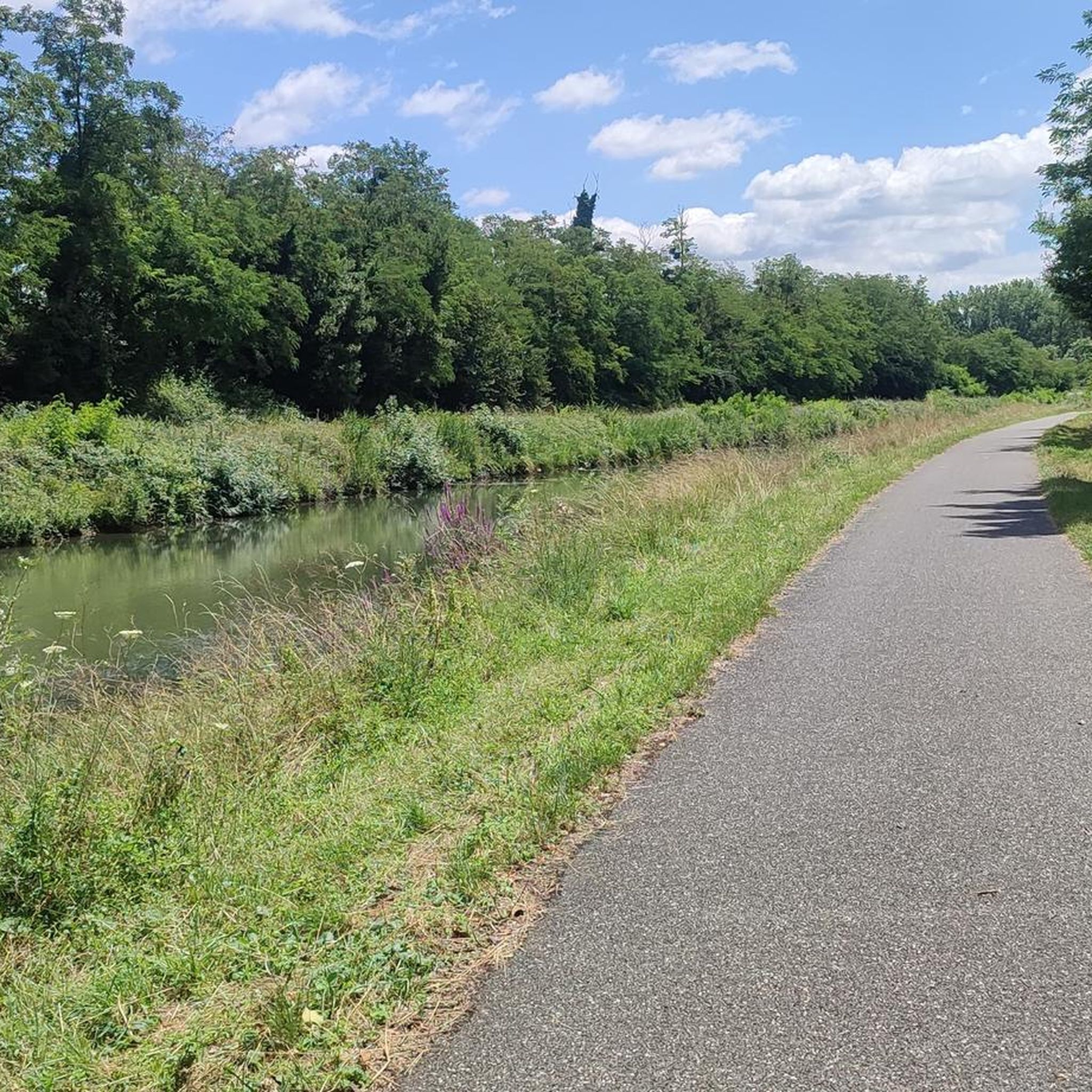
The route along the canal is always beautiful, no matter which canal. There's always something very calming about it.
1
0
Very interesting flood marks, sometimes you can't even imagine how high the water once was.
1
0
Beautiful cycle path along the canal.
1
0
Frequently Asked Questions
How many touring cycling routes are available around Sainte-Foy-La-Longue?
There are over 80 touring cycling routes around Sainte-Foy-La-Longue, offering a wide range of options for exploring the region's landscapes and historical sites.
What is the general difficulty level of touring cycling routes in this region?
The routes around Sainte-Foy-La-Longue cater to various skill levels. You'll find 19 easy routes, 41 moderate routes, and 23 more challenging routes, ensuring there's something for everyone from casual riders to experienced touring cyclists.
Are there family-friendly touring cycling routes near Sainte-Foy-La-Longue?
Yes, the region offers several family-friendly options. The Canal latéral à la Garonne – Fontet Marina loop from Caudrot is a moderate 40.3 km path that provides pleasant riding along the canal. Additionally, the 'Véloroute Voie Verte' is an ideal path for family bike rides, often featuring gentle riverside sections.
What historical sites or landmarks can I explore while cycling around Sainte-Foy-La-Longue?
The area is rich in history. You can cycle through charming bastide towns like Sainte-Foy-la-Grande itself, or visit nearby historical sites. Notable attractions include the Château de la Benauge, the Roman villa at Montcaret known for its mosaics, and the medieval town of Eymet. The Sauveterre-de-Guyenne bastide is also a fascinating stop.
Are there any scenic viewpoints or natural features to look out for on the cycling routes?
Absolutely. Many routes wind along the picturesque Dordogne River, offering views of its tranquil waters and diverse wildlife. You'll also cycle through extensive vineyards, including those of Saint-Emilion and Bergerac, and plum orchards. The rolling countryside provides a mix of forests and fields, ensuring varied and beautiful scenery.
Can I cycle along canals or rivers in Sainte-Foy-La-Longue?
Yes, the region is well-suited for riverside and canal cycling. The Dordogne River offers pleasant rides along its banks, and the Garonne Lateral Canal is a prominent feature, with routes like the Espiet tunnel – Canal latéral à la Garonne loop from Caudrot exploring its scenic path.
What do other cyclists say about the routes around Sainte-Foy-La-Longue?
The touring cycling routes in Sainte-Foy-La-Longue are highly rated by the komoot community, with an average score of 4.6 stars from over 360 reviews. Cyclists often praise the quiet countryside, the beauty of the Dordogne River valley, and the charming historical towns encountered along the way.
Are there any circular touring cycling routes in the area?
Yes, many routes are designed as loops, allowing you to start and end in the same location. Examples include the Le Moulin de Loubens – Canal latéral à la Garonne loop from Caudrot, a challenging 94.7 km ride, and the View of Saint-Macaire – Church in Langon loop from Caudrot, a shorter 24.5 km option.
What is the best time of year to go touring cycling in Sainte-Foy-La-Longue?
The region is generally pleasant for cycling from spring through autumn. Spring offers blooming landscapes and mild temperatures, while autumn provides beautiful colors in the vineyards and forests. Summers can be warm, so early morning or late afternoon rides are often preferred.
Are there opportunities for food and drink stops along the cycling routes?
Yes, the region is known for its gastronomy and wine. Many routes pass through villages and towns where you can find cafes and restaurants. Some vineyards, like Château Carbonneau, even offer food platters and wine tastings, making for excellent midway stops on longer rides.
Can I find routes that pass by castles?
Certainly. The area is dotted with historical châteaux. You can find routes that lead to or pass by impressive structures such as Benauge Castle, Château du Hamel, and Château de La Réole, offering a glimpse into the region's rich past.
What kind of terrain can I expect on the touring cycling routes?
The terrain is varied, ranging from relatively flat paths along the Dordogne River and canals to rolling countryside with gentle hills through vineyards and forests. While some routes are quite flat, others, like the Cadillac Gate – Verdelais loop from Caudrot, feature more significant elevation changes, offering a good workout.
Most popular routes around Sainte-Foy-La-Longue
Most popular attractions around Sainte-Foy-La-Longue

Get inspired with the komoot mobile app


Explore more
Browse the best Cycling routes in other regions.
