Attractions and Places To See around Lhospitalet - Top 20
Best attractions and places to see around Lhospitalet include historical and cultural sites within the Lot department of the Occitanie region. This small commune is situated near Cahors, a city known for its significant landmarks. The area features a mix of medieval architecture and scenic viewpoints, reflecting its rich history and geographical setting. Visitors can explore sites that highlight the region's past and natural beauty.
Best attractions and places to see around Lhospitalet
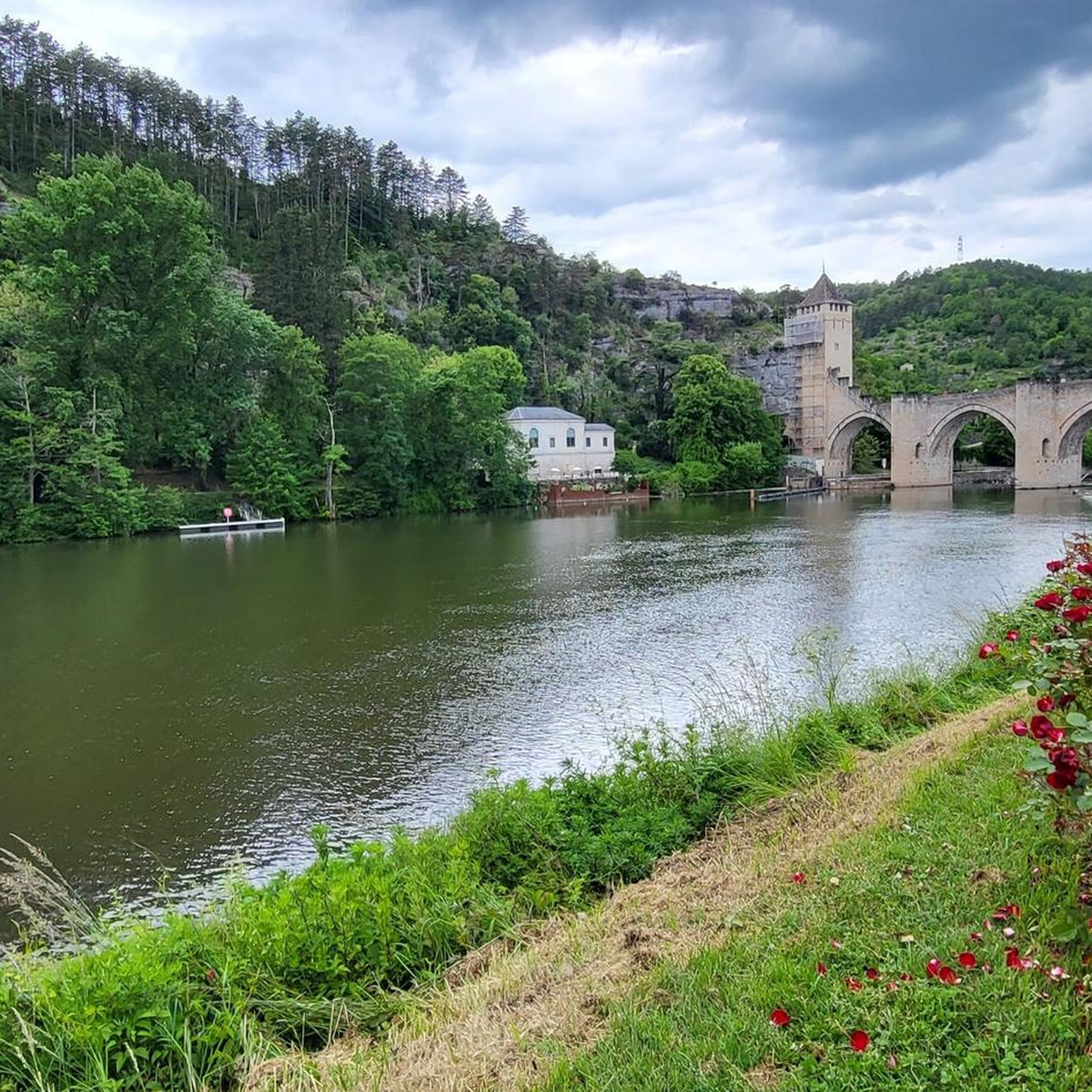
- The most popular attractions is Valentré Bridge…
Last updated: October 23, 2026
Valentré Bridge
Highlight • Monument
Showing Translation
Tip by

Saint Stephen's Cathedral
Highlight • Religious Site
Construction began in the late 11th century, but it is said to have taken another 400 years to complete.
Translated by Google •
Tip by

Sign up now to discover places like this
Get recommendations on the best single tracks, peaks, & plenty of other exciting outdoor places.
Mont Saint-Cyr viewpoint overlooking Cahors
Highlight • Viewpoint
Translated by Google •
Tip by

Cahors Railway Bridge
Highlight • Bridge
Translated by Google •
Tip by

water clock
Highlight • Other
Translated by Google •
Tip by

Sign up for free to discover even more attractions around Lhospitalet.
Already have an account?
Start today with a free account
Your next adventure awaits.

Tips from the Community

An essential monument of the Occitanie region, it is distinguished by its large domes on pendentives, among the largest in France. The cathedral is doubly classified: as a Historic Monument in France and as a UNESCO World Heritage Site as part of the Routes of Santiago de Compostela.
0
0
In Cahors, there isn't strictly a water clock (or clepsydra), but the city is home to a famous and unusual monumental ball clock. Located on Place Saint-Urcisse, in the heart of the old town, this kinetic work of art is often associated with water as it sits in the middle of a U-shaped fountain. It is a monumental mechanical clock weighing 2 tons and standing 3.5 meters high. It operates without electricity for its pendulum movement: its energy comes exclusively from the weight of 54 steel pinball balls (weighing 80 grams each) descending along metal rails. An unusual performance: The mechanism consumes 640 grams of balls per minute, or nearly 921 kg per day. The balls travel approximately 18,000 km per year within the structure. Once they reach the bottom, the balls are automatically rewound thanks to a small mechanical system.
0
0

Two large domes dominate the Romanesque nave. They represent the most extraordinary example of the so-called "Aquitanian" architectural style: 16 meters in diameter and 32 meters high; only the Hagia Sophia in Istanbul has a taller dome. Also noteworthy is the small, golden church of Saint-Svair, with its large statue of Emperor Charlemagne, who presented it to the church of Cahors.
2
0

Worth seeing cathedral in Cahors.
0
0

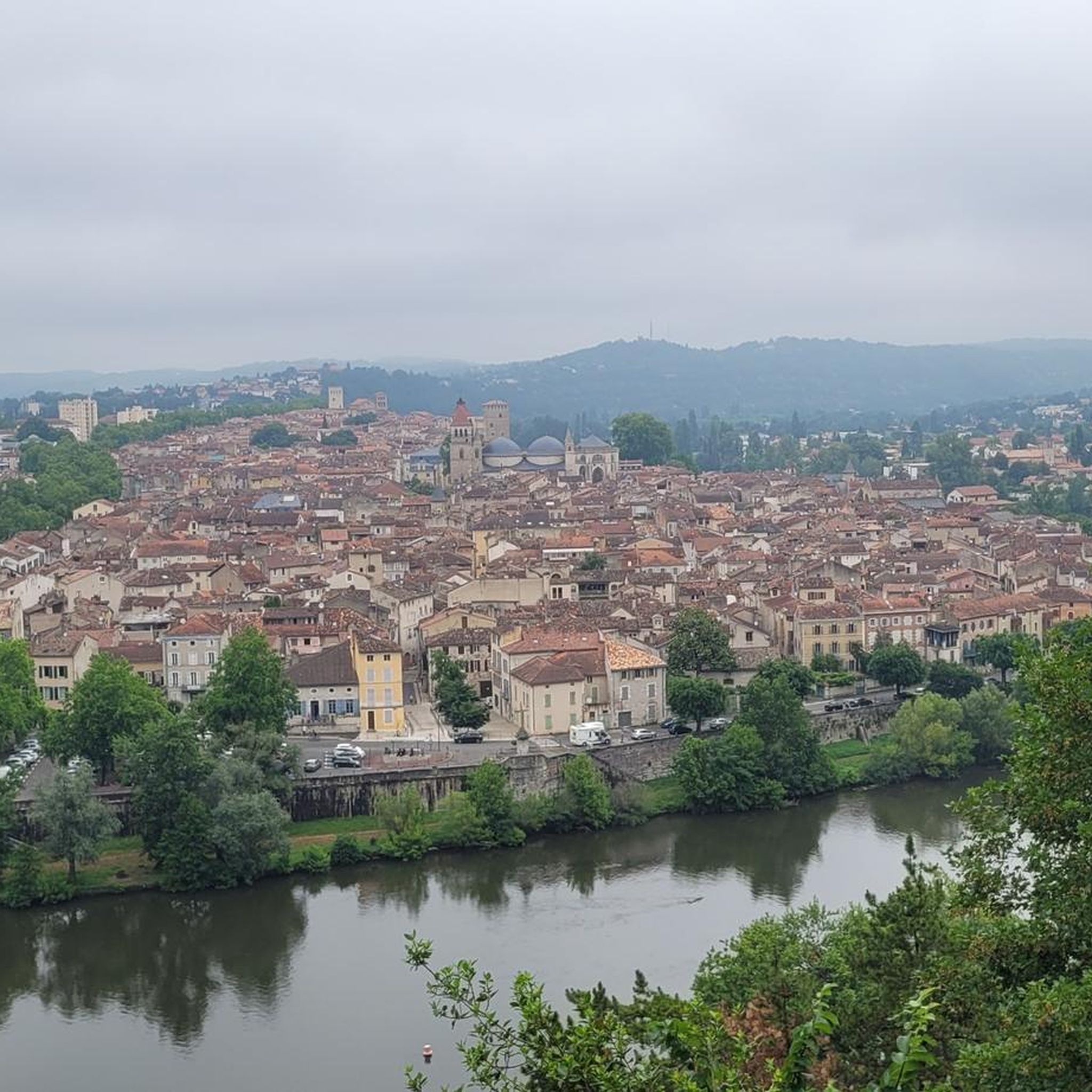
Here the hiker or pilgrim has the town of Cahors and the river Lot at his feet, a truly picture-book view.
1
0

This St. Etienne Cathedral impressed us deeply again! The building dates back to the 11th century and is very unique with its two domes. Only in Perigeux is there a cathedral with similar architecture. The special feature is the Saint Coiffe, a fabric relic in which the veil of Jesus from the tomb is venerated. In one dome you can see frescoes of saints, in the middle of St. Stephen, the first martyr of the Christians in Jerusalem. During our visit (September 2024), pictures by the late impressionist painter Henri Martin were projected onto the other gray dome. It is worth spending some time in the cathedral!
1
0

This railway bridge was built on the Montauban-Brive line, an axis declared of public interest because it corresponded to the shortest route between Toulouse and Paris. Built at an angle to the riverbed, it combines traditional techniques and implementations typical of industrial architecture. The structure was built between 1880 and 1883 by the engineers Jean LANTEREIS and Jean-Louis LACAZE, employed by the Fives-Lille company. It consists of 5 arches with an opening of 36 meters. The pillars decorated with pilasters are made of hewn Cantal granite. The industrially manufactured metal trusses were melted down in the Fourchambault workshops on behalf of the Orléans company and transported to the location by rail.
1
0
This monumental ball-bearing clock was donated to the city of Cahors in 1997. Designed by Michel Zachariou, it took two years of work. A total of 54 pinball machines, each weighing 80 grams, keep the clock ticking. According to the designer, it can last forever as long as it is maintained.
0
0
Frequently Asked Questions
What historical sites can I explore near Lhospitalet?
The region around Lhospitalet is rich in history. You can visit the impressive Valentré Bridge in Cahors, a UNESCO World Heritage site known for its defensive architecture. Also in Cahors is Saint Stephen's Cathedral, an 11th-century religious building featuring Romanesque and Gothic elements. Further afield, consider the Romanesque architecture of Moissac Abbatiale St Pierre or the prehistoric Dolmen de Pech-Laglaire near Gréalou.
Are there any family-friendly attractions in the Lhospitalet area?
Yes, several attractions are suitable for families. The Valentré Bridge and Saint Stephen's Cathedral in Cahors are both listed as family-friendly historical sites. Additionally, the Mont Saint-Cyr viewpoint overlooking Cahors offers panoramic views and picnic areas, perfect for a family outing.
Where can I find the best panoramic views near Lhospitalet?
For stunning panoramic views, head to the Mont Saint-Cyr viewpoint overlooking Cahors. From this elevated spot, you can appreciate the city's unique location within a large bend of the Lot river and enjoy the surrounding landscape. It's also a great place for a picnic.
What outdoor activities are available near Lhospitalet?
The area around Lhospitalet offers various outdoor activities. You can explore numerous hiking trails, with options ranging from easy to difficult, such as the 'Trigodina Guesthouse loop from Lhospitalet' (10.4 km, moderate). For cyclists, there are road cycling routes like the 'Quercy Blanc Loop via Castelnau-Montratier' (48.9 km, moderate). Runners can also find dedicated trails, including a 'Running loop from Lhospitalet' (10.3 km, moderate). Find more details on these activities in the hiking, road cycling, and running guides.
Are there any easy hiking trails near Lhospitalet?
Yes, there are easy hiking options available. For example, the 'Cézac Loop – Theron fountain loop from Pern' is an easy trail spanning approximately 5.5 km. You can find more hiking routes and their difficulty levels in the hiking guide for Lhospitalet.
What are some notable villages or towns to visit near Lhospitalet?
Beyond Cahors, several charming villages are worth exploring. Castelnau-Montratier, about 11 km away, features a historic village with an imposing church. Montpezat-de-Quercy, 15 km away, boasts arcaded houses and a 14th-century collegiale. Montcuq, 16 km to the west, is a pleasant small town with a large church, and Albas, on the Lot river, is known for its wine festival.
Where can I experience local culture and markets near Lhospitalet?
To experience local culture, visit the markets in nearby towns. Cahors, Montpezat-de-Quercy, Montcuq, Catus, Prayssac, Caussade, Septfonds, Puy-l'Eveque, and Limogne-en-Quercy all host various markets on different days of the week, offering local produce and goods. These markets are excellent places to immerse yourself in the regional atmosphere.
What are some unique architectural sights in the area?
Beyond the famous Valentré Bridge and Saint Stephen's Cathedral, you can also observe the Cahors Railway Bridge. Built between 1880 and 1883, it's a significant example of industrial architecture from that period, combining traditional techniques with metal trusses.
What do visitors particularly enjoy about the attractions around Lhospitalet?
Visitors frequently praise the historical significance and architectural beauty of the sites. The Valentré Bridge is often highlighted as an emblematic and impressive monument. The panoramic views from Mont Saint-Cyr are also very popular, offering a unique perspective of Cahors and the Lot valley, often enjoyed as a picnic spot.
Are there any memorials or monuments to visit?
Yes, you can visit the Monument des Morts. This memorial commemorates the fallen of the world wars, serving as a poignant reminder of the region's history and sacrifices.
Can I find prehistoric sites near Lhospitalet?
Yes, for those interested in prehistory, the Dolmen de Pech-Laglaire near Gréalou is a notable megalithic monument located approximately 41 km from Lhospitalet. It offers a glimpse into ancient human activity in the region.
What is the best way to explore the Lot river valley near Lhospitalet?
The Lot river valley can be explored through various activities. The Mont Saint-Cyr viewpoint provides an excellent overview of the river's course around Cahors. You can also find villages like Albas situated directly on the Lot river, offering a chance to experience its charm up close, perhaps during its annual wine festival.
Most popular routes around Lhospitalet

Get inspired with the komoot mobile app


Explore more
Still not found the Highlight you’re looking for? See guides of the top attractions in other regions:
