The best road cycling routes around Thivars
4.4
(134)
3,722
riders
660
rides
Road cycling around Thivars is characterized by the flat to gently undulating landscapes of the Beauce plain, offering expansive views of cultivated fields. The region is in proximity to the Eure River Valley, which provides more lush, riverside scenery. To the west, the Perche Regional Natural Park introduces rolling hills and woodlands, offering varied topography. This terrain is highly suitable for road cycling, with mostly well-paved surfaces and minimal elevation gain.
Best road cycling routes around Thivars
- The most popular…
Last updated: July 2, 2026
4.0
(1)
10
riders
35.7km
01:23
110m
110m
Easy road ride. Great for any fitness level. Mostly well-paved surfaces and easy to ride.
4.5
(2)
10
riders
Easy road ride. Great for any fitness level. Mostly well-paved surfaces and easy to ride.

Sign up for free
9
riders
Moderate road ride. Great for any fitness level. Some segments of this route may be unpaved and difficult to ride.
4
riders
52.8km
02:04
160m
160m
Moderate road ride. Good fitness required. Mostly well-paved surfaces and easy to ride.
5
riders
Moderate road ride. Good fitness required. Mostly well-paved surfaces and easy to ride.
Get access to more routes and recommendations from other explorers.
Sign up for free
Already have an account?
Our route recommendations are based on thousands of hikes, rides, and runs completed by other people on komoot.
Start today with a free account
Your next adventure awaits.
Login or Signup

Tips from the Community

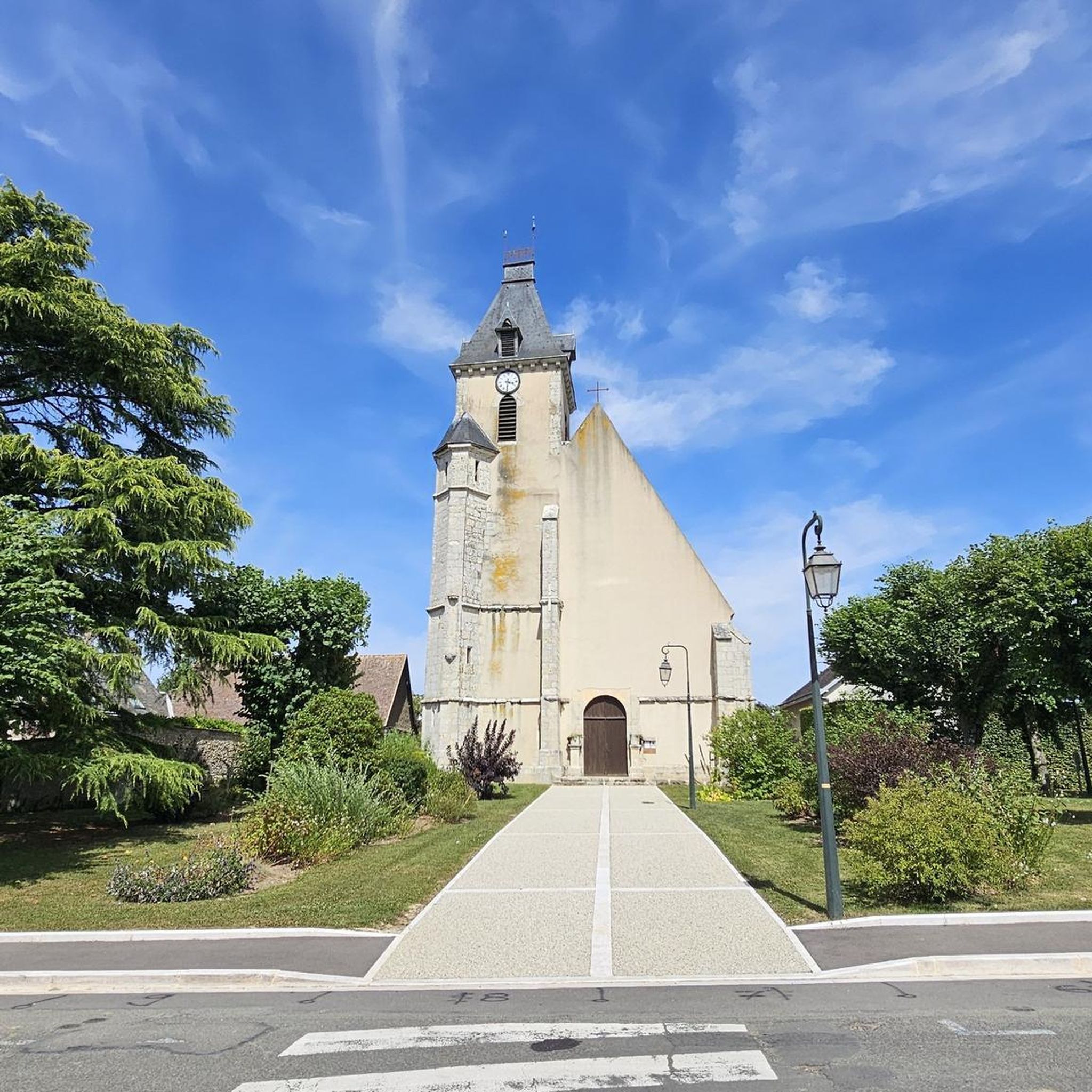
Of Romanesque origin, the church, surrounded by a cemetery, has a curious bell tower supported by machicolations and uprights of sandstone, making it one of the most unique in the region. Perhaps it was originally a bell gable, later augmented by a platform supported by these machicolations? In front of the entrance, a small building called a "caquetoire" (a small meeting place) allows the faithful to gather and converse. Inside the church, the furnishings date from the 18th and 19th centuries: a marble high altar and its gray-painted wooden altarpiece (18th century) – a painted wooden altarpiece of St. Joseph (late 18th or early 19th century) an altarpiece for the altar of the Virgin Mary (19th century) a baptismal font in red-veined marble (19th century) a waxed wooden pew (18th century) a waxed wooden choir stall upholstered in velvet paintings: the Assumption of the Virgin Mary by Octave Hauser (1839) and the Annunciation (18th century) The stained-glass windows date from 1874. The church and the eclipse A bit of history: The parish, established in the 13th century, was part of the deanery of Courville. The church's patron saint, Luperche or Luperchius, gave his name to the village. We must go back to the 4th century to find the first trace of this saint: At that time, Dacius, governor of the part of Spain that included Catalonia, Aragon, and the Kingdom of Valencia, was one of the most cruel ministers of persecution. Incited by the emperors Diocletian and Maximilian, he had eighteen confessors of Jesus Christ executed in the city of Zaragoza. In their honor, the poet Prudentius wrote hymns, and among these confessors, a certain martyr named Luperche became the patron saint of our church.
0
0
The oldest document mentioning the Church of Saint-Martin in Fresnay-le-Comte is the charter of Renaud de Mouçon, Bishop of Chartres, confirming the possessions of the Abbey of Marmoutier, near Tours. This charter dates only from the last years of the 12th century, but the church's foundation may have already existed at that time. The building comprises two parts of roughly equal size and from different periods. The older part, roughly corresponding to the nave, is of a rather undefined style. The west portal, with its pointed arch devoid of any decoration, may date back to the 12th or 13th century, as may the first window of the nave, on the right. In the north wall, there is a small, walled-up doorway, whose lintel, adorned with an accolade, is no earlier than the 15th century, but the relieving arch above it appears older, perhaps from the 12th century. Half of the church, including almost the entire chancel, is from a more recent period and easily recognizable. The polygonal apse and the windows with their flamboyant tracery of late design indicate the very end of the 15th century. An inscription on one of the chancel's tie beams gives a precise date: In the year 1529, this chancel was completely rebuilt. The statue of the Virgin Mary was baptized during the Mass of October 30, 2021, by Father Pierre Paul. This statue, moved from the Chapel of the Three Marys in Mignières, was restored by Mr. Martial Moulin, a sculptor from Chartres.
0
0
The Church of Saint-Hilaire in Montainville is a religious monument located in the commune of Les Villages Vovéens. This place of worship, whose construction period is not specified in available sources, is an integral part of the local architectural landscape. Its name, Saint-Hilaire, suggests a dedication to a Christian saint, a common practice for medieval and modern churches, but no further information allows us to determine its exact origin or historical specifics. In the Centre-Val de Loire region, parish churches like Saint-Hilaire played a central role in community life, serving as places of prayer, gatherings, and social organization. Lacking precise data on this monument, it can be assumed that it fulfilled the traditional functions of rural religious buildings: celebrating religious services, administering the sacraments, and maintaining connections among the inhabitants. The dominant agricultural activities of the region often influenced the maintenance and use of these places, although it is not possible to assert a direct link with this particular church.
0
0

This church in Meslay-Le-Vidame, whose architecture reflects the formal language of antiquity, was dedicated to the patron saint of Saint Etienne. He was one of the first seven deacons of the original Jerusalem church and, according to the biblical accounts in the New Testament, the first martyr (martyr) of early Christianity. The church commemorates his death on Boxing Day, December 26th. As the Acts of the Apostles recounts: When Stephen recounted his vision of the open heavens, "And he, full of the Holy Spirit, looked up into heaven and saw the glory of God, and Jesus standing at the right hand of God" (Chapter 7, Verse 55), the people were so outraged that they drove him out of the city and stoned him.
0
0


Unfortunately, the church was not accessible when I visited (mid-September 2024). You could only look in through a gate and the dance of death depictions on the left side were not really visible. In front of them were transparencies with skeleton drawings. Maybe those were the depictions...
0
0
The Saint-Germain de Morancez church could date from the 10th century. Its cut stone facade is punctuated by four buttresses framing a portal. This is composed of three concentric arches resting on engaged columns, decorated with capitals. The zigzag decoration of the arches confirms a dating before the 12th century. The occulus surmounting the porch illuminates a semi-circular vaulted nave. This was enlarged with an aisle built much later and where there is an altar dedicated to the Virgin. The furniture remains simple but not without interest with its benches enclosed in painted wood. However, it is worth mentioning a sculpted pulpit from the 18th century. In 1707, the prior-parish priest of Morancez was Nicolas Courvoisier, religious of the Saint-Jean-en-Vallée abbey. A poet, he is notably the author of a Latin ode addressed to the people of Chartres on the death of Paul de Godet des Marais1. He died on May 14, 1742 in Morancez and was buried in the church. (his tombstone remains to be identified.) Although Morancez was a modest parish, in 1851 it benefited from a prestigious gift from Jérôme Bonaparte, brother of Napoleon I, governor of Les Invalides, then in residence at the Château de Gourdez. He offered the church a painting, Moses makes water flow from the rock, painted by Giovanni Francesco Romanelli between 1657 and 1660. This Italian artist had been called to decorate the cabinet called "At the water's edge" of the apartment of Queen Anne of Austria at the Louvre. He created a decor, now dismembered, composed of a set of six paintings devoted to the story of Moses, including the work, classified as a Historic Monument, preserved in our church. Another interesting work which could be attributed to the school of Philippe de Champaigne represents Jesus among the doctors. These two paintings benefited from a restoration in 1998
0
0

Beautiful bay window with spiral staircase in it; unfortunately not available to visit
1
0
Frequently Asked Questions
What kind of terrain can I expect when road cycling around Thivars?
The region around Thivars is primarily characterized by the flat to gently undulating landscapes of the Beauce plain, offering expansive views of cultivated fields. You'll find mostly well-paved surfaces with minimal elevation gain, making it ideal for comfortable road cycling. Closer to the Eure River Valley, you can expect more lush, riverside scenery, and to the west, the edges of the Perche Regional Natural Park introduce slightly more varied topography with rolling hills.
Are there road cycling routes suitable for beginners or families in Thivars?
Yes, the largely flat terrain of the Beauce plain makes Thivars an excellent destination for beginners and families. Many routes feature minimal elevation gain and well-maintained surfaces. For example, the Ponds of Fontenay sur Eure – Fontenay-sur-Eure Church loop from Barjouville is an easy 28.5-mile route, perfect for a leisurely ride.
What are some scenic highlights I can experience on a road bike around Thivars?
Road cycling around Thivars offers diverse scenery. You can enjoy expansive views across the open agricultural plains of Beauce, or explore the greener, more lush landscapes of the Eure River Valley. Routes also touch upon the edges of the Perche Regional Natural Park, known for its rolling hills and woodlands. For a route that showcases the agricultural landscape, consider La fondation d'Aligre loop from Ver-lès-Chartres.
Can I find longer road cycling routes for endurance training near Thivars?
Absolutely. While many routes are easy, the region's extensive network allows for longer distances by combining paths or choosing routes like the Ponds of Fontenay sur Eure – Fontenay-sur-Eure Church loop from Barjouville, which covers nearly 28.5 miles. The generally flat terrain is conducive to maintaining a steady pace over extended periods, making it suitable for long-distance training.
What attractions can I visit by bike from Thivars?
Thivars' proximity to Chartres makes it easy to cycle to significant cultural sites. You can reach the magnificent Chartres Cathedral, a UNESCO World Heritage site. The area is also close to the Veloscenic route, which can lead you to other attractions like the historic Château de Maintenon. Exploring charming local villages and markets is also a popular option.
Are the road cycling routes around Thivars typically circular?
Many of the popular road cycling routes around Thivars are designed as loops, allowing you to start and finish at the same point. Examples include the Ponds of Fontenay sur Eure – Orrouer Church loop from Fontenay-sur-Eure and Queen Berthe's Staircase – The Eure at Ver les Chartre loop from Ver-lès-Chartres, providing convenient cycling experiences.
What do other road cyclists say about the routes in Thivars?
The road cycling routes around Thivars are highly rated by the komoot community, with an average score of 4.4 stars from over 150 reviews. Cyclists often praise the well-paved surfaces, the tranquility of the open plains, and the variety offered by the Eure River Valley and the edges of the Perche Natural Park.
Is it possible to access road cycling routes around Thivars using public transport?
While Thivars itself is a smaller commune, its proximity to Chartres, a major city, means you can often reach starting points for routes via public transport connections to Chartres. From Chartres, many cycling paths and quiet roads extend into the surrounding area, making it feasible to combine public transport with your cycling adventure.
Are there any specific landmarks or points of interest along the road cycling routes?
Yes, beyond the natural landscapes, you can encounter various points of interest. The historic city of Chartres itself is a major landmark, with its famous cathedral. Other highlights include historical structures like the Guillaume Gate and local markets such as the Vegetable Market, offering glimpses into local life.
When is the best time of year for road cycling in Thivars?
The region around Thivars is generally pleasant for road cycling from spring through autumn. The Beauce plains offer open skies, which can be particularly enjoyable during milder weather. Summer provides long daylight hours, though it's advisable to cycle earlier or later in the day to avoid the midday heat. Spring and autumn offer comfortable temperatures and beautiful scenery as the agricultural landscape changes.
Are there options for moderate difficulty road cycling routes in Thivars?
Yes, while many routes are easy, there are also numerous moderate options for those seeking a bit more challenge. Out of over 670 routes, more than 460 are rated as moderate. These routes might feature slightly more varied topography, such as those closer to the Perche Regional Natural Park, or cover longer distances. An example is The Eure at Ver les Chartre – Église de Corancez loop from Luisant.
Most popular attractions around Thivars

Get inspired with the komoot mobile app


Explore more
Browse the best Road cycling routes in other regions.
