The best road cycling routes around Nogent-Le-Phaye
4.4
(221)
5,294
riders
649
rides
Road cycling around Nogent-Le-Phaye, a rural commune in the Eure-et-Loir department of France, features largely flat to gently rolling terrain, with altitudes ranging between 127 and 151 meters. The area is characterized by expansive fields, charming woods, and small rivers like La Branche and La Roguenette. This landscape provides an ideal setting for road cyclists seeking routes without extreme climbs, connecting to nearby Chartres and the broader Veloscenic cycle route.
Best road cycling routes around Nogent-Le-Phaye
- The most popular road…
Last updated: July 16, 2026
3.0
(1)
13
riders
57.0km
02:15
140m
140m
Moderate road ride. Good fitness required. Mostly well-paved surfaces and easy to ride.
5.0
(1)
15
riders
35.6km
01:27
190m
190m
Easy road ride. Great for any fitness level. Mostly well-paved surfaces and easy to ride.

Sign up for free
13
riders
40.0km
02:00
180m
180m
Moderate road ride. Great for any fitness level. Some segments of this route may be unpaved and difficult to ride.
8
riders
31.4km
01:47
80m
80m
Hard road ride. Great for any fitness level. You may need to push your bike for some segments of this route.
7
riders
Moderate road ride. Good fitness required. Mostly well-paved surfaces and easy to ride.
Get access to more routes and recommendations from other explorers.
Sign up for free
Already have an account?
Our route recommendations are based on thousands of hikes, rides, and runs completed by other people on komoot.
Start today with a free account
Your next adventure awaits.
Login or Signup



Tips from the Community

What to do with the disused water tower? ... that's the question Marc Molet, the mayor of the commune of Soulaires, has asked himself many times. Finally, the project to give the water tower a second life has come to fruition: a water tower in local colors! In addition to the local colors, the painters wanted to add a humorous touch by painting some of our rural "companions".
0
0
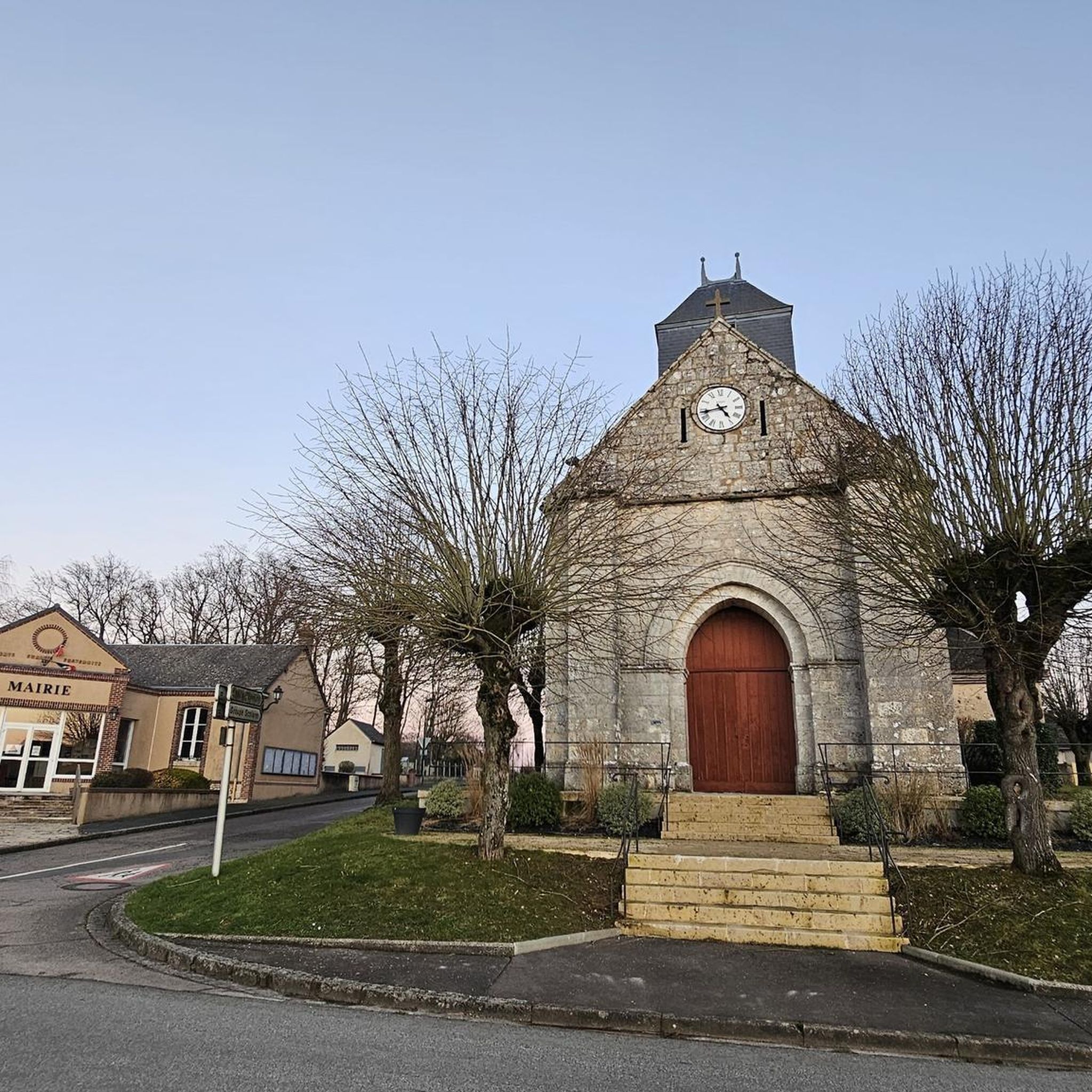
The oldest document mentioning the Church of Saint-Martin in Fresnay-le-Comte is the charter of Renaud de Mouçon, Bishop of Chartres, confirming the possessions of the Abbey of Marmoutier, near Tours. This charter dates only from the last years of the 12th century, but the church's foundation may have already existed at that time. The building comprises two parts of roughly equal size and from different periods. The older part, roughly corresponding to the nave, is of a rather undefined style. The west portal, with its pointed arch devoid of any decoration, may date back to the 12th or 13th century, as may the first window of the nave, on the right. In the north wall, there is a small, walled-up doorway, whose lintel, adorned with an accolade, is no earlier than the 15th century, but the relieving arch above it appears older, perhaps from the 12th century. Half of the church, including almost the entire chancel, is from a more recent period and easily recognizable. The polygonal apse and the windows with their flamboyant tracery of late design indicate the very end of the 15th century. An inscription on one of the chancel's tie beams gives a precise date: In the year 1529, this chancel was completely rebuilt. The statue of the Virgin Mary was baptized during the Mass of October 30, 2021, by Father Pierre Paul. This statue, moved from the Chapel of the Three Marys in Mignières, was restored by Mr. Martial Moulin, a sculptor from Chartres.
0
0
According to tradition, the church choir covers the remains of an older building, possibly dating back to the 6th century, which was built to house the saint's body. According to current knowledge, the commune of Saint-Piat (Sanctus Piatus in Latin) officially appeared in 1087, mentioned in a charter of the Nottonville Priory (Eure-et-Loir), on which it depended. The current building was rebuilt during the time of Francis I, as suggested by the date 1535 engraved on two buttresses of the apse and the date 1542 engraved on a piece of wood from the vault. This is according to a study by the SAEL (Eure-et-Loir Archaeological Society). The three-sided apses, the dripstone towers (horizontal members projecting from a wall), and the sculpted roof structures are a testament to the importance of the reconstructions carried out in the department during the 16th century. The church of Saint-Piat is one of them. While the church has not been officially recognized, it nevertheless contains objects that have attracted attention both for their antiquity and quality, but not always for good reason. Their artistic value, far from attracting only religious or aesthetic interest, has also aroused a covetousness that, unfortunately, remains for some of them. Fortunately, those still in place are carefully cared for and offer the curious a story to discover, a beauty to slowly ponder as they progress toward the choir.
0
0
The town's monumental heritage is defined by the Church of Saint-Cyr and Sainte-Julitte. Built in the 12th century, the building underwent numerous modifications during the 13th, 15th, and 16th centuries. The apse sanctuary is lit by five 12th-century Romanesque windows, while the choir and nave date from the 13th century. Like some fifty churches around Chartres, the Huguenots set fire to the church of Jouy in 1568. However, the walls were not destroyed. Only the building's portal is listed as a Historic Monument by decree of December 30, 1913. This listing was motivated by the architecture of the portal, which features foliate capitals. Nevertheless, the church also has a rectangular tower, a polygonal staircase turret, and a wooden vaulted tower.
0
0
In the village of Houville (parish of the Epiphany), the crypt, closed for decades, was reopened on February 1, 2020. It contains a well and wall paintings dating back to the 12th century. This crypt is therefore an important place in the village's history, a place of pilgrimage to Saint Léger, with a miraculous spring! Houville also saw the conversion of Célestine Paragot at the end of the 17th century, who, with her strong personality, led the villagers to Christ. This village figure encountered Christ while convalescing after a fall, and her conversion attracted many people. The church and presbytery were expanded and decorated, and thus Houville became known as Houville the Saint, or the Island of Sanctity. The village's vocation continued into the 20th century, as the hamlet (now home to 450 people) offered the Lord 8 priests and 8 nuns, one of whom was at the Visitation. During the war, the crypt served as a refuge for the arrival of German troops, as evidenced by the initials HF that François Heurtault inscribed in June 1940.
0
0
beautiful church with an imposing facade
0
0
Thivars is mentioned in 966 in the Chartres cartulary. In the 12th century, the church became the property of Josaphat Abbey. The current church was built in the 16th century: a date of 1545 is engraved on a cherub in the turret. It is a very high construction but very irregular, this comes from the fact that it belongs to several eras: ogival style in the windows, the entrance door is Romanesque (it may be the door of the first Romanesque church) . The choir was formerly separated from the nave by an iron grille which disappeared during the French Revolution. The ceiling has pretty paneling dating from 1645. The two side altars are dedicated: one to Notre Dame des Victoires and the other to Saint Joseph. Among the furniture we can note an interesting painting which represents Our Lord pronouncing on a coin. In 1940, two bombs fell less than 30 m from the church, destroying the stained glass windows on the south side which were replaced by grisailles in 1987. Three pretty stained glass windows light up this church: Nativity stained glass window installed by Mr Campin in 1955 Stained glass windows of the village's patron saints, Saint Radegonde and Saint Hilaire, installed in 1900 and 1987 respectively.
1
0
The Saint-Germain de Morancez church could date from the 10th century. Its cut stone facade is punctuated by four buttresses framing a portal. This is composed of three concentric arches resting on engaged columns, decorated with capitals. The zigzag decoration of the arches confirms a dating before the 12th century. The occulus surmounting the porch illuminates a semi-circular vaulted nave. This was enlarged with an aisle built much later and where there is an altar dedicated to the Virgin. The furniture remains simple but not without interest with its benches enclosed in painted wood. However, it is worth mentioning a sculpted pulpit from the 18th century. In 1707, the prior-parish priest of Morancez was Nicolas Courvoisier, religious of the Saint-Jean-en-Vallée abbey. A poet, he is notably the author of a Latin ode addressed to the people of Chartres on the death of Paul de Godet des Marais1. He died on May 14, 1742 in Morancez and was buried in the church. (his tombstone remains to be identified.) Although Morancez was a modest parish, in 1851 it benefited from a prestigious gift from Jérôme Bonaparte, brother of Napoleon I, governor of Les Invalides, then in residence at the Château de Gourdez. He offered the church a painting, Moses makes water flow from the rock, painted by Giovanni Francesco Romanelli between 1657 and 1660. This Italian artist had been called to decorate the cabinet called "At the water's edge" of the apartment of Queen Anne of Austria at the Louvre. He created a decor, now dismembered, composed of a set of six paintings devoted to the story of Moses, including the work, classified as a Historic Monument, preserved in our church. Another interesting work which could be attributed to the school of Philippe de Champaigne represents Jesus among the doctors. These two paintings benefited from a restoration in 1998
0
0
Frequently Asked Questions
How many road cycling routes are available around Nogent-Le-Phaye?
There are over 650 road cycling routes around Nogent-Le-Phaye, offering a wide variety of options for different preferences and fitness levels. The komoot community has explored more than 4,600 of these routes.
What is the terrain like for road cycling in the Nogent-Le-Phaye area?
The region around Nogent-Le-Phaye is characterized by largely flat to gently rolling terrain, with altitudes typically ranging between 127 and 151 meters. This makes it ideal for road cyclists seeking enjoyable rides without extreme climbs, passing through expansive fields, charming woods, and gentle river valleys.
Are there road cycling routes suitable for beginners or less experienced cyclists?
Yes, Nogent-Le-Phaye offers a good selection of routes for beginners. There are over 170 easy road cycling routes available. An example is the Parc du Château de Laval – Saint Stephen's Church loop from Halle Jean Cochet, which is an easy 38.8 km trail.
Can I find longer road cycling tours around Nogent-Le-Phaye?
Absolutely. For those looking for longer rides, there are over 460 moderate and 15 difficult routes. A popular moderate option is the Lavoir de Soulaires – Spot for a break on the banks of the Eure loop from Nogent-le-Phaye, covering 65.3 km and offering an extensive exploration of the Eure river landscape.
What historical landmarks or attractions can I see while cycling near Nogent-Le-Phaye?
The area boasts several historical points of interest. You can cycle past the iconic Bollée Wind Turbine, the 11th-century Saint-Pierre-et-Saint-Paul Church, and the impressive Château de la Boissière. Additionally, the magnificent Chartres Cathedral is just a short distance away in Chartres.
Is there good cycling infrastructure connecting Nogent-Le-Phaye to nearby towns?
Yes, a significant development for cyclists is the planned dedicated cycling path that will connect Nogent-le-Phaye directly to Chartres, enhancing safety and accessibility. This will complement existing local routes that are generally well-paved.
Can I access major cycling routes like the Veloscenic from Nogent-Le-Phaye?
Yes, Nogent-le-Phaye's proximity to Chartres provides easy access to the renowned Veloscenic cycle route. This extensive 433-kilometer itinerary links Versailles to Mont-Saint-Michel, with a 90-kilometer section passing through Eure-et-Loir via Chartres. You can find more information on the Veloscenic route via Tourisme28.
Are there circular road cycling routes available in the area?
Many of the routes around Nogent-Le-Phaye are designed as loops, allowing you to start and end in the same location. For example, the Lavoir de Soulaires – Spot for a break on the banks of the Eure loop from Gasville-Oisème is a popular 47.5 km circular route.
What do other road cyclists enjoy most about road cycling in Nogent-Le-Phaye?
The area is highly rated by the komoot community, with an average score of 4.3 stars from over 170 reviews. Cyclists often praise the tranquil landscapes, the mix of expansive fields and charming woods, and the gentle river valleys that make for pleasant rides without challenging climbs.
What is the best time of year for road cycling in Nogent-Le-Phaye?
Spring and autumn generally offer the most pleasant conditions for road cycling in Nogent-Le-Phaye, with mild temperatures and beautiful scenery. Summer can also be enjoyable, though it's advisable to start earlier in the day to avoid the midday heat. Winters are typically cooler and can be wet, but routes remain accessible.
Are there places to stop for refreshments or cafes along the road cycling routes?
While specific cafes are not always directly on every route, the routes often pass through or near small villages and towns where you can find local establishments for refreshments. Chartres, being a larger city nearby, offers numerous options for cafes, restaurants, and other amenities.
What are the parking options for cyclists in Nogent-Le-Phaye?
As a rural commune, Nogent-Le-Phaye typically offers accessible parking in and around the village center, often near public spaces or the church. When starting a route from a specific point, it's usually possible to find street parking or designated areas in nearby towns or villages.
Most popular routes around Nogent-Le-Phaye
Most popular attractions around Nogent-Le-Phaye

Get inspired with the komoot mobile app


Explore more
Browse the best Road cycling routes in other regions.
