The best road cycling routes around Deux-Évailles
4.7
(18)
1,295
riders
245
rides
Road cycling routes around Deux-Évailles traverse a landscape characterized by rolling hills and agricultural fields, offering varied terrain for cyclists. The region features a network of paved roads that wind through the countryside, connecting small villages and natural areas. Elevation changes are common, providing both challenging climbs and scenic descents. This area is suitable for road cyclists seeking routes through rural French landscapes.
Best road cycling routes around Deux-Évailles
- The most popular road cycling route is Mont rochard – Mount…
Last updated: July 5, 2026
4.0
(2)
417
riders
117km
05:34
1,340m
1,340m
Hard road ride. Very good fitness required. Mostly well-paved surfaces and easy to ride.
5.0
(2)
24
riders
99.7km
04:52
760m
760m
Moderate road ride. Good fitness required. Some segments of this route may be unpaved and difficult to ride.

Sign up for free
26
riders
47.5km
01:59
240m
240m
Easy road ride. Great for any fitness level. Mostly well-paved surfaces and easy to ride.
20
riders
70.5km
02:53
410m
410m
Moderate road ride. Good fitness required. Mostly well-paved surfaces and easy to ride.
5.0
(1)
29
riders
42.8km
01:55
370m
370m
Moderate road ride. Good fitness required. Mostly well-paved surfaces and easy to ride.
Get access to more routes and recommendations from other explorers.
Sign up for free
Already have an account?
Our route recommendations are based on thousands of hikes, rides, and runs completed by other people on komoot.
Start today with a free account
Your next adventure awaits.
Login or Signup


Tips from the Community

The cathedral (i.e., a bishop's church) in Laval was not dedicated to one of the many people we venerate as saints, but rather, the ONE God in THREE Persons – God the Father, God the Son (Jesus Christ), and God's Holy Spirit – was chosen as its patron saint. Father Reinhard Körner writes about the mystery of the Holy Trinity: + "Among the great prayer-givers in the history of Christianity... I found prayer texts in which each of the divine Three was explicitly addressed – in the same prayer. When I tried to recite the texts, I could sense that these people had not only individually envisioned God the Father, Jesus Christ, and the Holy Spirit – they were addressing a divine community. And it seemed to me that they could only do this in their written prayers because they also did so otherwise, quietly in their hearts."
0
0
This church was not dedicated to one of the many people who died as martyrs (witnesses to their faith) for their Christian beliefs, or whom we venerate as blessed or saints because of their exemplary lives. Rather, this parish has chosen God himself – in the "Holy Trinity" – as its patron saint. According to Christian doctrine, we believe in ONE God, who exists in THREE persons – God the Father, God the Son (Jesus Christ), and the Holy Spirit. The following description can be found on the EKD (Evangelical Church in Germany) website: + “The word attempts to express the seemingly impossible, namely that God is simultaneously three and one. To understand this, it helps to consider how people have experienced God throughout history: as a Creator who loves his world and humanity like a father loves his children. As a God who himself became human in Jesus Christ, his Son, and shared human life. And finally, as a God who is still present and alive among people in the Holy Spirit.”
0
0

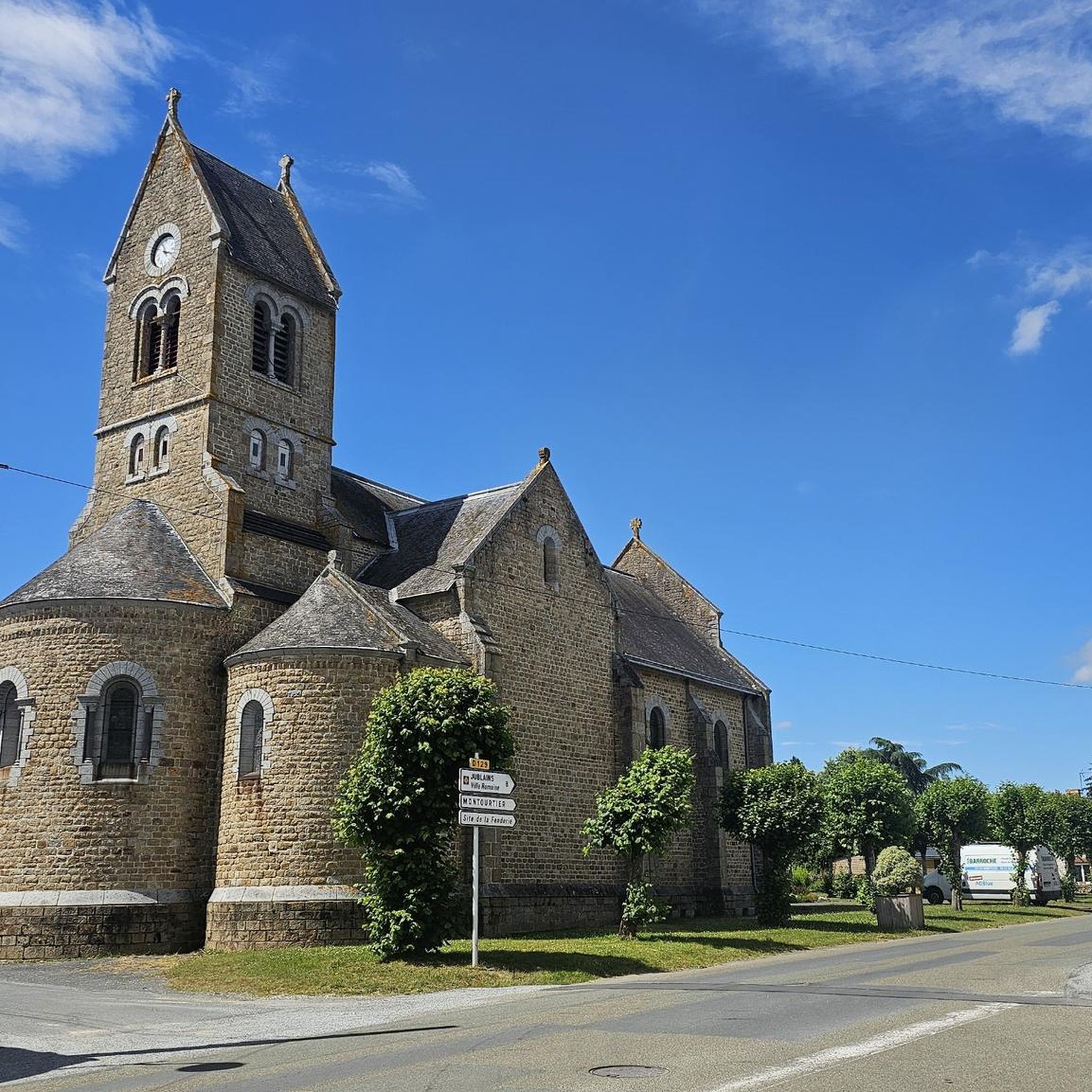
This church is a neo-Romanesque building made of limestone and granite rubble. The architect was Pierre-Aimé Renous. The building houses several works listed as Historic Monuments, including stained-glass windows from the workshop of François Fialeix. Also inside are two wooden altarpieces, statues of the Three Marys from the Seigneurial Chapel, and a statue of Saint Martin from the Chapel of St. Martin.
0
0
In June 1795, the Chouans set fire to the church of Brée to flush out the Blues who had taken refuge there. Detailed article: Battle of Brée. The church was restored in 1809, based on an estimate by Tellot, architect, for 12,490 francs. The tower was restored and crowned with the current spire in 1866 by Mr. Baudriller of Évron.
0
0
Romanesque church that preserves superb medieval wall paintings, dating from the mid-13th century, depicting the life of Saint Vigor and the Resurrection of the Dead. Remarkable 17th-century altarpiece with marble and tufa columns, the work of Michel Langlois. Free admission.
0
0
The foundations of Saint-Pierre Church likely date back several centuries, perhaps replacing an older structure. It has witnessed the changes in Voutré, from times of prosperity to more difficult periods. Significant historical events, community celebrations, and local transformations have left their mark on the walls of this church, making it a place where local history comes to life.
0
0

Very nice rating, but very hard
0
0
Frequently Asked Questions
How many road cycling routes are available around Deux-Évailles?
There are over 250 road cycling routes around Deux-Évailles, offering a wide variety of options for different skill levels and preferences.
What kind of terrain can I expect on road cycling routes in Deux-Évailles?
The region is characterized by rolling hills and agricultural fields, with a network of paved roads winding through the countryside. You can expect varied terrain, including both challenging climbs and scenic descents, typical of rural French landscapes.
Are there road cycling routes suitable for beginners in Deux-Évailles?
Yes, Deux-Évailles offers nearly 50 easy road cycling routes. A good option for beginners is the Saint-Cénéré Church – La Chapelle-Anthenaise loop from Montsûrs, which is 21.2 miles (34.1 km) long and features moderate elevation changes.
What about more challenging road cycling routes for experienced cyclists?
For experienced cyclists seeking a challenge, there are nearly 40 difficult routes. The Mont rochard – Mount Rochard loop from Neau is a demanding 72.8 miles (117.1 km) route with significant elevation gain through varied terrain.
Are there any loop routes for road cycling around Deux-Évailles?
Many of the road cycling routes in Deux-Évailles are designed as loops, allowing you to start and finish at the same point. For example, the Pont Aristide-Briand – Jublains, Gallo-Roman town loop from Montsûrs is a popular 62.2 miles (100.2 km) loop that combines open roads with historical points of interest.
What interesting sights can I see along the road cycling routes in Deux-Évailles?
While cycling, you can explore various points of interest. Consider routes that pass by the Gué de Selle Pond for a scenic break, or visit the Jublains, Gallo-Roman town for a historical detour. The View of Montaigu also offers a picturesque vista.
Are there historical sites to visit while road cycling in the region?
Yes, the region is rich in history. The Jublains, Gallo-Roman town is a significant historical site, and you can learn more about its past at the Jublains Museum. Routes like the Jublains, Gallo-Roman town – Château de Mayenne loop from Neau incorporate these historical landmarks.
What is the best time of year for road cycling in Deux-Évailles?
The spring and autumn months generally offer the most pleasant conditions for road cycling in Deux-Évailles, with milder temperatures and beautiful scenery. Summer can also be enjoyable, though it may be warmer, while winter cycling is possible but requires appropriate gear for colder, potentially wetter weather.
What do other road cyclists enjoy the most about road cycling in Deux-Évailles?
The area is highly rated by the komoot community, with an average score of 4.4 stars from over 18 reviews. Cyclists often praise the quiet country roads, the varied terrain with rolling hills, and the opportunity to explore charming rural French landscapes.
Are there any family-friendly road cycling paths in Deux-Évailles?
While many routes involve some elevation, there are easier options that families can enjoy. Look for routes categorized as 'easy' in the komoot guide, which typically feature less challenging climbs and shorter distances, such as the Jublains, Gallo-Roman town – Saint Victor Church loop from Montsûrs, a 29.5 miles (47.5 km) trail through rural landscapes.
Where are good starting points for road cycling in Deux-Évailles?
Many routes start from villages like Montsûrs or Neau, which are common hubs for local cyclists. These locations often provide convenient access to the network of paved country roads that define the region's cycling experience.
Most popular routes around Deux-Évailles
Most popular attractions around Deux-Évailles

Get inspired with the komoot mobile app


Explore more
Browse the best Road cycling routes in other regions.
