The best cycling routes around Ayette
4.7
(21)
385
riders
98
rides
Touring cycling routes around Ayette are situated in a region characterized by gently rolling terrain and agricultural landscapes. The area features moderate elevation changes, with routes often traversing open fields and connecting historical sites. These routes provide opportunities to explore the local countryside on well-maintained paths.
Best touring cycling routes around Ayette
- The most popular touring cycling route is The Carré des Sources – Sunken Road Cemetery loop from Boisleux, a 39.2 miles (63.0 km) trail that takes 4…
Last updated: July 2, 2026
2.0
(1)
37
riders
62.4km
04:43
430m
430m
Moderate bike ride. Good fitness required. Mostly paved surfaces. Suitable for all skill levels.
3.0
(1)
23
riders
39.7km
03:00
350m
350m
Moderate bike ride. Good fitness required. Mostly paved surfaces. Suitable for all skill levels.

Sign up for free
5.0
(1)
14
riders
37.6km
02:51
230m
230m
Hard bike ride. Good fitness required. You may need to push your bike for some segments of this route.
11
riders
76.1km
05:17
550m
550m
Hard bike ride. Very good fitness required. Mostly paved surfaces. Suitable for all skill levels.
10
riders
39.1km
02:52
250m
250m
Hard bike ride. Good fitness required. You may need to push your bike for some segments of this route.
Get access to more routes and recommendations from other explorers.
Sign up for free
Already have an account?
Our route recommendations are based on thousands of hikes, rides, and runs completed by other people on komoot.
Start today with a free account
Your next adventure awaits.
Login or Signup




Tips from the Community

An interesting anecdote is that the Royal Naval Division was originally formed from reservists of the British Navy who had no place on ships during the war. This unit was trained as infantry and played a crucial role in several battles, including the Battle of the Ancre.
6
0
The British Royal Naval Division Memorial in Beaucourt-sur-l'Ancre commemorates the officers and men of the Royal Naval Division who died during the Battle of the Ancre, part of the great Somme offensive. The memorial is located on Rue d'Hamel (Route D50) and Chemin de Serres les Pusieux.
6
0
On 11 April 1944, an Avro Lancaster Mk I, serial number LL836 BQ-E, crashed near Achiet-le-Petit, in the Bois de Logeast, during a mission by the RAF 550 Squadron. The aircraft had taken off from North Killingholme in England and was part of a bombing raid on the railway installations at Aulnoye-Aymeries, as part of the Allied Transportation Plan2. The Lancaster was intercepted and shot down at around 02:43 by a German night fighter, a Messerschmitt Bf 110, flown by Hauptmann Helmut Bergmann. The aircraft exploded in mid-air and came down in flames approximately 1.5 km north-northwest of Achiet-le-Petit3. All seven crew members were killed. Among them were five Britons and two Canadians, including: F/Lt Richard William Picton (pilot, age 24, DFC) F/O John Foster Potter (bomb aimer, age 23, RCAF) F/O John James Logan (navigator, age 26, DFC) Sgt William Essar (age 22, RCAF) Sgt Thomas Henry Guest (flight engineer) Sgt Kenneth Percy Charles Williams (radio operator, DFM) F/Lt William Hugh Waycott (air force, age 22, DFM)3 They are all buried in Achiet-le-Petit cemetery. The crash is a harrowing illustration of the risks faced by bombers during night operations over occupied Europe.
8
0
An interesting anecdote is that Achiet-le-Petit changed hands several times during the war. The village was occupied by British troops in March 1917, lost to the Germans in March 1918, and retaken by the British in September 1918. In 1924, 300 bodies that had been temporarily buried elsewhere were transferred to this cemetery.
6
0
Cimetière militaire allemand d'Achiet-le-Petit is a World War I military cemetery located in Achiet-le-Petit, France. The cemetery contains the graves of 1,314 German soldiers. It was created in the autumn of 1914 to bury the bodies of German soldiers who had fallen during the fighting in the region.
6
0

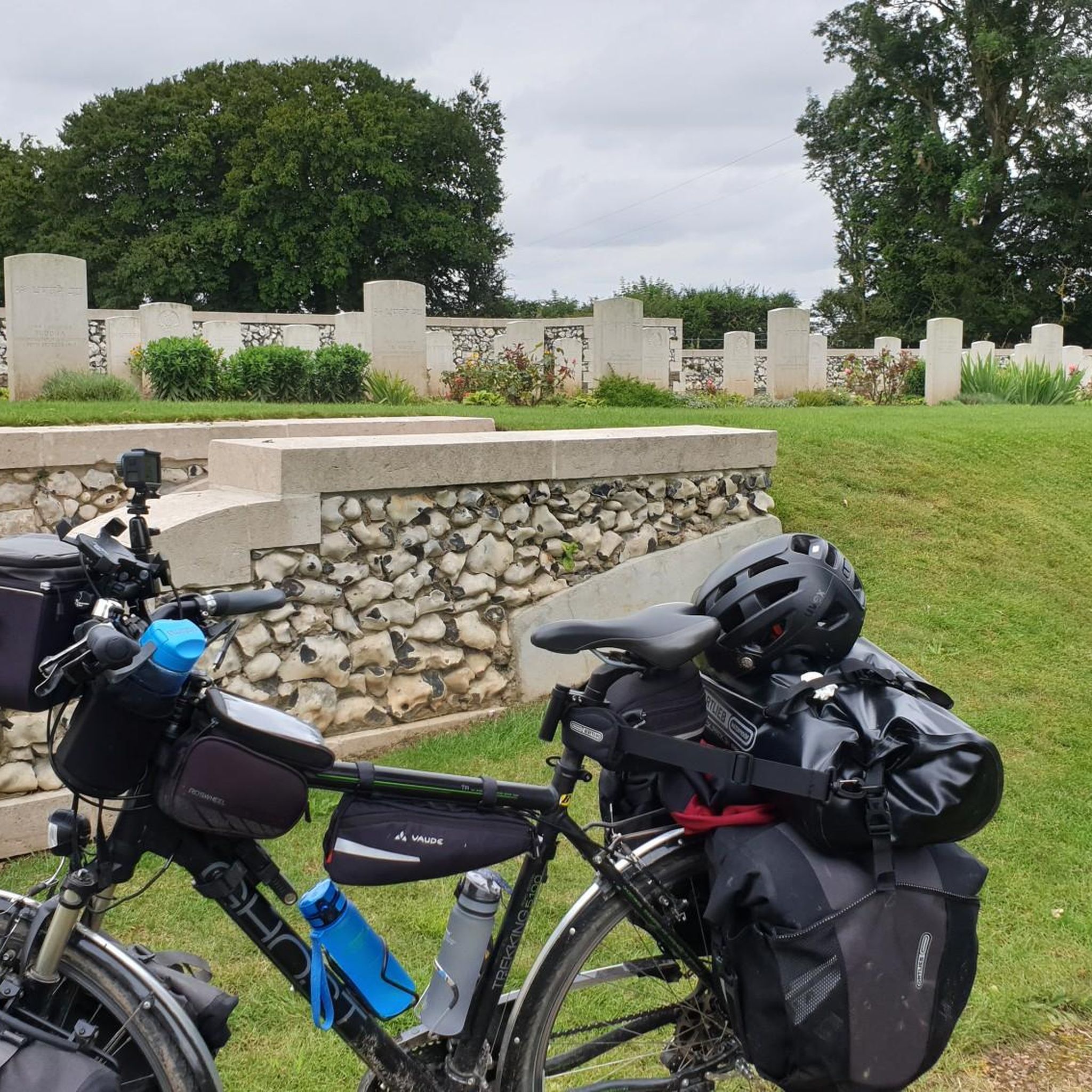
Redan Ridge Cemetery No. 2 (Redan Ridge Military Cemetery) contains 279 casualties of the 1914-18 war, 124 of whom are unidentified. All but one fell in July and November 1916 near Beaumont-Hamel, which was then on the front line. The cemetery was established in the spring of 1917, when these battlefields were cleared.
1
0
The monument to the 8th Argyll and Sutherland Highlanders is a Celtic cross symbolically erected on the embankment of a sunken road, at the spot where the men of this regiment rushed to capture the village of Beaumont-Hamel on November 13, 1916, at the end of the Battle of the Somme. First, on July 1, when it was located in no man's land, exactly equidistant from the British and German trenches, and served as a refuge for so many soldiers wounded during the fighting; then, five days before the end of that same battle, when the village of Beaumont-Hamel was finally captured on November 13, by the men of the 8th Argyll and Sutherland Highlanders, who had rushed from that position. The 8th Argyll and Sutherland Highlanders was a Scottish regiment that fought on several fronts. A reading of the inscriptions engraved on the different sides of the base of this monument tells us this. Thus, this cross is dedicated to the glory of the battalion's glorious dead and to the memory of those who will never return. Its combat losses, throughout the war, amounted to 51 officers and 831 men and non-commissioned officers, including 105 wounded officers and 2,527 men and non-commissioned officers. Finally, a Celtic inscription reveals "it is good to have friends on the day of battle." Mobilized from August 4, 1914, to November 12, 1919, a period of five years and 100 days, the regiment fought from May 1, 1915, to November 11, 1918, in Belgium and France. Until 1918, the 8th Argyll and Sutherland Highlanders belonged to the 51st Division; In 1915, it fought at Richebourg, Festubert and on Thiepval Ridge, which was to leave a sad memory for the British on 1 July 1916 (this is where the memorial to the missing now stands); in 1916, it fought at the Labyrinth, Vimy Ridge, Fourcaux Wood (High Wood), Beaumont-Hamel (there, therefore) and Courcelette; in 1917, it was Roclincourt, Arras, Roeux, Ypres and Cambrai. In 1918, the 8th Argyll and Sutherland Highlanders fought as part of the 61st Division at Saint-Quentin, Holnon Wood, Villéveque, Nesle, Villers-Bretonneux and on the Lys; but also within the 15th division which distinguished itself at Soissons, at Buzancy and in the final advance which would lead to the armistice
0
0
At the start of the Battle of the Somme, a powerful German fortified redoubt stood at this location on a hilltop protecting the approach to Beaumont-Hamel. On July 1, 1916, while all the mines exploded at 7:28 a.m., two minutes before the assault began, Hawthorn Ridge exploded at 7:20 a.m. This was a decision made by Lieutenant-General Hunter-Weston, commanding the 8th Corps. Its explosion certainly caused damage to the fortifications and the German troops, but they had plenty of time to set up their machine guns, much to the misfortune of the British infantrymen who set out to assault this ridge carrying thirty kilos of equipment over a distance of approximately 500 meters. On November 13, 1916, the final phase of the Battle of the Somme began, ending three days later. Beaumont-Hamel, one of the objectives of July 1st, was still in German hands. This time it was up to the Scots of the 51st Division to capture the village. In support of this attack, a second mine exploded under Hawthorn Ridge (November 26, 1916) a few minutes before the troops rushed from their positions, this time located less than 250 meters away, where today stands the monument to the Scottish regiment of the 8th Argyll and Sutherland Highlanders. The ruins of Beaumont-Hamel railway station and the village were this time captured.
0
0
Frequently Asked Questions
How many touring cycling routes are available around Ayette?
There are over 90 touring cycling routes around Ayette. These routes cater to various skill levels, with 30 easy, 50 moderate, and 10 difficult options available.
What is the general terrain like for touring cycling in Ayette?
The terrain around Ayette is characterized by gently rolling hills and agricultural landscapes. Routes often feature moderate elevation changes, traversing open fields and connecting various historical sites on well-maintained paths.
Are there any family-friendly touring cycling routes in Ayette?
Yes, Ayette offers 30 easy touring cycling routes that are suitable for families. These routes typically feature less challenging terrain and shorter distances, making them ideal for a leisurely ride with children.
What kind of historical sites can I explore on a touring bike around Ayette?
Many touring cycling routes in Ayette pass by significant historical landmarks, particularly those related to the First World War. You can visit sites like the Scottish Divisions Memorial at the Sunken Lane, Hawthorn Ridge Crater, and the Thiepval Memorial, which are often incorporated into routes such as the St John the Baptist Church – Thiepval Memorial loop from Bucquoy.
Are there any circular touring cycling routes in Ayette?
Yes, many routes around Ayette are designed as loops. For example, the popular The Carré des Sources – Sunken Road Cemetery loop from Boisleux and the Newfoundland Memorial – Hawthorne ridge crater loop from Bucquoy are both circular routes, allowing you to start and end at the same point.
What do other touring cyclists say about the routes in Ayette?
The touring cycling routes in Ayette are highly rated by the komoot community, with an average score of 4.6 stars from over 20 reviews. Cyclists often praise the well-maintained paths, the historical significance of the area, and the varied terrain that offers options for different skill levels.
What are some notable attractions or points of interest near the cycling routes?
Beyond the historical sites, you can find other points of interest such as The Carré des Sources, the village of Saint-Léger, and the Chapel of Our Lady of La Salette. These can be explored as part of or alongside your cycling adventures.
Are there any challenging touring cycling routes for experienced riders?
Yes, Ayette offers 10 difficult touring cycling routes for experienced riders. Routes like the Saint-Léger Church – Boisleux-St-Marc loop from Ablainzevelle and the Saint-Léger – Beaurains Road Cemetery loop from Boisleux feature more significant ascents and varied terrain, providing a good challenge.
What is the longest touring cycling route available in Ayette?
One of the longer touring cycling routes is the St John the Baptist Church – Thiepval Memorial loop from Bucquoy, which spans 41.3 miles (66.5 km) and includes over 500 meters of elevation gain.
Can I find routes that combine historical exploration with cycling?
Absolutely. Many routes are designed to take you through areas rich in history. For instance, the Newfoundland Memorial – Hawthorne ridge crater loop from Bucquoy offers varied terrain while leading through areas of significant historical importance, particularly related to the First World War.
How much elevation gain can I expect on a typical touring cycling route in Ayette?
Elevation gains vary by route difficulty. Moderate routes like The Carré des Sources – Sunken Road Cemetery loop from Boisleux can have around 436 meters of ascent, while more difficult routes such as the St John the Baptist Church – Thiepval Memorial loop from Bucquoy can feature over 500 meters of climbing.
Are the cycling paths around Ayette generally well-maintained?
Yes, the touring cycling routes around Ayette are known for being on well-maintained paths, making for a pleasant and smooth riding experience across the agricultural landscapes and rolling terrain.
Most popular attractions around Ayette

Get inspired with the komoot mobile app


Explore more
Browse the best Cycling routes in other regions.
