The best walks and hikes around Neuville-Saint-Vaast
4.5
(749)
5,337
hikers
15
hikes
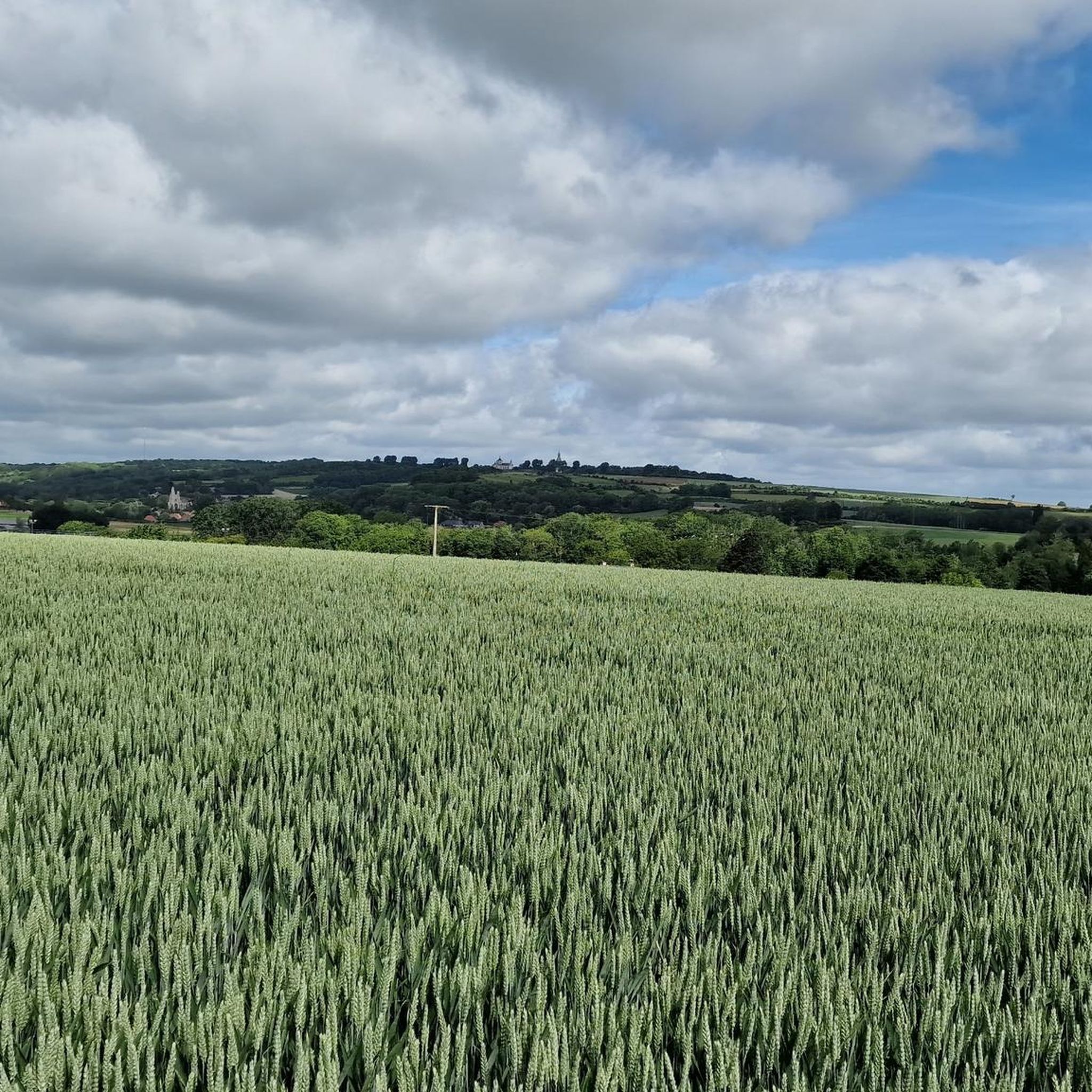
Hiking trails around Neuville-Saint-Vaast traverse a landscape rich in historical significance and natural features within the Hauts-de-France region. The area is characterized by an extensive network of walking routes that often lead through open fields, past memorials, and into areas of natural beauty. While not featuring high peaks, the terrain includes gentle undulations and offers opportunities to explore sites like the Canadian National Vimy Memorial and the Marais de Maroeuil.
Best hiking trails around Neuville-Saint-Vaast
- The most popular hiking route…
Last updated: July 9, 2026
4.0
(1)
16
hikers
7.46km
01:59
80m
80m
Easy hike. Great for any fitness level. Easily-accessible paths. Suitable for all skill levels.
5.0
(2)
20
hikers
4.97km
01:17
20m
20m
Easy hike. Great for any fitness level. Easily-accessible paths. Suitable for all skill levels.

Sign up for free
7
hikers
12.5km
03:19
130m
130m
Moderate hike. Good fitness required. Easily-accessible paths. Suitable for all skill levels.
4.7
(3)
54
hikers
Easy hike. Great for any fitness level. Easily-accessible paths. Suitable for all skill levels.
10
hikers
Easy hike. Great for any fitness level. Easily-accessible paths. Suitable for all skill levels.
Get access to more routes and recommendations from other explorers.
Sign up for free
Already have an account?
Our route recommendations are based on thousands of hikes, rides, and runs completed by other people on komoot.
Start today with a free account
Your next adventure awaits.
Login or Signup

Tips from the Community

The Battle of Vimy Ridge (April 9-12, 1917) This is one of the most famous battles for Canadians during the First World War. Vimy Ridge was a strategic position fortified by the Germans since 1914. In April 1917, the four Canadian divisions, united for the first time, attacked to retake it. - 💥 The bombardments that created the shell holes Before the assault For several weeks, Allied artillery (mainly British and Canadian) bombarded the German positions to weaken the defenses, cut the barbed wire, and destroy the enemy trenches. It is estimated that more than a million shells were fired in preparation for the attack. During the attack On April 9, 1917, the Canadian infantry advanced under a creeping barrage, that is, artillery fire that advanced just ahead of the soldiers to protect their advance. Result These intense bombardments literally riddled the ridge with craters. Each shell exploding in the ground dug a hole of varying width (depending on the caliber, often between 1 and 5 meters in diameter). 🏞 After the War Why are the shell holes still there? After 1918, it was decided to preserve certain areas as they were, particularly around the future memorial, to demonstrate the scale of the fighting. The land was therefore not leveled or cultivated, unlike other areas of the front, which reverted to agricultural fields. A Landscape for Remembrance The shell craters, reconstructed trenches, and replanted trees (each tree represents a killed Canadian soldier) create a living memorial park, keeping the scars of the conflict visible for future generations.
0
0
Located right next to the monument, the historical interpretation center presents the Battle of Vimy Ridge in two ways. First, you can discover an exhibition with diagrams, photographs, maps, and some exhibits. You'll learn about the historical context from a political and military perspective, with numerous images showing the lunar landscapes of the trench line and No Man's Land. Books about the Battle of Vimy Ridge are also available for purchase at the reception desk. Next, a superb Sound & Light show, using period videos, recounts the preparation for the offensive, the fighting, the advance of the troops, and the lives of soldiers during the battle. A video table and televisions allow you to relive these moments. Commentary is available in French, English, and German.
0
0
The Vimy Memorial is the most prestigious Canadian monument in Europe. It is located on the very site of the 1917 fighting near Vimy in the Pas-de-Calais region of France. Erected on the highest point of the hill, Hill 145, the objective of the operations that began on April 9, 1917, it overlooks the Douai Plain. In 1921, architect and sculptor Walter S. Allward (1875-1955) won the competition from the Canadian Battlefield Memorials Commission. The significance of the battles at the site and the favorable location at the top of the hill allowed Vimy to receive the most prestigious work. The monument's architecture consists of twenty figures and a massive base topped by two immense pillars. Carved from a single 30-ton block, the main statue, symbolizing the spirit of Canada mourning its fallen, dominates the Douai Plain. At the top, the angels of Justice and Peace stand guard over the gate. At the front of the monument, between the pillars, two statues represent the spirit of sacrifice, one representing the spirit of sacrifice, and the other representing the passing of the torch. The 27-meter-high pylons symbolize both the gates of eternity, as well as France, with the fleur-de-lis, and Canada, with the maple leaves. They are also adorned with representations of Truth, Knowledge, Valor, Sympathy, and the coats of arms of Canada, England, and France. On either side of the façade wall, cannons adorned with laurel and olive branches, symbolizing Victory and Peace, can be seen. Below, figures represent the Breaking of the Saber and Sympathy for the Victims. Each of the monument's statues embodies an ideal: Justice, Peace, Honor, Faith, Charity, Truth, Knowledge, Hope... The following words are engraved on its base: "TO THE VALOR OF HER SONS DURING THE GREAT WAR, AND IN MEMORY OF HER SIXTY THOUSAND DEAD, THE CANADIAN PEOPLE HAVE ERECTED THIS MONUMENT." The names of 11,285 missing persons are also etched in stone for eternity. This list complements those on the monument erected in memory of the Armies of the British Empire at the Menin Gate, Ypres. Indeed, 18,283 Canadian soldiers were never found... Construction work began in 1925. The memorial was inaugurated on July 26, 1932, in the presence of King Edward VII and Albert Lebrun, President of the French Republic.
0
0

The 3rd Canadian Division Memorial in Neuville-Saint-Vaast commemorates the soldiers of the 3rd Canadian Division who fought and gave their lives during the First World War. This memorial is located near the famous Vimy Ridge and pays tribute to the courage and sacrifice of these troops.
6
0
A remarkable story about the Vimy Memorial concerns its unveiling in 1936. More than 50,000 people, including 6,200 Canadians, attended the ceremony. The presence of so many veterans and survivors underscored the profound impact of the war and the enduring bond between Canada and France. The memorial has since become a symbol of Canadian courage and sacrifice.
6
0
The Mémorial national du Canada à Vimy is an impressive war memorial, commemorating the members of the Canadian Expeditionary Force who died during the First World War. The memorial, designed by Walter Seymour Allward, was unveiled on 26 July 1936 by King Edward VIII. It commemorates the 11,169 Canadian soldiers who died in France and have no known grave.
7
0
3rd Canadian Division monument erected to the glory and eternal memory of our valiant comrades who gave their lives in defense of the line from October 23, 1916 to February 15, 1917 and in the capture of Vimy Ridge on April 9, 1917.
0
0
Within the 107 hectares of the Vimy Ridge National Historic Site of Canada, near the grandiose memorial erected in honor of the 66,000 Canadian soldiers who died in the Great War, a more modest building is dedicated "to the memory (...) of the officers, non-commissioned officers, and soldiers of the Moroccan Division who fell gloriously here on May 9, 10, and 11, 1915." Before the Canadians captured Vimy Ridge from the Germans in April 1917, other soldiers had already set foot there but were unable to hold their ground due to a lack of reinforcements and sufficient artillery support. These "forerunners" were the Moroccan Zouaves and riflemen, wearing red chechias and baggy trousers, accompanied in the Moroccan Division by Foreign Legion volunteers from 52 countries. To the men of the Moroccan Division who set out to assault Vimy Ridge On the morning of May 9, 1915, they broke through the German lines, crossed Folie Wood, and approached Vimy Ridge. To monitor their advance and adjust artillery fire, squares of white cloth were sewn to their backs, making them prime targets for the Germans on their flank. Furthermore, the artillery was running low on ammunition, and reinforcements were not forthcoming: the order to withdraw came with the evening. The Moroccan soldiers were forced to abandon the conquered ground at the cost of heavy losses. The riflemen of the Moroccan Division were among the approximately 820,000 men mobilized in the French colonies or protectorates during the First World War, including 636,000 sent to France as soldiers or laborers. Among the 449,000 engaged in the fighting, the majority came from Algeria (150,000) and the others from sub-Saharan Africa (135,000), Indochina (43,000), Tunisia (39,000), Morocco (34,000). 70,000 of them died on French soil.
0
0
Frequently Asked Questions
How many hiking trails are available around Neuville-Saint-Vaast?
Neuville-Saint-Vaast offers an extensive network of hiking paths, with 15 routes detailed on komoot. The wider region boasts over 200 kilometers of walking routes, catering to various fitness levels.
What is the general difficulty level of hiking trails in Neuville-Saint-Vaast?
The trails around Neuville-Saint-Vaast are predominantly easy to moderate. Out of 15 routes, 11 are classified as easy, and 4 are moderate. There are no difficult trails, making the area accessible for most hikers.
Are there any circular walks available in Neuville-Saint-Vaast?
Yes, many routes in the area are circular. For example, the Canadian Memorial – Canadian Memorial loop from Neuville-Saint-Vaast is a moderate 17.2 km circular trail, and the Canadian Memorial – Moroccan monument loop from Neuville-Saint-Vaast offers an easier 7.5 km circular option.
What kind of terrain can I expect on the hiking trails?
The terrain around Neuville-Saint-Vaast typically features gentle undulations, leading through open fields and past historical sites. While there are no high peaks, you'll encounter varied landscapes including natural swamp areas and memorial grounds.
Are there any family-friendly hiking options in the area?
Yes, with 11 easy routes, there are plenty of family-friendly options. A shorter, easy walk is the Canadian Memorial – Canadian Memorial loop from Givenchy-en-Gohelle, which is 2.7 km and takes about 42 minutes to complete, suitable for a leisurely family outing.
What historical landmarks can I see while hiking in Neuville-Saint-Vaast?
The region is rich in historical landmarks. You can visit the impressive Canadian National Vimy Memorial, the solemn Notre-Dame-de-Lorette National Cemetery, or explore the Vimy Ridge Shell Craters. Many trails incorporate these significant sites.
Are there any natural features or wildlife to observe on the trails?
Absolutely. The nearby Marais de Maroeuil is a protected natural swamp area known for its rich and diverse flora and fauna, including rare species like the fumeterre orchid. This area offers excellent opportunities for nature observation.
What do other hikers enjoy most about hiking in Neuville-Saint-Vaast?
The area is highly rated by the komoot community, with an average score of 4.4 stars from over 600 reviews. Hikers often praise the combination of historical significance with natural beauty, and the well-maintained network of trails that connect these points of interest.
Are there any shorter, easy routes for a quick walk?
Yes, for a quick and easy walk, consider the Canadian Memorial – Canadian Memorial loop from Neuville-Saint-Vaast, which is 4.5 km and typically takes just over an hour to complete. Another option is the Single in the wood – Canadian Memorial loop from Vimy, an easy 5 km route.
What is the best time of year to hike in Neuville-Saint-Vaast?
The region is suitable for hiking throughout much of the year. Spring and autumn offer pleasant temperatures and beautiful scenery, especially when visiting the natural areas or historical sites. Summer is also popular, though it can be warmer.
Is there a specific trail that leads to the Broadmarsh Crater?
Yes, there is a specific hiking path that leads to the Broadmarsh Crater. This route is moderately difficult, approximately 8.25 km long, and typically takes about two hours to complete, combining physical activity with a visit to this poignant historical site.
Most popular routes around Neuville-Saint-Vaast
Most popular attractions around Neuville-Saint-Vaast

Get inspired with the komoot mobile app


Explore more
Browse the best Hikes in other regions.
