The best road cycling routes around Allmannshofen
4.6
(416)
5,224
riders
308
rides
Road cycling routes around Allmannshofen are characterized by a gently rolling landscape, featuring open fields, agricultural areas, and sections along river valleys. The terrain generally presents moderate elevation changes, making it suitable for various fitness levels. Routes often connect small villages and offer views of the rural Bavarian countryside.
Best road cycling routes around Allmannshofen
- The most popular road cycling route is Roadbike loop from Nordendorf, a 36.8 miles (59.2 km) trail that takes 2 hours 32 minutes to…
Last updated: October 21, 2026
5.0
(3)
38
riders
59.2km
02:33
480m
480m
Moderate road ride. Good fitness required. Mostly well-paved surfaces and easy to ride.
5.0
(1)
35
riders
45.8km
01:49
170m
170m
Easy road ride. Great for any fitness level. Mostly well-paved surfaces and easy to ride.

5.0
(1)
26
riders
56.3km
02:15
230m
230m
Moderate road ride. Good fitness required. Some segments of this route may be unpaved and difficult to ride.
17
riders
Hard road ride. Very good fitness required. Some segments of this route may be unpaved and difficult to ride.
5.0
(2)
10
riders
19.1km
00:46
50m
50m
Easy road ride. Great for any fitness level. Mostly well-paved surfaces and easy to ride.
Get access to more routes and recommendations from other explorers.
Already have an account?
Our route recommendations are based on thousands of hikes, rides, and runs completed by other people on komoot.
Start today with a free account
Your next adventure awaits.


Tips from the Community


Holzen Monastery & Karlsberg – Historical Overview Today's Holzen Monastery is situated on Karlsberg, a hill rising approximately 20 meters above the Schmutter Valley near Allmannshofen. The name "Karlsberg" originates from a chapel built in the early 17th century in honor of St. Charles Borromeo. Originally, the Benedictine convent, founded in the 12th century, was located in the valley near the Schmutter River. Due to the risk of flooding and structural decay, a decision was made at the end of the 17th century to build a new monastery on the higher plateau. The monastery complex, with its prominent Baroque Church of St. John the Baptist, was constructed between 1696 and 1710 according to plans by the Vorarlberg architect Franz Beer. After secularization in 1803, the complex was initially used for secular purposes. Since 1927, it has belonged to the Dominikus-Ringeisen-Werk (Dominican Ringeisen Foundation) and today serves as a social institution, hotel, and conference center. Holzen Monastery and Karlsberg Hill form a historically developed ensemble that impressively combines the landscape, local history, and Baroque architecture of the region. schwabenmedia.de/Kirchen/Landkreis-augsburg/St-johannes-holzen.php Site plan of Holzen Monastery (PDF) kloster-holzen.de/media/78971/lageplan-kloster-holzen-2784639.pdf
0
0

Roman Catholic parish church, originally built as a medieval choir tower church, which was replaced by an early neoclassical new building in the second half of the 18th century. More on the history: https://de.wikipedia.org/wiki/St._Vitus_(Langweid_am_Lech)
1
0
After the old nave was demolished in 1737, the current one was rebuilt, and the church was consecrated in 1743. Opposite the pulpit is a crucifix from the mid-18th century. The coat of arms of Abbot Rogerius Friesl of Kaisheim can be seen on the west gable. A cemetery surrounds the parish church. Source and further information: https://timm4.donauwoerth.de/sehenswertes/kath_pfarrkirche_st_martin-8826/
0
0

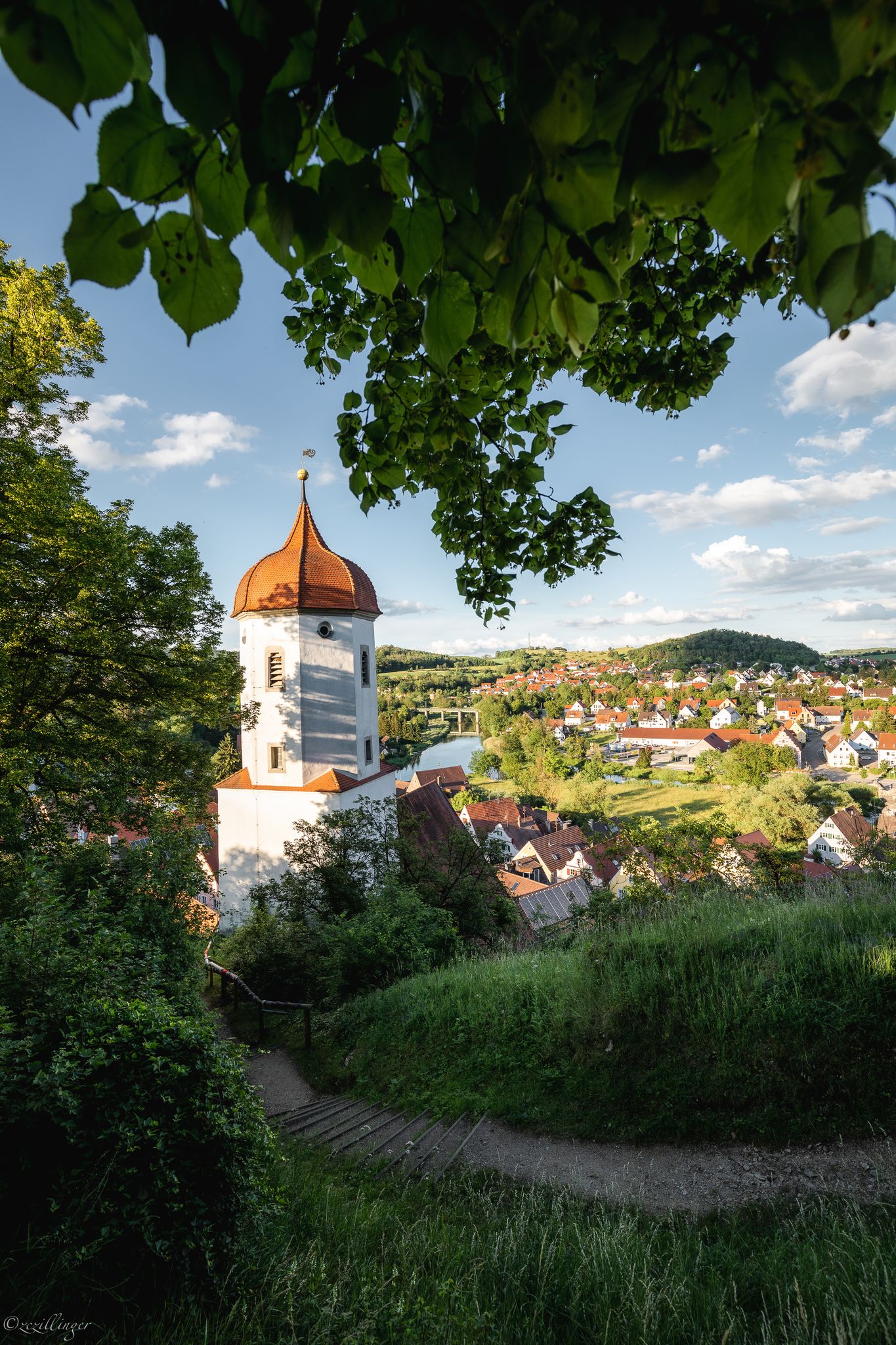
Medieval choir tower church, extended in 1727. Nave renovated in 1767/1777. Tower with pointed roof.
0
0
A hall church with a recessed choir, the core of which is late Gothic. The southern tower has an onion dome.
0
0

The ensemble of the castle and St. Martin's Church offers an impressive view. Further information is available here: https://www.schlossgablingen.de
0
0
Frequently Asked Questions
How many road cycling routes are available around Allmannshofen?
There are over 300 road cycling routes available around Allmannshofen, offering a wide variety of options for different skill levels and preferences.
What kind of terrain can I expect on road cycling routes near Allmannshofen?
The road cycling routes around Allmannshofen are characterized by a gently rolling landscape, featuring open fields, agricultural areas, and sections along river valleys. The terrain generally presents moderate elevation changes, making it suitable for various fitness levels.
Are there road cycling routes suitable for beginners in Allmannshofen?
Yes, Allmannshofen offers a good selection of routes for beginners. Over 100 easy routes are available, such as the Church in Achsheim – Gablingen Castle loop from Nordendorf, which is 28.4 miles (45.8 km) long and passes through villages and historical landmarks.
What are some options for more experienced road cyclists in the Allmannshofen area?
More experienced road cyclists can find over 180 moderate routes and 20 difficult routes. A popular moderate option is the Roadbike loop from Nordendorf, a 36.8 miles (59.2 km) trail with varied terrain and rural views.
Are there any circular road cycling routes around Allmannshofen?
Many of the road cycling routes in Allmannshofen are designed as loops, allowing you to start and end at the same point. Examples include the St. Martin's Church, Mertingen – Road to Bäumenheim loop from Nordendorf and the Osterbuch–Affaltern country road – Straßer Haus Café loop from Nordendorf.
What is the typical duration for road cycling routes in Allmannshofen?
The duration of road cycling routes in Allmannshofen varies. Many popular routes range from 2 to 3 hours, such as the Roadbike loop from Nordendorf which typically takes 2 hours 32 minutes, or the St. Martin's Church, Mertingen – Road to Bäumenheim loop from Nordendorf at about 2 hours 18 minutes.
What interesting sights or landmarks can I see while road cycling around Allmannshofen?
Road cycling routes often pass through small villages and offer views of the rural Bavarian countryside. You can encounter historical landmarks like Markt Castle (Fugger Castle Markt) or Fugger Castle Nordendorf. Many routes also feature churches and traditional architecture.
Are there natural attractions to discover along the road cycling routes?
Yes, the region offers several natural attractions. You might cycle near the Swabian Danube Valley Nature Reserve, the Schmutteraue Nature Reserve, or along the Zusam River, providing scenic natural backdrops to your ride.
Can I visit historical castles on a road cycling tour near Allmannshofen?
Absolutely. The Allmannshofen area is home to several historical castles that can be incorporated into your road cycling tours. Notable examples include Markt Castle and Rain Castle, offering interesting stops along your journey.
What do other road cyclists appreciate about the routes in Allmannshofen?
The road cycling routes in Allmannshofen are highly rated by the komoot community, with an average score of 4.6 stars from over 300 reviews. Cyclists often praise the varied terrain, the quiet rural views, and the well-maintained paths that connect small villages and historical sites.
Is it possible to find cafes or refreshment stops along the road cycling routes?
Many routes pass through small towns and villages, which typically offer opportunities for refreshment stops. While specific cafes are not listed for every route, the presence of villages along paths like the Osterbuch–Affaltern country road – Straßer Haus Café loop from Nordendorf suggests that you will find places to stop for a break.
Where can I find parking for road cycling tours in Allmannshofen?
While specific parking areas are not detailed for every route, many tours, such as those starting from Nordendorf or Allmannshofen, typically have designated parking available in or near the starting villages. It's advisable to check local parking options upon arrival in the respective towns.
Most popular routes around Allmannshofen
Most popular attractions around Allmannshofen

Get inspired with the komoot mobile app


Explore more
Browse the best Road cycling routes in other regions.
